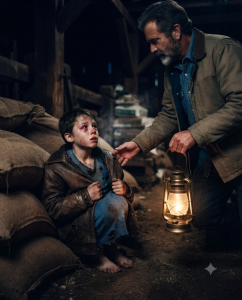
At two in the morning, on a forgotten ranch in Sonora, Samuel Rivas found a barefoot boy hiding between sacks of feed with one eye swollen shut, both knees split open, and terror clinging to him like a second skin.
That image stayed with Samuel long after everything else was over.
At that moment, he was standing in the cold with a kerosene lamp in one hand, breathing steam into the January dark. The wind rattled the tin roof above the barn, and somewhere in the corral his horse stamped at the frozen ground. Samuel had gone out because he’d heard a noise by the feed room. A scrape. A shift. Something too careful to be livestock and too desperate to be the wind.
He expected a coyote, maybe a thief.
He did not expect a child.
The boy was crouched low between the feed sacks, trying to make himself small enough to disappear. His shirt was torn. His ribs showed. His feet were raw, red, and caked with dirt. One side of his face was badly bruised, his left eye swollen nearly shut. When Samuel lifted the lamp, the boy recoiled before a single word was spoken.
Like he had lived too long learning what usually happened next when a grown man found you cornered.
Samuel had not touched another human being gently in seven years.
Not since his wife, Elena, died of fever in a spring so dry the earth itself seemed to crack open with her. After that, he stopped being the man who spoke softly. He left his federal rural agent badge in a drawer, closed the door on that life, and buried himself in work on the ranch. His hands hardened around reins, wire, tools, rifle stocks, and rough lumber. He knew how to mend fences, break horses, track thieves, and keep people at a distance.
Tenderness had become something he remembered, not something he practiced.
But looking at that boy in the feed room, something old and human shifted painfully inside him.
Without thinking too much about it, Samuel took off his leather coat and laid it over the child’s shoulders.
The boy flinched anyway.
Samuel lowered the lamp so the flame wouldn’t shine directly in his face. “What’s your name, son?”
No answer.
The child’s eyes kept darting to the doorway, measuring the distance, calculating escape.
Samuel softened his voice. “I’m not going to hurt you.”
The boy swallowed.
“I’m not going to force you to stay either,” Samuel went on. “But it’s freezing out here, and you don’t have shoes. Give me half a minute. Tell me your name first.”
The answer came so quietly he almost missed it.
“Tomás.”
“Samuel Rivas,” he replied. “This ranch is mine. Nobody touches you here unless I allow it.”
Tomás gripped the coat with both hands. It was a small movement, but Samuel understood it immediately. The boy wasn’t just cold. He was starved for shelter. Starved for the possibility that something solid might still exist in the world.
“How long have you been running?”
“Three days.”
Samuel did the math in silence. Sonora nights in January were merciless in a different way than the daytime sun. The cold was dry, sharp, and patient. A child out in that for three days, barefoot and alone, was not running from a whipping or a lecture.
He was running from death.
“From who?”
This time Tomás looked straight at him.
Samuel saw something in that stare that no child should carry: the blunt fatigue of someone who already knew adults could fail you in every possible direction. They could arrive too late, look away, pretend not to understand, or hand you over if the price was right.
“Do you know Mauro Lizárraga?” the boy asked.
Samuel went still.
Everyone in that part of Sonora knew Mauro Lizárraga. He owned land, cattle, water access, debts, favors, and half the local officials in one form or another. He paid for festivals, gave to church repairs, sponsored school paint, and smiled with all the polished charm of a man who wanted witnesses to his generosity. But beneath the polished boots and public kindness was something uglier. Men lost land around him. Families vanished off roads they had traveled all their lives. Contracts changed after they were signed. Complaints dissolved. Witnesses forgot what they had seen.
“I know who he is,” Samuel said.
Tomás’s jaw tightened. “Then you know what happens to people who talk.”
Samuel said nothing.
“My father talked,” the boy said. “They killed him. Now they’re coming for me because I saw everything.”
The cold seemed to deepen in the room between them.
Samuel brought Tomás into the house and fed him beans, tortillas, and water. The boy ate quickly but without greed, the way hungry children sometimes do when they have learned that speed matters more than pleasure. He never stopped listening. Every creak in the walls made him tense. Every brush of wind against the shutters drew his eyes to the door.
When he finished, Samuel sat across from him.
“Tell me about your father.”
Tomás cupped the glass in both hands and stared into the water as if the memories were in there.
“His name was Daniel Voss,” he said. “He leased the pasture at La Quebrada for eleven years. Lizárraga wanted it because of the stream.”
Samuel knew the land. In dry country, water wasn’t just wealth. It was power, survival, inheritance, leverage, and future all braided together. A stream could make one patch of land worthless and another untouchable.
“My dad wouldn’t sell,” Tomás continued. “Wouldn’t sign either.”
Years earlier, during a bad drought, Daniel had borrowed forty pesos to buy feed. According to Tomás, he repaid thirty-two before falling behind. Then papers appeared claiming he owed four hundred sixty. The debt had changed shape somewhere in the fine print. Interest, fees, penalties, new terms—whatever poison had been written into the contract, it had grown teeth.
“Could he read it?” Samuel asked quietly.
“Not all of it,” Tomás admitted. “Not the small writing. He trusted the wrong people.”
The worst part came next.
Three men rode to Daniel’s place just after dawn on Tuesday. Leading them was Néstor Reina, Lizárraga’s foreman. Néstor was known for carrying out ugly work with a calm face. He was the kind of man who didn’t need to raise his voice because everybody already knew what he was willing to do.
“They told my dad the time was over,” Tomás said. “That the land was gone.”
Daniel had stepped onto his porch holding a letter from a lawyer in Hermosillo. He had said the contract had been altered and that he would take it before a judge.
He never got farther than that.
Néstor shot him in the chest.
Tomás had been hiding behind a stack of wood less than ten yards away. He saw his father fall. He saw two other men enter the house, turn everything upside down, and leave carrying papers.
“I stayed beside him until he stopped breathing,” Tomás said. “Then I ran.”
Samuel looked at the scar across his own hand, the one left by a bullet years before, and knew exactly what this meant. A murdered father. A surviving witness. A powerful man who understood that children were easier to erase than adults. A town soaked in fear. A sheriff likely bought, compromised, or both.
Still, he could not turn the child away.
He gave Tomás the room at the back of the house and told him to lock the door from the inside. When the boy asked why he cared, Samuel answered with the only truth he had.
“Because somebody has to.”
Samuel did not sleep. Before dawn, he saddled his horse Relámpago and rode into town. The sheriff’s office smelled faintly of dust, stale tobacco, and indifference. The sheriff—Comisario Beltrán—was just unlocking the place when Samuel arrived. Beltrán listened with a face that shifted at the right moments but never quite reached outrage.
Daniel Voss murdered.
Tomás alive.
Mauro Lizárraga responsible.
Beltrán asked whether Samuel had a signed statement from the child. He talked about caution. About not damaging the reputation of a respected businessman. About how rumors could inflame a town.
Samuel left with one certainty: the law in town would not protect the boy.
On his way out, he stopped at the telegraph office and paid a trusted courier named Eusebio to carry a sealed letter toward Hermosillo. In it, Samuel wrote to an old federal commander he had once served under, a man named Arturo Salcedo, one of the few officials he still believed had not sold his soul to convenience. The letter was blunt. Murder. Fraud. Corruption. Child witness in danger.
Then he rode back fast.
Tomás was waiting at the kitchen table when he returned, shoulders tense, face pale but composed in the strange way frightened children sometimes try to imitate adults.
“The sheriff won’t help,” Samuel told him. “I sent for someone who might.”
“Will that be enough?” Tomás asked.
Samuel opened his mouth to answer, but before he could, he heard the pounding of two horses approaching from the north road.
He went to the door.
Néstor Reina rode at the front.
The second rider was younger, restless in the saddle, but Samuel barely registered him because of what was tied across the back of the second horse: a long bundle wrapped in a blanket stained dark in several places.
Tomás came up behind Samuel, saw it, and made a shattered little sound.
Néstor halted at the gate and smiled.
“We’re looking for a runaway boy,” he said. “Thin thing. Barefoot. Talks too much.”
“No boy here,” Samuel replied.
Néstor’s gaze drifted, just for a second, toward the house.
Not searching. Confirming.
Samuel felt the meaning of that glance like a nail driven under the skin. This visit wasn’t guesswork. They already knew.
Someone had told them.
Then Néstor peeled back the blanket.
A boot showed beneath it.
Old work leather. Mud dried along the heel. A dark stain by the seam.
Tomás stumbled backward as if struck. “That’s my father’s.”
“We found what was left on the property,” Néstor said almost kindly. “Thought the boy might want a keepsake.”
Samuel’s hand lowered toward the rifle near the door.
Néstor saw it and chuckled softly. “Pull that gun, Samuel, and the first one to die won’t be me. It’ll be the man carrying your letter to Hermosillo. He never left town.”
Cold traveled through Samuel’s spine.
Eusebio.
That meant the trap had begun the moment Samuel tried to step outside local control. It also meant Lizárraga’s reach was wider, faster, and better informed than Samuel had hoped.
Then came the sound that finished the picture.
Another horse behind the barn.
A third rider.
Samuel turned slightly and saw movement through the side window. They were being boxed in.
Néstor called out, louder this time. “Hand over the boy, and this ends clean.”
Samuel knew men like Néstor. “Clean” meant quick, silent, and useful only to the people doing the killing.
He shut the door, slid the bolt, and moved with sudden force. “Back room,” he told Tomás.
The boy didn’t argue. He ran.
Samuel grabbed the rifle, checked the chamber, and looked through the front window. Néstor had dismounted. The younger rider hung back. The third man was circling toward the rear of the house.
The first shot shattered a kitchen window.
Tomás cried out from the hallway, but Samuel barked for him to stay low. Glass sprayed across the floor. Samuel fired once through the broken frame, aiming low enough to force cover. A horse screamed outside. Men cursed.
There was no more room for hesitation after that.
Samuel moved from window to window, firing rarely and carefully, making each shot sound like more men were inside. It worked for a while. Néstor’s crew spread out and slowed, trying to gauge whether Samuel was alone. The old training Samuel had buried years before came back like muscle memory. Angles. Cover. Sound. Timing.
He shouted toward the back room in a voice meant for Tomás but loud enough to carry outside. “Stay where you are. Don’t open that door for anyone but me.”
Then he took two shells from the box, slid along the wall, and slipped out the back through the pantry.
The third rider never saw him until Samuel hit him hard from the side of the barn. The man crashed into the dirt, lost his pistol, and reached for a knife instead. Samuel kicked it away and slammed the man’s wrist against a trough until the fight left him in a howl. Before the man could recover, Samuel dragged him upright and jammed the barrel of the rifle under his jaw.
“Who told you?” Samuel demanded.
The man spat blood and silence.
Samuel twisted his injured wrist. “Who told you Tomás was here?”
“The sheriff,” the man gasped. “Beltrán told Lizárraga. Said Rivas came in breathing fire, said the boy was at the ranch—”
The rest ended with a choke because Samuel shoved him down and turned toward the front.
So that was it.
Not suspicion. Fact.
Beltrán had sold them in less than an hour.
Néstor must have heard enough to know his man had talked, because the shooting changed immediately. Less cautious now. More desperate. Samuel got back inside through the side door just as the younger rider kicked at the porch steps and tried to force entry. Samuel fired through the wood. The man screamed and dropped away.
Then there was silence.
A bad kind of silence.
Samuel knew better than to trust it.
He moved toward the hall and found Tomás crouched near the back room, shaking but alert, holding something in both hands. Daniel Voss’s lawyer’s letter.
“I had it,” Tomás whispered. “I took it before they searched the house.”
Samuel stared at him. “You had this the whole time?”
Tomás nodded. “I didn’t know if I should trust you.”
Samuel took the paper and scanned it quickly. It was more than a complaint. It named dates, land records, altered debt amounts, and two witnesses willing to testify that Daniel’s contract had been swapped after he signed it. One of the names made Samuel stop.
Father Esteban.
The parish priest.
Not a brave man by reputation. But if he had put his name on that paper, Daniel’s case had been stronger than Samuel realized.
Then the front door boomed.
Néstor was trying to ram it.
Samuel looked at Tomás. “Listen carefully. There’s a dry wash behind the corral. It leads east to the old chapel. Find Father Esteban. Show him this letter. Tell him Samuel Rivas said to ring the bell until half the town wakes up.”
Tomás stared at him. “What about you?”
“I’ll keep them busy.”
Tomás looked nine again then—small, frightened, unwilling to leave the first shelter he had found in days.
Samuel crouched in front of him and put both hands on the boy’s shoulders.
“Your father died because he stood alone at the wrong moment. You don’t repeat that. You run to the place where other eyes can see.”
Another blow hit the door.
Tomás nodded once.
Samuel shoved open the back exit, pointed toward the wash, and sent him running.
Then he turned back toward the front of the house.
The door gave way.
Néstor entered first with murder on his face and a pistol in his hand. Samuel fired from the shadow of the hallway and caught him high in the shoulder. Néstor spun, slammed into the frame, and fired wildly. Plaster burst from the wall beside Samuel’s head.
The younger rider stumbled in behind him, limping and white with pain. Samuel hit him with the rifle butt hard enough to drop him. Néstor, bleeding heavily, dragged himself behind the table and kept shooting.
“You dead fool!” he shouted. “You think anyone’s coming?”
“Yes,” Samuel said, though at that point he didn’t know if it was true.
Outside, a horse took off riderless.
Inside, the smoke thickened.
Néstor tried one last thing then. He laughed through gritted teeth and said, “Even if the boy gets away, no one will testify. Beltrán is ours. The records are ours. The town knows how to survive.”
Samuel stepped forward, rifle trained on him.
“That’s the problem,” he said. “They’ve forgotten how to live.”
Then, faint at first but unmistakable, a church bell began to ring.
Once.
Twice.
Again and again and again.
Néstor’s expression changed.
So did the sound outside.
Voices.
Many of them.
Doors opening. Men shouting. Dogs barking. Hoofbeats heading not away from trouble, but toward it.
In small towns, fear can rule for years. Then one crack appears in the wall, and all at once people realize they are not the only ones who have been afraid.
Father Esteban must have seen the letter and understood what was at stake, because he did more than ring the bell. He brought the papers Daniel had left with him. And when neighbors arrived, he read aloud enough names, dates, and false debt figures to turn whispers into certainty.
Beltrán came too, but not to restore order. He came because he had no choice once the square filled with witnesses. Someone grabbed Eusebio alive from the cantina cellar where he had been held. Someone else dragged in the young rider from Samuel’s porch. Under pressure, and with blood loss making him weaker by the minute, Néstor said the one thing men like Mauro Lizárraga only say when they believe their master will still save them.
“Mauro ordered all of it.”
He said it in front of too many people to bury.
By midday, Mauro Lizárraga tried to spin the story into slander. By evening, Father Esteban had produced contract copies and church records showing dates had been changed. Eusebio testified Beltrán intercepted the letter. The younger rider admitted they had been sent to recover the witness and destroy the last of Daniel’s documents. And when federal officers from Hermosillo finally arrived the next afternoon—because Eusebio’s assistant had secretly sent a duplicate wire before the sheriff could stop it—the weight of it was already too public to bury.
Beltrán was arrested.
Néstor was taken under guard.
Mauro Lizárraga was led from his own house in front of people who had once lowered their eyes when he passed.
He did not look powerful then.
Just old.
And furious.
And shocked that fear had finally failed him.
Daniel Voss was buried three days later. Tomás stood through the service in borrowed shoes and Samuel’s coat, even though the weather had warmed. He did not cry where others could see. But when the grave was filled and the last prayer finished, he reached down, took a handful of dirt, and held it so tight that mud streaked his palm.
Samuel stood beside him the whole time.
Afterward, Father Esteban asked what would happen to the boy.
Samuel looked at Tomás.
Tomás looked back.
Neither one made a speech of it.
The child returned to the ranch with Samuel that same afternoon.
Healing was not quick. Tomás woke screaming some nights. He hid food in his room for weeks. He startled at laughter if it came too suddenly from another room. He watched doors, counted footsteps, and stiffened whenever strangers rode too close to the fence.
Samuel never pushed him to become a child again on anyone else’s schedule.
He taught him how to saddle a horse, mend tack, split kindling safely, and read every line of every paper before signing anything. Tomás learned. Slowly, the fear stopped being the loudest thing in him.
Months later, when the first rain came, Tomás stood in the doorway watching the yard darken under the storm. Samuel stepped beside him and handed him a mug of coffee cut with milk.
Tomás took it and said, almost casually, “I knew that night in the barn you might still throw me out.”
Samuel looked over. “Why didn’t you run when I turned my back?”
Tomás stared at the rain. “Because you lowered the lamp.”
Samuel said nothing.
“You didn’t shine it in my face,” the boy went on. “Nobody had done that before.”
It was such a small thing. A movement Samuel had made without thinking. But often, the smallest mercies are the ones that prove a person still belongs to the human world.
People in town would argue about the whole story for years after. Some said Daniel Voss should have known better than to trust men like Lizárraga. Some said Samuel was reckless to interfere. Some said Father Esteban should have spoken sooner. Some said fear made cowards of good people and that cowardice had nearly cost a child his life.
All of them were right in some way.
But the truth that lasted longest was simpler and harder.
A powerful man had counted on a town to stay silent.
A child had carried the truth farther than grown men dared.
And a broken widower who thought tenderness had died in him discovered, in the middle of a freezing night, that sometimes the first act of resistance is not a gunshot or a speech.
Sometimes it is just this:
You find someone hunted.
You lower the light.
You offer your coat.
And you decide they will not face the dark alone.
Whether Mauro deserved forgiveness was never the real question. No one really asked that with a straight face. The question people asked themselves in quieter moments was worse: how many lives might have been different if more of them had spoken before a nine-year-old boy had to run barefoot through the cold carrying the truth by himself?