They had barely finished covering Lucía Saldaña’s grave when Mateo began to understand that grief was not a clean wound.
It did not bleed once and stop.
It opened again every morning.
The cemetery on the hill outside San Jacinto was still fresh in his mind four months later: the red-brown dirt, the black shawls, the priest’s voice swallowed by dry wind, the box disappearing into the earth too fast for a man to believe a whole life could fit inside it. Lucía had died from an infection that took her in less than five days. One week she had been laughing in the kitchen, flour on her cheek, arguing over whether the bougainvillea needed more water. The next she was burning with fever, barely able to open her eyes, and then gone before Mateo could understand that “gone” had become permanent.
After that, the ranch lost its soul.
El Mezquite was big enough to make loneliness echo. The rooms stayed clean because no one lived in them. The stove stayed cold until Mateo forced himself to light it. He quit caring whether the horses were brushed properly. He ate because not eating made Tomás Rivas come by and curse at him. He slept in broken pieces, two hours at a time, and woke each dawn to the same stunned silence.
The worst part was not the emptiness.
It was the habits.
Every evening he still turned his head when the gate creaked, expecting Lucía to come in from the garden with her basket. Every morning he still almost called her name before remembering there was no one left to answer.
So when Tomás rode out one morning saying the state charity train would stop at San Jacinto and local families could take in orphaned children, Mateo met the idea with anger.
“No,” he said before Tomás had even finished.
Tomás stayed seated on his horse, studying him. “I didn’t say you had to.”
“You came here because you thought I should.”
“I came because you’ve been sitting in a dead house waiting to die slower than your wife did.”
That should have started a fight, but Mateo was too tired. He turned away.
“I can’t even carry myself,” he muttered. “I’m not carrying someone else.”
Tomás looked as though he wanted to say more, but the distant train whistle floated across the dry fields and broke the moment apart. It was sharp enough to make both horses flick their ears.
For reasons Mateo could not name, he walked straight to the stable, threw a saddle on Relámpago, and mounted.
Tomás almost smiled. “Thought so.”
“Don’t talk,” Mateo snapped, and spurred the horse toward town.
The station was already crowded when they arrived. Farmers, housewives, idle shopkeepers, men with hands tucked in belts, women pretending they were there only by chance. Everyone wore the same expression—curiosity sharpened by judgment.
Mateo hated that expression.
He pushed through the crowd and then saw why they had gathered so tightly.
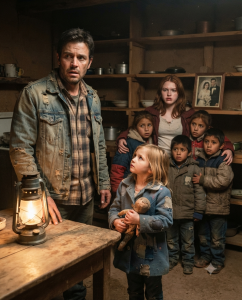
Seven children stood in the center of an open ring as if the crowd itself were a corral.
The oldest, a thin red-haired girl with a split lip, held her arms out like a shield in front of the others. She looked no older than fourteen, but there was something in her face that belonged to someone twice that age: the flat alertness of a person who had learned too early that adults could become dangerous without warning.
Behind her stood the others in a cluster that somehow managed to be terrified and disciplined at the same time. A dark-eyed boy who said nothing and watched everything. A pale blonde girl whose breathing seemed too shallow. A freckled boy vibrating with anger. A little girl with a stern, almost severe expression. A smaller child glued to the older girl’s side, mute with fear. And the youngest, holding a broken doll so carefully that Mateo understood at once it was all she had left.
Then he saw Rogelio Barragán.
Everything about the scene turned uglier.
Barragán owned the copper mine outside town. He paid wages, lent money, bought men, silenced problems, and behaved as if the whole municipality were just another extension of his property line. At that moment he had the freckled boy by the arm.
“This one will do,” Rogelio said. “He can work.”
The red-haired girl stepped forward. “Let him go.”
Rogelio smiled at her as though she were a dog making noise. “The rest aren’t worth feeding.”
She moved again, and he struck her hard enough to knock her to the ground.
Mateo reached him before he had time to enjoy it.
He twisted Rogelio’s wrist until the man gave a raw cry of pain and released the boy.
“Try it again,” Mateo said softly, “and you’ll need the other hand to feed yourself.”
People in the crowd looked away. No one liked Barragán, but most feared him more than they hated him.
Rogelio straightened, humiliated and furious. “You’ve gone crazy, Saldaña.”
That was when Mateo noticed the papers pinned to the children’s coats.
He stepped closer, reading them one by one.
Troublemaker.
Defective.
Sickly.
Savage.
Strange.
Mute.
Unknown.
For a second he honestly did not understand what he was seeing. Then the meaning landed, and with it came a kind of cold disgust deeper than rage.
“Who did this?”
A woman dressed in severe black answered from beside the train car. “The children’s home. Families should be informed.”
“Informed of what?”
“Of the difficulties.”
Mateo stared at her. “You pinned labels on children like they were crates.”
She lifted one shoulder. “Better honesty than false expectations.”
He turned back toward the oldest girl and pulled the first tag free. The metal pin snagged cloth. The girl flinched, expecting pain, but he only crumpled the paper in his hand. Then he removed the rest. One by one. He stripped every child of every verdict until the words were gone.
The station had fallen silent.
“They are not damaged,” Mateo said, looking around at the watching faces. “You are.”
Nobody answered.
Then Rogelio laughed.
“Take them yourself, then. All seven. You? A half-dead widower with no wife and no children?”
Mateo should have ignored him. Instead he heard himself say, “I will.”
The crowd shifted in surprise.
The red-haired girl rose slowly from the ground, wiping blood from her lip. Her stare was not grateful. It was wary.
Good, Mateo thought. It meant she still had sense.
He crouched in front of her. “What’s your name?”
After a long hesitation, she said, “Graciela.”
“I’m Mateo Saldaña. I have a ranch north of here. There’s food. Beds. I won’t force you to trust me.”
Graciela glanced back at the others. He noticed that each of them waited for her. Not just followed her—waited for her judgment.
“If you hurt them,” she said evenly, “I’ll kill you while you sleep.”
Tomás gave a soft cough of disbelief, but Mateo didn’t smile.
“All right,” he replied.
That answer, more than anything, seemed to unsettle her.
They left at sundown in a wagon loaded with blankets, bread, beans, and seven children who did not believe good things existed without hidden cost. Graciela sat beside Mateo, rigid the entire way. The others rode in silence except for the youngest, who hummed under her breath to the broken doll.
At first Graciela said nothing. Then, as the sky deepened to copper and purple, the words began to come.
Twelve homes in two years.
One family wanted the boys for labor.
Another wanted the girls quiet and invisible.
One woman punished bed-wetting by making them sleep outside.
A man who called himself religious locked the mute child in a pantry whenever she made noise.
One couple wanted only the pretty blonde one, but Graciela refused to leave the others.
They had learned quickly that adults preferred grateful orphans to grieving ones, obedient children to wounded ones, silence to truth.
“What happened to your parents?” Mateo asked eventually.
Graciela looked ahead. “Depends which one.”
He let the answer stay there.
When El Mezquite came into view, the children stiffened again. The ranch house, even dim in fading light, looked too large and too quiet. Mateo climbed down first, then helped the younger ones. None thanked him. He was glad. Thank-yous from frightened children always sounded like apologies.
Inside, he lit lanterns and the stove. The warm glow changed the house, drawing color back into the walls. He found blankets in a cedar chest, laid out bread and milk, and opened doors that had stayed shut since Lucía died.
One of them was the sewing room.
He paused with his hand on the knob before turning it.
Lucía’s scent was gone now, but her order remained. Folded fabric. Thread spools. Her scissors. The chair by the window. Mateo had not let anyone enter because he could not bear change. Yet now the room seemed to wait, as if it had been empty for someone else all along.
The children wandered cautiously, reading the place the way hunted creatures read a new shelter.
Then the youngest stopped before a framed wedding photograph on the shelf.
Lucía smiled from the picture, one hand resting on Mateo’s arm, sunlight caught in her hair.
The little girl stared.
“That lady looks like my mama,” she whispered.
The room changed temperature.
Mateo stepped closer. “What did you say?”
The child held the doll tighter. “My mama had a photo of a lady who looked just like her. She said it was her sister. She said one day she’d find us.”
Graciela turned sharply. “Don Mateo… did your wife have a sister?”
Mateo felt as though the floor had shifted under him.
Lucía had once had a younger sister, yes. Isabel. But years ago Lucía told him they’d become estranged. Then, eventually, that Isabel was gone. “Gone” was the exact word she used. Mateo had assumed it meant dead, or lost beyond reach. Whenever he asked questions, Lucía closed like a door.
Now he looked at the blonde child. Pale hair. Clear eyes. The delicate tilt of the head Lucía had whenever she was listening. He had noticed it earlier without understanding. Now he could not unsee it.
“What was your mother’s name?” he asked.
The youngest opened her mouth, but the sickly blonde girl answered first.
“Isabel.”
Mateo sat down hard in the nearest chair.
No one spoke for several seconds. Fire popped in the stove.
“Where is she now?” he finally managed.
The children looked at one another. Graciela answered.
“Dead. Fever took her. Before that she told us not to separate. She said there was one person left who might know who we were.”
Mateo’s throat tightened. “Why didn’t you say this before?”
“Because adults lie,” Graciela said. “And because every time we tell the truth, someone tries to take one of us.”
That was a fair answer. Too fair.
He began asking questions carefully, building a shape from fragments. Isabel had lived farther south under another surname. Some of the children were hers by birth. Some were not. She had taken in others along the way—children lost, abandoned, hidden, displaced by violence, debt, or death. She kept them together. She moved often. She spoke of a sister she trusted once, then stopped speaking of her with certainty, as if that faith had been injured but not destroyed.
Lucía had known.
Not everything, perhaps—but enough.
Enough to hide it from Mateo.
Enough to keep letters, burn them, disappear into town without explanation.
The realization hurt with a strange double edge. Even dead, Lucía was still capable of surprising him. Even dead, she had left behind a truth larger than his grief.
The pounding at the front door came before he could think further.
Tomás stood outside, breathing hard. “Barragán’s men are riding this way.”
Mateo’s body went still. “For what?”
Tomás looked uneasily toward the house. “Not what. Who.”
He stepped inside and lowered his voice. “Word is Rogelio recognized one of the girls. Or thinks he did. Says there’s money tied to her.”
Fear moved through the room like smoke.
“Which girl?” Mateo asked.
Tomás’s eyes shifted to the youngest with the doll.
The child pressed herself against Graciela’s skirt.
“On what grounds?” Mateo demanded.
Tomás hesitated. “There are rumors. About Barragán’s brother. About a woman he kept hidden years back. About land transfers and inheritance. Nobody knows the whole story.”
Mateo did not need the whole story to understand danger when it reached his doorstep.
He barred the door, checked the rifle above the mantel, then looked at the children.
“No one opens anything. No one goes outside.”
Graciela lifted her chin. “We’re not leaving her.”
“You’re not,” he said.
The riders arrived after dark.
Hooves. Voices. Lantern light moving across the yard.
Rogelio called from outside with false politeness. “Saldaña! We’ve come to help clear up a misunderstanding.”
Mateo stepped onto the porch with the rifle in plain sight. “Then clear it up from there.”
Rogelio smiled without warmth. Behind him stood four men from the mine.
“One of those girls may belong to my family.”
“Children don’t belong to families the way cattle belong to ranches.”
Rogelio’s smile faded. “Careful.”
“No. You be careful.”
The two men held each other’s gaze while dust moved around their boots. Finally Rogelio said, “You’re protecting something you don’t understand.”
“Then explain it.”
But Rogelio didn’t. Men like him never offered truth until cornered. He only said, “You have until morning. After that I’ll come back with papers.”
“Bring a priest too,” Mateo said. “You may need one.”
The men rode off, but nobody in the house slept.
Near midnight, Mateo sat in the kitchen with Tomás and the oldest two children while the younger ones dozed in borrowed blankets. He spread out everything he knew, which was not enough. Lucía’s locked chest in their bedroom. The letters she burned. The unexplained trips. Her insistence years ago that if anything ever happened to her, he was to trust his own conscience over the law.
At the time he thought it was grief talking. Now it sounded like preparation.
The chest yielded to a pry bar.
Inside were documents, old photographs, and three letters tied with blue ribbon.
One photograph showed Lucía and a younger woman standing shoulder to shoulder under a mesquite tree. Sisters, unmistakably. The younger one held a baby. On the back Lucía had written only one word: Isabel.
Another paper was a baptism record with a name that made Tomás swear softly.
The youngest girl was registered as Alma Isabel Barragán.
Rogelio’s niece.
The daughter of his dead brother.
And if the brother had died without legitimate sons, that child represented a claim—not just to money, but to land rights buried in an old family division Rogelio had clearly preferred to erase.
“He doesn’t want to raise her,” Tomás said. “He wants to control what she can inherit.”
Mateo kept reading.
Lucía’s letters filled in the rest.
Years earlier, Isabel had fled after Rogelio’s brother tried to force her into signing away property held in trust. When the brother died, Rogelio took over and sent men after her under the excuse of family protection. Lucía helped her disappear. They communicated in secret for years. Lucía begged Isabel to come north, but Isabel feared leading danger to the ranch. Then the letters stopped. The final one, written months before Lucía died, said only this: If anything happens to me, the children must stay together. Don’t let Rogelio take Alma. He will bury the truth with us.
Mateo read the line three times.
Lucía had carried this alone.
Maybe she told herself she was protecting him. Maybe she didn’t trust what danger would follow. Maybe she intended to speak and ran out of time.
The hurt remained, but it changed shape. It was no longer only the pain of losing her. It was the pain of realizing how much she had borne in silence.
At dawn Rogelio returned with two municipal clerks and folded papers.
Mateo was ready.
So was Tomás.
And, to Rogelio’s visible irritation, so was the parish priest, who had baptized half the town and hated Bullies in expensive boots.
Rogelio presented a claim of guardianship over Alma. Mateo answered by laying the baptism record, Lucía’s letters, and a sworn statement from Tomás on the table in front of the clerks. The priest added that Lucía had privately asked him, weeks before her death, to witness her intention that any child sent by Isabel be protected at El Mezquite until lawful kinship could be proved.
Rogelio’s face changed then—not with grief or concern, but with calculation gone wrong.
“You forged this,” he said.
“Say that again,” Mateo replied.
The clerks looked frightened enough to be useful. One examined the papers again, then asked questions Rogelio did not like. Dates. Signatures. Witnesses. Why he had attempted to remove a child by force at the station before presenting any legal claim. Why the child had traveled under state supervision at all if family had been actively seeking her. Why no prior petition had been filed.
Every answer made him smaller.
Then Graciela did something Mateo never forgot.
She stepped forward with Alma’s hand in hers and said, very clearly, “If he wanted family, he should have come before our mother died. Not after he learned there was property.”
Silence followed.
Truth often sounded simplest in the mouth of a child.
The municipal men withdrew to confer. Rogelio tried one final tactic, lowering his voice, offering private arrangements, money, convenience. Mateo stared at him until the man stopped speaking.
By noon the temporary ruling was made. Alma would remain at El Mezquite pending formal review. The other children would not be separated because witness testimony and letters established Isabel’s explicit wish that they stay together under safe care. An investigation into Barragán’s conduct would be opened.
It was not perfect justice.
But it was enough to deny him immediate power.
Rogelio left with murder in his eyes.
Tomás watched him ride away and muttered, “That won’t be the last of him.”
“No,” Mateo said. “But next time he won’t come thinking we’re alone.”
The weeks that followed were not easy, only real.
The children did not transform into sweetness because they were safe. Safety is not magic. The freckled boy stole food and denied it with fierce outrage. The mute child woke screaming from nightmares she could not describe. The pale blonde girl needed medicine and quiet. Alma cried whenever anyone moved her doll. The serious one inspected every room as if expecting hidden traps. The silent boy avoided touch for nearly a month.
And Graciela challenged Mateo over everything.
Rules. Bedtimes. Work. Tone. Doors left open or closed. Whether he had the right to ask where they were going on his own land.
At first Tomás found this hilarious.
Mateo did not. Then, gradually, he did.
Because resistance meant life. Defiance meant they were beginning to believe the house would still be standing tomorrow.
The first time one of them laughed at the table, everyone froze, as if joy itself were suspicious.
The first time Alma ran into the yard without clutching the doll, Mateo turned away so nobody would see his eyes.
Lucía’s sewing room became a bedroom. The bougainvillea were watered again. Shoes began appearing in the wrong places. Voices crossed hallways. The ranch, which had become a monument to absence, slowly remembered how to hold people.
Months later, the court confirmed what the letters suggested. Alma was indeed tied to the Barragán inheritance, though it would be managed under strict oversight until adulthood. Rogelio lost his claim and much of his standing. Men who had bowed to him for years discovered sudden moral principles once documents became public.
It was ugly. It was political. It was human.
But he lost.
And the children stayed.
One evening nearly a year after the train station, Mateo stood on the porch while the sun dropped gold over the fields. Alma was chasing chickens. The freckled boy—Nico, who still pretended he disliked everyone—was teaching the serious girl to whistle with two fingers. The mute child, whose name was Inés, sat under the bougainvillea while the blonde girl brushed her hair. The silent boy, Samuel, was mending tack beside the stable. Graciela leaned against a post, arms crossed, pretending not to keep watch over all of them at once.
Mateo looked at the yard and understood something that grief had hidden from him.
Lucía had not left him with an empty house.
She had left him with a door.
A dangerous one. A painful one. One he would never have chosen on his own.
But still a door.
Graciela came to stand beside him.
“You still look haunted sometimes,” she said.
“My wife would tell you I looked like that before all this too.”
That almost made her smile.
After a moment she asked, “Are you angry with her? For not telling you?”
Mateo watched the children.
“Yes,” he said honestly. “And no.”
Graciela waited.
“I’m angry she carried so much alone,” he said. “I’m angry she didn’t trust I could help. But if she hadn’t done what she did, you might not be here. None of you.”
Graciela was quiet for a long time.
Then she nodded. “I’m still angry with my mother too. For dying.”
“That doesn’t stop you from loving her.”
“No.”
They stood together in the fading light.
Love, Mateo thought, had never been clean either. Not in marriage. Not in grief. Not in family. It came mixed with silence, fear, sacrifice, mistakes, and unfinished explanations. Sometimes the dead left comfort behind. Sometimes they left riddles. Sometimes they left seven children at a train station with labels pinned to their coats and a truth no one powerful wanted spoken aloud.
Lucía had left all of that.
And yet, as Alma’s laughter floated across the yard and the house behind him glowed warm with lamplight, Mateo knew one thing with painful certainty:
whatever secret his wife had taken to the grave, whatever trust she had broken by keeping it, the greater truth was that she had still been trying to save lives long before he ever understood she was asking him to finish the work.
Who was right?
The woman who kept dangerous secrets from her husband, or the man who needed those secrets to break open his ruined life before he could finally become the person someone else needed?
Mateo never found a simple answer.
He only knew that the biggest red flag had never been the children.
It had been every adult who looked at them and saw burden before blood, trouble before pain, inconvenience before innocence.
He had almost done the same.
That was the part that stayed with him.
Not that grief made a man empty.
But that sometimes emptiness is exactly where a lost family finally finds room to enter.