They sold her like freight.
That was the thought Abigail Higuera held onto as the northbound train rattled through the dry spine of Mexico, carrying her farther and farther from the polished salons of Mexico City and deeper into a landscape that seemed made of dust, stone, and punishment. The windows of the railcar shook in their frames. The seats were hard. The air smelled of coal smoke, sweat, and old leather. Every jolt of the train made her feel as though the life she had known was being knocked loose from her bones one piece at a time.
At twenty-four, Abigail was already too old, too outspoken, too large, and too inconvenient for the future her father had designed. At least that was what he had spent years making her believe.
Josías Higuera was the sort of man others admired before they knew him. In public, he was charming, commanding, generous with his money when eyes were on him. He owned shipping interests, held contracts with the expanding railroads, and knew how to speak to politicians in the language of mutual profit. At banquets, he toasted progress. At church, he bowed his head at all the right moments. At home, he measured the value of everyone around him by usefulness.
His younger daughter, Clara, fit the picture he wanted to display to the world—small-waisted, delicate, sweet-voiced, and easily coached. Abigail did not. She had her mother’s height, a stronger frame, a face too honest to hide contempt, and a mind that noticed things people preferred to keep hidden. She understood ledgers. She caught inconsistencies. She could glance at a page of accounts and see where numbers had been nudged, tucked, or disguised. More than once, she had prevented serious losses in her father’s household simply by refusing to ignore what she saw.
He never thanked her.
He only grew colder.
The final humiliation came with papers placed on his desk and one sentence spoken without mercy.
“You are going north.”
At first Abigail had not understood. Then he explained with horrifying calm that he had arranged a proxy marriage. A man in the Chihuahua highlands had requested a strong wife. Josías had paid for the arrangement. The man’s name was Severo Montenegro.
When Abigail begged to remain in the house quietly, unseen, her father had given her the truth in its cruelest form.
“As long as you remain here, Clara’s prospects suffer.”
It was not marriage he was arranging. It was disposal.
So she signed, because refusing him had never saved her from anything.
By the time she stepped off the train in Puerto de Ceniza, she was numb from fatigue and dread. The settlement crouched at the foot of the mountains like something wounded. Mud sucked at boots. Smoke hung low. Men in work coats and hats stood outside rough buildings with the exhausted stillness of people who had seen too much greed to be surprised by another victim.
Conversation faded when they saw her luggage.
It was Comisario Ezequiel Cobo who approached her. He was a lean man with the kind of smile that never reached his eyes. His badge shone. His boots were polished despite the filth around him. He carried authority the way petty men often did—with enjoyment.
When Abigail asked for Severo Montenegro, Cobo laughed and told her her family must have hated her. Then he painted a picture so ugly and vivid that even the cold seemed to sharpen around his words. Severo was a brute, he said. A drunk. A killer. A man who had nearly murdered a trespasser and likely buried his own brother somewhere on Bloody Hill.
Abigail wanted to disbelieve him, but fear is persuasive when one has nowhere else to go.
An old cart driver dropped her at the mountain trail near dusk and fled before she had fully gathered herself. So she began the climb alone, dragging her trunk behind her through snow crust and frozen earth, her breath tearing at her throat. The wind cut through her cloak. Pine branches creaked overhead. Once, she nearly slipped and tumbled backward down the slope.
More than once, she thought of turning around.
But turning around to what? To her father? To the town below where everyone had already marked her as doomed?
So she climbed.
At the top, through the dark and wind, she saw a cabin lit from within. It was sturdy, well-built, and unexpectedly beautiful in its plainness. When the door opened, she braced for a nightmare.
The man framed in warm firelight was immense. Taller than any man she had ever seen up close, with thick shoulders, rough hands, and a scar slicing across one side of his face. He looked, at first glance, exactly like the kind of man stories turn into warnings.
Then he noticed her bleeding fingers.
And instead of dragging her inside like a purchase, he lifted her trunk, stepped aside, and told her she would freeze if she remained in the storm.
The first hour inside the cabin confused her more than the journey had. The place was immaculate. The floor had been swept. The tools were organized. Supper simmered over the fire, fragrant with herbs. Nothing about it suggested drunken chaos or violent neglect. When her hands shook so badly that she dropped a cup of coffee and it shattered, she fell to her knees, instinctively apologizing and pleading not to be struck.
Severo’s expression changed then, but not with anger. With something closer to pain.
He crouched, cleaned the cuts on her hand, and said quietly, “I do not hit women.”
There was no performance in it. No self-congratulation. Just fact.
In the days that followed, Abigail kept waiting for the mask to fall. It never did. Severo was reserved, careful with space, and almost severe in his habits, but never cruel. He gave her the bedroom. He slept near the hearth. He chopped wood at dawn, cooked simply, spoke little, and watched the windows and ridgelines with the alertness of a man who did not expect peace to last.
He also noticed things.
He noticed when she flinched at sudden movement. He noticed when she tried to pretend she was not hungry. He noticed she read the labels on old ledgers stacked in one corner, and when he realized she understood bookkeeping, something like respect entered his gaze for the first time.
By the second day, Abigail had reached the conclusion she could not stop circling.
If Severo Montenegro was not the monster everyone claimed, then the monster had to be somewhere else.
The answer arrived before dawn on the third morning.
Fists pounded on the cabin door hard enough to shake the frame. Severo was awake instantly. He took the rifle from above the mantle and ordered Abigail into the bedroom. She obeyed, but left the door cracked just enough to see.
Comisario Cobo stood outside with three armed men. He announced that the municipality now claimed the lower portion of Severo’s land because a silver vein had been discovered beneath it. His tone made it clear that legality had nothing to do with it. He expected surrender because he expected fear.
Instead, Severo raised the rifle and fired.
The bullet snapped Cobo’s badge clean off his chest.
For one frozen second nobody moved. Then Cobo’s men dropped their guns into the snow.
“The next shot goes through your mouth,” Severo said.
There was no shouting from Cobo after that. Only retreat.
When the danger passed, Severo shut the door and leaned against it, trembling. Not from cowardice. From strain. Abigail saw then what fear had cost him over the past year: vigilance worn down to the marrow.
He told her everything.
His younger brother Tomás had found signs of silver on the property. Tomás, more trusting and more talkative, had made the mistake of speaking too freely in town. Cobo learned of it and began pressuring the brothers to sign over access. They refused. Then Tomás disappeared. Officially, no crime had been proven. Unofficially, everyone knew who had benefited. But in a place where Cobo controlled deputies, records, permits, and rumor, knowing was worthless.
Severo had done the only thing left to him. He had made himself into a story.
He let the town believe he was unstable, violent, half feral with grief. He threatened trespassers. He stayed armed. He kept people away. It was easier to survive as a demon than as a grieving witness no one would protect.
Abigail listened without interrupting. She thought of her father paying to send her there. She thought of Cobo meeting her at the station with too much interest, too much satisfaction. Neither act felt accidental anymore.
She poured two fresh cups of coffee and handed one to Severo.
“We are not married to fear,” she said. “We are married to a war.”
For the first time, something almost like a smile touched his mouth.
The war announced itself that same night.
A metallic thud sounded outside the cabin, near the edge of the clearing. Then another. Abigail turned toward the window. Severo extinguished the nearest lantern and stood perfectly still, listening.
“Someone’s digging,” she whispered.
He said nothing for a second, and that silence told her more than words would have. Then he crossed to a loose floorboard beneath the table and pulled out an oilskin-wrapped packet. Inside were folded letters, a map marked by hand, and a small ledger.
“What is it?” she asked.
“Tomás’s record,” Severo replied. “He wrote down names. Payments. Dates. He believed that if anything happened to him, proof might still matter.”
Outside, voices rose. A lantern beam flickered across the window. One of the men digging swore loudly. Then another shouted for Cobo.
“What did they find?” Abigail asked.
Severo’s face had gone pale beneath the scar.
“I don’t know,” he said. “But if they found what I fear, this ends tonight.”
The pounding on the door came again. Cobo’s voice followed, oily and triumphant.
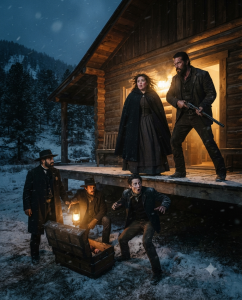
“We found a trunk, Montenegro. And inside is a seal from the Higuera house.”
Abigail felt the blood leave her face.
Her father’s seal.
Severo looked at her sharply, but there was no accusation in his eyes—only calculation, and beneath that, trust trying very hard not to break.
He opened the door a fraction, rifle angled low but ready.
Cobo stood in the snow beside an old iron-bound trunk half-caked in frozen dirt. Abigail recognized it at once. It was not hers, but it belonged to her father’s shipping office. She had seen dozens like it in warehouse inventories. On the lid, beneath grime and ice, was the Higuera crest.
Cobo smiled when he saw recognition flash across her face.
“Well now,” he said. “It seems our bride knows more than she should.”
“What is in the trunk?” Severo asked.
Cobo’s gaze slid to Abigail. “That depends. Would you like me to tell him, señora, or would you rather confess?”
Abigail’s mind raced. Why would one of her father’s trunks be buried on this mountain? Why here? Why now? Then memory surfaced with brutal clarity: altered invoices, freight routes to Chihuahua, unexplained mineral shipments listed under timber classifications, and sums that never matched the cargo manifests. She had flagged them once, years before. Her father had dismissed her from the office for “confusing domestic matters with business.”
She had not been confused at all.
Josías Higuera had been moving contraband silver under false accounts.
And Bloody Hill had been part of it.
Tomás must have discovered more than silver in the ground. He must have discovered theft—collusion between Cobo and powerful men far beyond the mountain. Men like her father.
“What’s inside?” Severo repeated.
Cobo gave a theatrical sigh and nudged the trunk with his boot. “Records. Payments. Routes. Enough to bury prominent men. Enough to prove your brother was not killed over stubbornness but over profit.”
Severo’s hand tightened on the rifle.
“And you brought it here because?”
“Because I am reasonable,” Cobo said. “Give me Tomás’s papers, and I might forget the señora’s family was involved.”
Abigail saw the lie instantly. A man like Cobo forgot nothing that could be used later.
She stepped forward before Severo could answer.
“You’re frightened,” she said.
The comisario blinked. “Be careful.”
“No,” Abigail said, louder now. “You dug that trunk up because someone else is pressuring you. Someone larger than this town. Someone who wants those records gone before the wrong names reach the wrong court.”
Cobo’s expression changed by a fraction, but it was enough. Severo saw it too.
“You should have stayed the shame of a rich house,” Cobo said softly. “Smart women are a nuisance.”
“My father taught me that,” Abigail answered. “But you taught me something else. Monsters who rely on rumor are usually cowards when facts appear.”
The men behind Cobo shifted uneasily. Snow hissed in the dark. Firelight from the cabin stretched across the clearing.
Severo spoke without taking his eyes off the comisario. “Open the trunk.”
Cobo did not move.
“Open it,” Severo repeated.
One of the deputies, younger than the others and visibly rattled, bent down and pried it open with numb fingers. Inside were ledger books, folded papers, and a small cloth bundle. The deputy unwrapped the bundle and recoiled.
A signet ring gleamed in his palm.
Tomás Montenegro’s ring.
For one terrible moment nobody breathed.
Then Severo stepped forward with a sound Abigail would remember all her life—not a shout, not yet, but the breaking edge of grief finally meeting proof. He looked from the ring to Cobo, and the whole mountain seemed to draw tight around that silence.
“You buried this,” he said.
Cobo backed up one step. “I buried evidence for men who could ruin cities.”
“Did you kill him?”
Cobo did not answer quickly enough.
That was answer enough.
What happened next moved faster than thought. One of Cobo’s men bolted downslope. Another dropped to his knees, begging not to be blamed. The youngest deputy blurted out half a confession before fear strangled him. Names came out in fragments—payments from Higuera holdings, forged transport permits, silver moved under railroad protection, Tomás beaten after refusing to surrender his survey notes.
Cobo lunged for his pistol.
Severo was faster.
He struck the weapon aside, slammed Cobo into the trunk, and held him there with terrifying control. It would have been easy, Abigail realized, for Severo to become the beast they had invented. Easy to kill him in the snow and let the mountain keep the secret.
Instead, he stopped.
“Witnesses,” Abigail said, breathless but steady. “Not vengeance. Witnesses.”
Severo’s eyes met hers.
And he listened.
That was the moment the balance changed.
By dawn, three sworn statements had been written in Abigail’s own hand by firelight, signed shakily by Cobo’s men, and sealed with wax from Severo’s stores. The comisario was bound in the barn, raging and threatening names that no longer sounded as powerful in daylight. Abigail sorted the ledgers, cross-referenced initials, dates, and amounts, and built the pattern she had once suspected in her father’s books. By noon, Severo rode with two deputies and the packet of evidence toward the nearest district authority outside Cobo’s control.
It was not a quick victory. Men like Josías Higuera did not fall in a single day.
But records travel farther than intimidation when enough hands see them.
Within weeks, inquiries began. Cargo discrepancies surfaced in Mexico City. Bribes were whispered about, then documented. Cobo was removed before he could buy his way clear. Josías, confronted with ledgers in Abigail’s own script connecting his accounts to illicit silver transfers, finally understood the daughter he had tried to discard had become the most dangerous witness against him.
Clara wrote once. The letter was brief, frightened, and full of things left unsaid. Their father had called Abigail ungrateful, hysterical, corrupted by mountain savages. But servants were talking. Business partners were distancing themselves. Invitations had stopped arriving.
For the first time in his life, reputation was turning on him.
Months later, after the worst of winter had passed, Abigail stood outside the cabin and watched light spread over the ridges. The mountain no longer felt like a place she had been sent to die. It felt like the first place she had ever been allowed to become fully herself.
Severo came up behind her carrying two cups of coffee.
“No fear today?” he asked.
She took one and glanced at him. “A little. Enough to stay clever.”
He nodded, as though that were the only sensible answer.
Their marriage, born of coercion and cruelty, had turned into something neither of them had expected: an alliance first, then trust, and finally the fragile beginning of love. Not the decorative kind sold in ballrooms, but the hard-earned kind built in silence, danger, and truth.
Later, people would tell the story badly. They would say a wealthy woman was sent north to tame a monster and found a husband instead. They would leave out the ledgers. The corruption. The shovel striking frozen ground. The way a woman dismissed for her body and a man condemned by rumor saved each other because they could still recognize decency under all the damage.
But Abigail never forgot what had nearly happened.
Her father had mistaken her for disposable.
Cobo had mistaken Severo for isolated.
Both men had believed fear would keep the truth buried.
They were wrong.
And if there was any aftershock left when the dust settled, it was this: the most dangerous people in the story had not been the scarred giant on the mountain or the woman everyone mocked for taking up too much space.
It had been the polished men in warm rooms who thought they could buy lives, bury bodies, and still call themselves respectable.