By the time Santos Calderón came down from the mountains in the spring of 1883, San Jerónimo had already decided what kind of man he must be.
That was the trouble with a small mining town. Men who survived long enough became legends, and legends never belonged to themselves for very long.
Santos had spent most of the winter in the high country of the Sierra Madre Occidental, where the snow hardened into glass by dawn and the wind could strip warmth from a body faster than hunger ever could. He came down leaner than when he had gone up, with three mules carrying carefully bundled pelts and a limp in his right leg that had worsened over the last few years. People said a trap had once snapped against that knee. Others swore he had taken a musket ball and pulled it out with his own knife by firelight. Santos never corrected stories. He simply kept walking.
In San Jerónimo, that silence made him dangerous.
He had money, which made him useful. He had no wife, which made him interesting. He had no visible weakness, which made him irresistible to some and offensive to others.
The town’s main street was waiting when he arrived.
Clara Salvatierra reached him first, moving with the certainty of a woman who had never learned how to lose. Her husband had been twenty years older and twice as cautious, but death had left Clara richer than most men in town. She owned the largest store, half the debt notes in San Jerónimo, and, by rumor, the pride of nearly every man who had mistaken her attention for affection.
Beside her came Josefina Gálvez from the inn, quicker, warmer, and far more dangerous in ways that took longer to notice. She knew how to make a room feel intimate without lowering her voice. She knew what men drank when they were lonely and what they said when they believed no one important was listening.
Together, they were enough to make most men forget why they had entered town in the first place.
Santos did not.
He looked tired. His beard was rough. His coat needed brushing. But it was his boots that drew Clara’s eye. The leather was split, the soles nearly torn free, and fresh blood had soaked through the wrap at one heel.
She offered him new boots from her store with a polished smile.
He rejected them without hesitation.
“I don’t need decoration,” he said. “I need repair.”
People close enough to hear the words glanced at Clara at once. Even before the color rose in her face, they knew what had happened. She had offered favor. He had treated it like inconvenience.
That should have been the end of it. In another town, perhaps it would have been.
But after weighing his pelts and collecting payment, Santos did something stranger. Instead of taking a room at Josefina’s inn or calling on one of the respectable houses that would have welcomed him, he crossed into the poorer end of San Jerónimo and entered Don Bernabé’s tack shop.
No one on the main street understood why.
Bernabé was a drunk and had been one for years. He forgot orders, misplaced invoices, and snored through whole afternoons if someone failed to kick his chair hard enough. Yet the shop still turned out good work, and that was because of the quiet young woman laboring at the back table while Bernabé collected the name above the door.
Her name was Beatriz Henares.
She had come to San Jerónimo with her mother years earlier after her father died on a freight route farther south. Her mother had lasted one winter before fever took her too. Since then, Beatriz had worked wherever work was available—mending sacks, patching harnesses, re-stitching coats, cutting straps, scraping hides. When Bernabé discovered she had a gift for leatherwork and hands stronger than his own, he kept her on because the shop would have collapsed without her.
But skill had never bought her kindness.
Beatriz was large in a town that forgave women for many things except taking up visible space. She did not flirt, and she did not apologize for herself. She spoke little, avoided gatherings, and kept her eyes on her work. That alone would have been enough for people to call her proud. Her size made them call her worse.
So customers did what cowards often do. They used her labor and denied her humanity. They left boots on the counter and took back beauty from her hands without offering so much as a proper look.
Santos was not prepared for her.
When he entered the shop, he expected neglect and found precision instead. Beatriz examined his ruined boots, studied his feet, and wordlessly brought water and cloth. She cleaned the blood away without gentleness meant to flatter and without the grimace of someone performing charity. She simply did what needed doing. Then she sat at the bench and opened the seams with a knife so sharp and controlled it made Santos watch more closely than he intended.
He noticed details because that was the way he stayed alive in the mountains. The even spacing of her stitches. The pressure she used to pull waxed thread through leather without fraying it. The way she tested the sole with her thumb before deciding where reinforcement belonged. She did not waste motion. She did not seek approval.
When a person spends enough time in hard country, truth becomes easy to recognize. It often appears without polish.
For three hours, Santos sat in that shop and felt a kind of peace he had not expected to find in town.
Then Clara Salvatierra entered.
She did not come alone. Constable Tobías Ruiz followed her, carrying his official presence the way some men carried a borrowed coat—with discomfort and awareness that it did not quite fit. Clara laid an eviction notice on the counter and announced that Bernabé’s rent was overdue.
The law was on her side. That was what made her cruelty so clean.
Beatriz counted out silver from a pouch worn thin at the corners. She was short. Clara knew it before she asked. She had likely known it before she walked in.
“That doesn’t cover it,” Clara said.
Then she looked at Beatriz fully, with the cold confidence of a woman accustomed to wounding beneath the protection of respectability.
“A woman like you is good for very little except taking up space.”
Tobías looked away at once. He had probably heard rougher language in holding cells, but not in a voice that smooth.
Something in Santos changed then.
Later, people would say he defended Beatriz because he was noble, or lonely, or bewitched by pity. They were wrong in different ways. Santos had spent years among weather, hunger, and men who would let a partner freeze if it bought them one more day’s food. He knew exactly what contempt looked like when someone used it to trample a person who could not safely strike back.
He walked to the counter, set down his sack of gold, and paid the rent.
When Clara demanded whether he truly preferred that woman to her company, his answer was quiet enough to force everyone to listen.
“I would rather stand beside someone who knows how to work than someone who only knows how to humiliate.”
In San Jerónimo, humiliation was a public currency. Clara had dealt it for years. Receiving it was another matter.
She left with the money, but her face carried something uglier than anger. It carried insult without witness she could control.
Beatriz finished the boots anyway.
Santos tested them and found them stronger than before. When he tried to pay extra, she refused. She accepted only the amount the repair cost.
That refusal struck him harder than Clara’s outrage had. Beatriz would not let him rescue her into debt of another kind. She would not take more than her work deserved, even from the man who had just spared the shop from seizure.
By evening, the town had split into camps of fascination and malice. Men laughed over drinks about Santos choosing the shoemaker over the widows. Women whispered that Beatriz must have trapped him. Others said Clara would forgive the insult once she calmed down.
They did not know Clara well enough.
She spent the night in her store office, dismissing clerks one by one until she was alone. Then she opened the ledger where unpaid rents were listed and stared at Bernabé’s line until the numbers blurred. It was not the money that mattered. It was the scene. Santos had corrected her in front of a constable. He had done it for a woman no one important in town had ever bothered to defend.
Clara could have endured refusal. She could not endure comparison.
Near midnight, she called for a young stable hand named Matías, a boy indebted to her through his father’s drink and his own fear. She gave him a small flask of lamp oil and instructions soft enough to sound almost kind. He was not to hurt anyone, she said. Only frighten them. Burn the outside wall. Make the place useless. Make sure the lesson lasted.
But fear does not obey carefully spoken plans.
The fire started faster than Matías expected. Old leather, shavings, dry beams, and spilled spirits from Bernabé’s hidden bottle gave it more life than a simple warning should have had. By the time he panicked and ran, smoke was already filling the shop.
The first shout came from a woman drawing water nearby.
Santos, who had been crossing the square on his way from the stable where he had bedded his mules, heard it and turned. He saw orange light pulse behind the warped windows of Bernabé’s shop and broke into a run before the second cry.
Bernabé stumbled from the side door coughing, half-blind and useless with terror. Santos grabbed him and demanded where Beatriz was.
“Inside,” Bernabé choked. “Her tools—she went back for her tools—”
Santos did not wait for the rest.
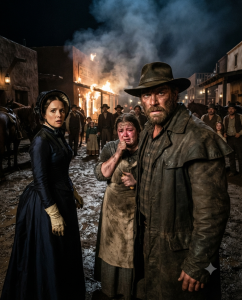
He wrapped his coat over his mouth and drove himself through the front entrance. Smoke rolled low and black. Sparks spat from the rafters. On the far side of the room, Beatriz was dragging a wooden chest across the floor instead of fleeing.
It was not a money box. It held her awls, knives, punches, needles, molds, and thread—the tools she had bought one by one across years of labor. The only property in that town that was truly hers.
A beam cracked overhead.
Santos crossed the room, seized the chest with one hand and Beatriz with the other, and hauled both toward the door. She resisted in fury, trying to pull free until a burning strip of roof collapsed near the bench where she had repaired his boots that afternoon. Then she let him force her outside.
The street had filled by then.
Neighbors stood in nightclothes. Men formed a bucket line too late to matter much. Clara Salvatierra appeared near the edge of the crowd with just enough horror on her face to pass for innocence.
“Merciful God,” she breathed. “How terrible.”
Santos heard the words and turned.
Beatriz, coughing into the crook of her arm, lifted her head at the same moment. She saw Clara’s gloves—cream-colored kid leather, still spotless except for one dark streak along the side of a finger. Oil.
Not soot. Not mud. Lamp oil.
Beatriz stared, then looked down at the ground near Clara’s hem. Fresh drops had darkened the dust by her shoes.
Santos followed her gaze.
“Where were you before you came here?” he asked.
Clara’s expression shifted almost too subtly to catch. “In my house, of course.”
“No,” Beatriz said hoarsely. It was the first time many people on that street had ever heard her raise her voice. “No, you weren’t.”
The crowd turned.
Clara laughed once, too sharply. “You’re choking on smoke and talking nonsense.”
But Matías had not run far enough. He was there at the edge of the gathering, pale, shaking, and twenty seconds from bolting again. Santos saw him first. Then Tobías Ruiz, who had just arrived, followed Santos’s line of sight and noticed the flask peeking from the boy’s coat pocket.
“What’s in there?” the constable demanded.
Matías broke.
He fell to his knees before anyone touched him. He swore he had not meant to burn the whole place. He cried that Señora Salvatierra had only wanted to scare them, to drive the woman out, to teach Santos not to mock her. With each sentence he spoke, Clara’s face lost another layer of composure.
“You stupid little liar,” she hissed.
But the flask was found. The smell matched the oil on her glove. Bernabé, still coughing, suddenly remembered that Clara’s clerk had been around earlier asking whether Beatriz stayed late. A neighbor recalled seeing Clara’s shawl near the alley not long before the flames. The pieces came together with the cruel speed of a town finally offered a scandal too shocking to ignore.
Tobías stepped toward her.
“Señora Salvatierra, I need you to come with me.”
Clara drew herself up as if dignity alone could erase what had been said. “Do you know who I am?”
“Yes,” Tobías answered, surprising even himself. “That’s the problem.”
She was taken from the street in front of the same people who had spent years flattering her. No one stepped forward to shield her then. Josefina watched from her inn doorway with unreadable eyes and said nothing. By dawn, every whisper in San Jerónimo had changed direction.
The shop could not be saved. By morning, the roof had collapsed and most of the front room was ash. Bernabé sat on an overturned trough and wept over what remained, more from shock than grief. Beatriz stood apart, arms folded around herself, staring at the blackened remains of the bench where she had done all her best work.
Santos carried her tool chest to the stable where he had taken a room for the night and set it down carefully.
“You can rebuild,” he said.
She looked at him then, not with gratitude alone but with the weary suspicion of someone who had learned that help often came with strings hidden inside it.
“With what?” she asked.
“With work,” he said. “Mine first. Then everyone else’s once they remember who made half the town’s leather hold together.”
It was not a declaration. It was a practical truth. For the first time, Beatriz almost smiled.
Over the next week, something happened in San Jerónimo that no one would have predicted. Men who had once left repairs at Bernabé’s place without acknowledging the woman behind them began bringing saddles, straps, rifle slings, and boots directly to the shed Santos rented near the corral, where Beatriz set up a temporary bench. Some came because they needed her skill. Some came because Santos’s public loyalty made mockery costly. Some came out of shame.
Shame still counts for something when a whole town feels it at once.
Clara was charged with ordering the fire, though her money softened the punishment. She avoided prison through influence and property arrangements, but the price was steep in the only currency she truly valued. Respect vanished. Credit tightened. Invitations stopped. People who had once hung on her words began lowering their voices when she passed. She remained wealthy, but wealth without admiration tasted bitter.
As for Beatriz, she refused pity exactly as she had refused Santos’s extra gold. When he offered to finance a full new shop under her name, she accepted only a loan written plainly and witnessed properly. She repaid it over two years, coin by coin, through work no one could honestly rival.
Their closeness grew the way strong things often do—without spectacle. Santos brought hides, straps, and mountain repairs. Beatriz cursed the condition of his gear and made it better. He began stopping by even when he had nothing broken. She began looking up when the door opened. By the following spring, there was less silence between them, and none of it felt empty.
San Jerónimo adjusted the way towns always do when reality survives long enough to become ordinary. People stopped calling Beatriz names where she could hear them. Then, gradually, they stopped altogether. Children were sent to her for apprenticeships. Ranchers waited weeks for her work rather than trust another hand. Bernabé, sobered by disaster and humbled by dependence, eventually admitted to anyone listening that the shop had never truly been his strength.
Years later, people still retold the night of the fire as if the flames had revealed more than one crime.
Maybe they had.
They had shown what envy looked like when dressed in silk. They had shown how quickly a town could help destroy a person by pretending not to see her. And they had shown that the man everyone thought would choose beauty, status, and ease had instead recognized worth where everyone else had been too small or too cruel to look.
Some said Santos saved Beatriz.
Others, if they were honest, admitted something sharper.
Beatriz was the one who showed him exactly what kind of life was worth walking back into from the mountain.
And that was the part that lingered longest in San Jerónimo—not the fire, not Clara’s downfall, not even the scandal. It was the uncomfortable question left behind after all the smoke had cleared:
How many people had passed that quiet workshop door for years, asking for good work with their heads held high, never once noticing that the strongest person in town had been sitting there all along?