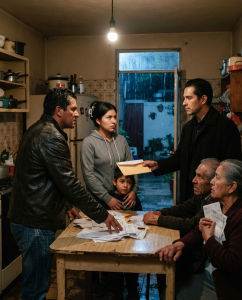
Darío Beltrán’s blood ran cold the moment he found a stranger feeding his sick father in the kitchen of the house he had avoided for eight months.
He stood in the doorway without making a sound at first, rainwater still dripping from the edge of his black coat, one bruised hand hanging at his side. The woman at the table didn’t belong there. He knew every object in that kitchen—the chipped yellow bowl, the cracked tile by the sink, the leaning cabinet his father had promised to fix for fifteen years and never had—but he had never seen her before.
She was young, maybe twenty-six. Black hair pinned up with a cheap clip. Gray sweatshirt, faded with too many washes. Wet sneakers. No jewelry. No makeup beyond the tiredness under her eyes. Yet she moved through the room as if she had been inside it long enough to know where everything mattered was kept.
His father, Samuel Beltrán, sat hunched in his chair while she fed him soup one spoonful at a time.
“Keep your hand steady,” she said, firm but calm. “That’s it. Let the spoon come to you.”
She wiped his chin with a napkin and went back for another spoonful.
Darío stepped onto a loose board. It cracked.
The woman turned. Her body shifted instantly, a single protective move that placed her between him and the skinny little boy drawing at the table beside Darío’s mother.
That tiny movement told him more than words.
She was somebody’s mother.
And she knew danger on sight.
“You’re the son,” she said.
Darío’s gaze dropped to the spoon. “Put it down.”
“He hasn’t finished the vegetables.”
“Put it down.”
“Shut up, Darío,” Samuel rasped. “You disappear for eight months, then come back growling at the only person who kept your mother from breaking her hip.”
The words hit harder than Darío expected.
He looked at his mother, Consuelo. She sat clutching unpaid electric bills like they might blow away if she loosened her grip. She looked smaller than he remembered. Not physically—she had always been tiny—but diminished, like life had been rubbing her down grain by grain.
“She’s Teresa,” Consuelo said softly. “She lives at number forty-eight. She helps us.”
The little boy glanced up at Darío with wide, uncertain eyes.
“What’s your name?” Darío asked.
“Santi.”
“Go to the living room, sweetheart,” Teresa said. “Take your dinosaur.”
The child left obediently, green crayon in hand.
Darío pulled out a chair and sat. “What agency are you from?”
“None.”
Consuelo answered for her. “The care agency stopped coming in September. Said the neighborhood was too dangerous.”
Darío felt the words land like a blade sliding between ribs.
He had been paying eighty thousand pesos a month for private home care.
“So they kept charging me,” he said slowly, “and nobody came.”
Consuelo looked away.
Teresa crossed her arms. “Your mother was trying to drag toilet paper up the steps with a walker in the rain when I saw her. I smelled gas. Your father had left the burner on for almost three hours without a flame.”
Darío stared at the stove. He didn’t know whether he wanted to smash something or vanish.
“I come before work and again around four,” Teresa said. “Your father needs food with his pills. If he takes them on an empty stomach, he throws up. Your mother can’t lift him when he falls.”
Darío opened the fridge.
Eggs. Milk. Spinach. Broth. Discount ground beef.
“Who paid for this?”
“We had a little in a jar,” Consuelo murmured.
“There were eleven pesos in the jar,” Teresa said. “I covered the rest.”
Without thinking, Darío dropped a stack of bills onto the table. “Don’t come back. There’ll be a nurse here tomorrow.”
Teresa picked up one bill, held it out, and said, “The groceries cost two hundred total. Keep the rest.”
“Take it.”
“I don’t owe people.”
“Neither do I.”
“Then don’t throw money around like you’re buying silence.”
Samuel made a dry, broken sound that might once have been a laugh.
Teresa left with her son.
Darío remained in the kitchen staring at the money, feeling poorer than he had in years.
The next morning, he sent two nurses.
Neither stayed.
One refused to get out of the car after seeing armed men near the corner. The other quit by noon after hearing shouting two blocks away and deciding the route wasn’t worth the pay. By the time Darío’s mother called in tears, Samuel had already fallen trying to make it to the bathroom.
When Darío arrived, Teresa was there again.
She was on the floor beside Samuel, issuing clear instructions to a neighbor while sliding a folded blanket beneath his hip.
“Lift with your legs,” she said. “Not your back. On three.”
She didn’t even look up when Darío came in.
That unsettled him.
Most people reacted to him. They watched their tone. They measured their words. They glanced at his hands, his jacket, the men who drove him. Teresa acted as if none of that mattered more than an old man on the floor.
“Why are you here?” he asked.
“Because your mother called me.”
“I told you not to come back.”
“And he would still be on the floor if I listened.”
There was no dramatic music to mark the moment, no revelation, no sentimental miracle. Just silence. His father, humiliated and pale. His mother trembling. Teresa, tired and practical. A little boy asleep on a couch with one shoe half off.
Darío stayed quiet.
That was the beginning.
Over the next few weeks, Teresa became impossible to deny. She came before dawn some days, after work on others. She corrected Samuel when he lied about taking his medicine. She coaxed Consuelo into eating before headaches started. She changed sheets, reset pill containers, aired out blankets, and learned where the floorboards groaned. Her son, Santi, often came with her, doing homework in the corner or quietly asking Samuel about old Mexico City before traffic swallowed every street whole.
Teresa never asked for money.
When Darío tried to pay her, she accepted only exact reimbursement for groceries or prescriptions, showing receipts folded neatly in a rubber-banded stack. Not a peso more.
That bothered him too.
He knew greed. He knew flattery. He knew opportunists disguised as helpers, lovers disguised as victims, businessmen disguised as gentlemen. Teresa fit none of the categories he understood.
One evening he found her washing dishes while Santi slept curled under her coat.
“You married?” Darío asked.
“Was.”
“What happened?”
She didn’t stop scrubbing the pot. “My ex happened.”
The answer should have ended there. Instead, the shape of her life emerged in fragments over time, never offered for pity. She worked cleaning offices before sunrise, waited tables in the afternoon at a small lunch counter, and picked up laundry jobs at night. Her ex-husband drifted in and out of trouble, always returning when he wanted money or someone to punish. She had left after he started taking her wages, pawning her belongings, and frightening Santi.
The boy was six and already knew how to go silent when adult voices changed.
That detail lodged in Darío’s mind.
He had grown up around men who shouted and men who smiled while ruining lives. He had become one of them in ways he rarely examined. He handled contracts, warehouse permits, cash routes, favors for local politicians, pressure on suppliers, pressure on debtors, pressure on anyone who forgot how the city really worked. He told himself he did what was necessary. He told himself he took care of his parents through money, and money was what mattered.
Then Teresa made that lie impossible to keep.
She took care of them through presence.
One Friday evening, the rain came down hard enough to turn gutters into brown streams. Darío was heading to his parents’ house to discuss moving them out temporarily while repairs were done on the roof when he heard shouting from inside before he reached the door.
A man’s voice.
Sharp. Bitter. Familiar in the worst way: the voice of a man who had failed so often that he now called his hunger injustice.
Darío pushed the door open.
Teresa stood by the table, her jaw locked, one hand behind her back. Santi was pressed into Consuelo’s side. Samuel was trying and failing to rise from his chair. In the middle of the kitchen stood a narrow-faced man in a wet leather jacket, eyes lit with cheap anger.
“I’m talking to my wife,” the man snapped.
“Ex-wife,” Teresa said.
He ignored her and jabbed a finger in her direction. “I heard you’ve been getting paid here. I want what’s mine.”
Darío closed the door quietly behind him.
That sound changed the room.
The man looked over, annoyed first, then uncertain.
“Who are you?” he asked.
Darío didn’t answer immediately. “Your name?”
The man hesitated. “Efraín.”
“And what do you think she owes you, Efraín?”
“She lived under my roof. Ate my food. I’m the one drowning while she plays saint for these rich old people.”
Consuelo nearly laughed at the word rich.
The kitchen ceiling leaked in one corner. The fridge rattled when it ran. The old tile floor was cracked near the sink. There was nothing rich about the Beltráns except the amount of regret sitting in that room.
Teresa finally spoke. “I bought groceries. I cleaned. I kept two old people from starving, falling, or blowing up in a gas leak. I haven’t taken a peso for myself.”
“Then ask them,” Efraín snapped. “Ask your rich friends.”
Santi began to cry silently, clutching his mother’s sleeve.
Darío saw it and felt something old and ugly stir in him—not because he was innocent, but because he recognized the particular cruelty of a grown man who made a child shrink in on himself.
He stepped closer to Efraín.
“You came here for money,” Darío said.
“Yeah. I did.”
Darío reached into his coat.
Teresa went rigid. Samuel’s hands gripped the table.
But Darío didn’t draw the gun.
He drew an envelope.
He laid it on the table.
“What’s that?” Efraín asked.
“A debt,” Darío replied. “One you never knew you had.”
Efraín laughed too quickly. “I don’t owe you anything.”
“Open it.”
Inside were copies of old loan slips, a pawn ticket, two photographs, and a police intake form from seven years earlier. One page had a scorched corner. Efraín’s expression changed before he could stop it.
Teresa saw it.
“I don’t know what this is,” Efraín said, but his voice had gone thin.
Darío leaned closer. “You borrowed money from Rogelio Vela after torching a delivery van for insurance cash. You ran before the debt was paid. Rogelio went to prison because your name never made it into the statement.”
Samuel looked down.
Darío continued, each word deliberate. “Mine did.”
The kitchen froze.
Teresa turned to him. “What are you talking about?”
Darío kept his eyes on Efraín. “I was nineteen. Young, stupid, useful. A friend introduced me to the job. I was told it was just intimidation, nothing serious. Then the van burned hotter than planned. The paperwork vanished. Names got switched. Rogelio took one fall. I took another.”
He looked at his father then, briefly.
“By the time my father managed to keep me from disappearing completely into that world, the debt was already attached to our name. Samuel sold machinery. Mortgaged things. Borrowed from people he should never have had to beg. We spent years paying for a crime that started with this coward.”
Efraín backed toward the counter. “That was years ago.”
“Yes,” Darío said. “And debts age badly.”
He pulled out one more document and laid it on top of the pile.
It was recent. Clean. Official.
Efraín went pale.
Teresa read the page upside down first, then snatched it fully into view. It was a notice tied to an active fraud investigation involving a series of false insurance claims, resale of stolen construction materials, and a name listed as a witness connected to older incidents under review.
Efraín’s.
But there was another name, handwritten in the margin of one attached statement.
Teresa’s.
Her lips parted. “Why is my name there?”
Efraín spoke too fast. “That doesn’t mean anything.”
Darío’s voice dropped. “He used your old address and your identity in paperwork three months ago.”
Teresa looked as if she’d been struck. “What?”
“He listed you as a co-signer on a storage rental used to move stolen materials. When the investigators started pulling prior records, your name surfaced again through him. If they keep following the trail, you don’t just get dragged into his mess. You get buried under it.”
Santi began to cry harder. Consuelo hugged him close.
Teresa took one slow step toward Efraín. “You used my name?”
Efraín spread his hands. “I was going to fix it.”
“With what?” Darío asked. “Another lie?”
“You don’t understand,” Efraín snapped. “I needed time. People were on me. I thought if I moved the materials, then got paid—”
“You thought you could hide behind her,” Teresa said.
Efraín’s face hardened. “I did what I had to do.”
Something in Teresa’s expression changed then. It wasn’t shock anymore. It was clarity.
All the years of excuses, apologies, promises, sudden tears, sudden rage—she saw them aligned in one straight line at last. He had never stumbled helplessly through life. He had walked through it choosing himself every single time.
“Get out,” she said.
He laughed bitterly, trying one last time to reclaim control. “You think he’s protecting you? You don’t even know who he is.”
“No,” Teresa said, voice shaking but steady. “I know exactly what you are.”
Efraín looked at Darío, desperate enough to be reckless. “You drag me in, I talk. I tell them everything. You think your hands are clean?”
Darío’s expression didn’t move. “My hands were never clean.”
That answer landed harder than a denial.
He took out his phone and called someone on speaker.
“Toño,” he said. “Come in.”
Efraín lunged for the envelope.
Darío caught his wrist so fast the chair legs scraped backward. Samuel half rose. Consuelo gasped. Santi buried his face in Teresa’s side.
Toño entered with another man from the SUV. Not flashy, not loud. Just solid. Certain.
Darío nodded toward Efraín. “He leaves now. He doesn’t come back. And tomorrow morning, the documents go where they need to go.”
Efraín started protesting, cursing, bargaining. He said Teresa needed him. He said Santi was his son. He said Darío was bluffing. He said prison would kill him. He said anything he could find that sounded like leverage.
Teresa never looked away.
When Toño and the other man dragged him toward the door, she spoke only once.
“If you ever come near my child again,” she said, “I won’t need anyone to save us from you.”
He was gone a second later.
The rain swallowed his shouting almost immediately.
For a long moment, nobody moved.
Then Teresa sat down because her knees nearly failed her. Santi climbed into her lap and wrapped both arms around her neck. She held him so tightly Darío looked away.
“What happens now?” Consuelo asked quietly.
Darío answered with the first honest certainty he had offered in that house for years.
“Now we clean up what he tied to her name. And then we make sure he can’t use it again.”
The next weeks were ugly, slow, and expensive.
Darío called in favors he had spent years collecting. Lawyers reviewed the forged documents. A retired clerk at a municipal office located older registration copies proving Teresa’s signature had been duplicated. A contact in insurance found the chain linking Efraín to the latest fraud claim. Rogelio Vela—older, sicker, but very much alive—confirmed Efraín’s role in the original van fire after learning who would finally be held accountable.
There was no miracle. There were statements, office lines, stamps, sworn corrections, and the particular humiliation of having to explain that your name had been used because someone once had access to your life.
Teresa endured all of it.
Darío drove her to appointments himself more than once. At first they spoke only when necessary. Then a little more. Enough for him to learn that she liked over-sweet coffee when she was exhausted, that she hummed while sorting medicine without noticing, that she still checked every room automatically when entering a new place, and that she had forgotten what it felt like to rely on someone without waiting for the bill to come due.
Eventually the case moved.
Efraín was arrested on fraud-related charges, document falsification, and renewed review of the older arson file after testimony reopened the paper trail. He tried to cut deals. He named names. Some mattered, some didn’t. But this time he couldn’t use Teresa as a shield, and he couldn’t vanish before the consequences arrived.
When the notice confirming Teresa had been cleared came in, she read it twice before believing it.
Then she cried in the Beltrán kitchen with both hands over her face while Consuelo cried with her and Samuel pretended he had something in his eye.
Santi asked, “Does this mean the bad man can’t come back?”
Teresa knelt in front of him. “It means he can’t hurt us the same way again.”
It wasn’t the fairy-tale answer children deserve, but it was true.
Darío had the roof repaired. Then the plumbing. Then the front lock. He fired the care company and made sure the fraud behind the billing reached people who could damage them more effectively than a refund demand ever would. He arranged legitimate medical care that would actually show up. Not because money solved guilt, but because for once he stopped mistaking payment for presence.
He started coming by even when nothing was wrong.
Samuel noticed first and said little, which for him was its own form of grace. Consuelo noticed everything and said too much, especially whenever Teresa was in the room. Santi stopped shrinking when Darío entered and eventually started showing him drawings without being asked.
One afternoon Santi held up a picture of the old kitchen. Consuelo was at the table. Samuel by the stove. Teresa in the middle. Darío near the door.
“You forgot yourself,” Darío said.
Santi shook his head. “No. I put you there because now you come in.”
Darío looked at the drawing longer than anyone expected.
Months later, on a day with no rain at all, Teresa stood outside the house while Santi chased a ball along the sidewalk. Darío leaned against the gate beside her.
“You still don’t like owing people?” he asked.
She gave him a sideways look. “I like choosing what I accept.”
He nodded. “Fair.”
After a moment she said, “You know, when I first saw you, I thought you were the most dangerous person in the room.”
“And now?”
Teresa watched Santi laugh as Samuel tried and failed to kick the ball straight from his chair.
“Now I think danger isn’t always the man with a gun,” she said. “Sometimes it’s the one who smiles while he empties your life one lie at a time.”
Darío absorbed that without defense.
She wasn’t wrong.
Maybe that was why the words that followed mattered.
“But debts aren’t always money either,” she said quietly. “Sometimes they’re what people owe the version of themselves they almost buried.”
He looked at her then, really looked, and for once found no accusation in her face. Just truth.
He had spent years believing debt meant power, leverage, punishment, balance. Something counted, collected, and enforced.
Teresa had shown him another kind.
The debt of a son who sent money but not himself.
The debt of a father who had nearly died waiting.
The debt of a woman who kept giving without asking.
The debt of a man who thought he was beyond repair until someone refused to fear him and forced him to see what remained.
Efraín went back to prison because of papers, testimony, and choices finally catching up with him.
Teresa stayed free because she had done the hardest thing long before the law helped her: she had left.
And Darío, who had once walked into that kitchen ready to throw cash at a problem he didn’t want to touch, learned too late and just in time that the debt he could never have imagined was never the one in the envelope.
It was everything love had covered for while he was gone.
Some people would say Teresa saved the Beltráns. Others would say Darío saved Teresa from the trap Efraín built around her name. Both versions are true, and neither is complete.
Because the real question isn’t who rescued whom.
It’s who would have kept falling if one tired single mother in wet sneakers had walked past an open door and decided that somebody else’s family was none of her business.