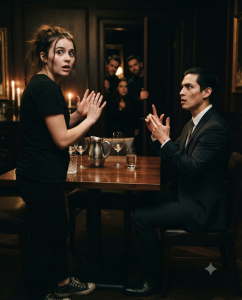
Her coworkers thought they were about to witness the most satisfying humiliation of the month.
Instead, they triggered the one conversation that would expose everything.
Marisol had been working at La Cúpula for almost eleven months, which in that restaurant felt like surviving a private war no one outside the building could see. The place was polished perfection on the surface. Crystal glasses. Velvet chairs. Waiters trained to glide instead of walk. Wealth wrapped in low lighting and expensive perfume. Customers came for the food, but they stayed for the feeling that everyone around them existed only to make their night smoother, richer, quieter.
People like Marisol were part of the decor.
At least that was how management wanted it.
She was good at her job, better than most of the people who mocked her. She remembered orders without writing them down, could carry more plates than anyone on staff, and had the kind of patience that only came from necessity. But competence didn’t buy acceptance at La Cúpula. Not if you didn’t dress the right way after shifts. Not if your shoes were too worn. Not if you refused to laugh when someone made a cruel joke about a customer or a coworker. Not if you went home every night instead of staying to drink with the rest of the team and pretend you weren’t being underpaid together.
Bruno hated that about her most.
He was the floor manager on most nights, the kind of man who treated small power like a drug. He wasn’t old, maybe thirty-two, but he had already perfected the smile of someone who could insult you and call it banter if you reacted. Carla was his favorite audience. She was beautiful in the sharp, polished way that the restaurant rewarded, and she laughed at everything he said with just enough exaggeration to stay on his good side.
Marisol learned early that silence was safer.
What none of them cared to learn about her was that she didn’t rush home because she thought she was better than them. She rushed home because life waited for her on the other side of every shift. Rent. Bills. Grocery lists calculated down to the peso. Her younger brother Mateo, who pretended not to need help more often than he really didn’t. And every Wednesday, after clocking out, a train ride across the city to a free sign language class in Iztapalapa.
Mateo had been seven when a fever changed everything. By the time the worst of it passed, a large part of his hearing was gone. Their mother had already left years before. Their father’s absence was older than either of them knew how to explain. So Marisol, still a teenager then, became the person who learned whatever the world demanded. How to stretch food. How to argue with landlords. How to keep Mateo from feeling pitied. How to translate government forms he didn’t understand. And eventually, how to sign so he would never again look alone in a room full of speaking people.
At first, her signing was clumsy. Mateo had laughed at her hand positions, corrected her expressions, taught her shortcuts no formal teacher would ever include. Over time, it became natural. Not perfect, but honest. Enough to carry affection, irritation, jokes, warnings, apologies. Enough to build a world where Mateo did not have to spend every minute translating himself to survive.
That was the world Marisol carried quietly inside her while everyone at La Cúpula called her weird.
Then came Esteban Rivas.
His name moved through the restaurant like smoke. No one ever said much around him, but everyone had a story. He owned warehouses. He financed clubs. He moved cash. He was connected to men in Tepito, men in Santa Fe, men at the border. Some stories said he had inherited an empire. Others said he built it from favors people were too afraid to describe. All anyone agreed on was that he was dangerous, rich, and untouchable.
And deaf.
He came every Thursday, always alone, always to the same private room in the back. He ordered expensive food but barely touched the wine. He paid in cash. He tipped more than some customers spent. He never stayed long. He almost never spoke.
That last part made him a favorite subject for Bruno’s jokes.
“He probably hears perfectly fine,” Bruno would say. “He just enjoys watching people squirm.”
Or worse: “Maybe he likes pretending so no one asks questions.”
The staff laughed because that was easier than deciding not to.
Marisol never joined in.
On the Thursday everything changed, Bruno approached her just before the dinner rush with a tray in his hand and malice shining through his smile.
“Private room,” he said. “Mr. Rivas.”
The kitchen went unnaturally still.
Carla tilted her head and smirked. “Maybe he’ll finally speak for you.”
Marisol understood immediately. This was entertainment. They wanted her in there because she was the safest sacrifice. The poor girl. The quiet one. The one with tired shoes and no backup. They expected her to return embarrassed while they laughed about it for the rest of the week.
She could have refused.
But refusing would have cost her in ways wealthy people never think about and cruel coworkers understand perfectly. Worse shifts. Fewer tables. Public comments disguised as corrections. Maybe eventually the job itself.
So she took the tray and walked in.
The private room was dimmer than the rest of the restaurant. Esteban sat near the window, his profile reflected faintly in the glass. Dark suit. Straight back. Unreadable expression. There was a glass of water in front of him, untouched.
“Good evening, sir. My name is Marisol. I’ll be taking care of you tonight.”
Nothing.
She noticed the door behind her was not fully shut. Of course it wasn’t. Bruno and the others wanted to watch.
She looked back at Esteban and saw what they had missed.
He was watching her mouth.
Not vaguely. Carefully. Deliberately. The way Mateo did when he was tired and the room was dark and he needed every clue he could get.
Marisol set her pad down.
Then she raised her hands and signed.
Good evening. My name is Marisol. What would you like to order?
His entire face changed.
It wasn’t dramatic. Men like Esteban probably survived by keeping shock locked behind their teeth. But she saw it anyway. A crack in the cold surface. A flash of something raw and disbelieving.
You know sign language? he signed back.
I learned because of my brother.
He stared at her for a moment longer, then gave a short nod and began placing his order. His signing was fluent, restrained, exact. Not decorative. Not softened for her comfort. It was the language of someone who had spent too long being forced to adapt to other people and was startled to discover he didn’t have to.
Outside the door, the prank died in confusion.
Inside the room, something else began.
Marisol served him through the meal, and each time she returned, the conversation stretched a little further. He asked how long she had been learning. She asked if he came there often because he liked the food or because private rooms were easier. That got the faintest trace of amusement from him.
Neither, he signed. Privacy reveals people. They behave differently when they think no one notices.
There was something unsettling in that answer, but not toward her.
When he left, he signed, Thank you for speaking to me like I’m human.
No one had ever thanked Marisol like that for something so simple.
Bruno’s expression when she stepped out of the room was enough to tell her the joke had failed in the worst possible way. Carla looked furious. The others avoided her eyes.
At home, Mateo noticed immediately that something had happened.
“What?” he asked when she kept reheating the same plate of rice and eggs without taking a bite.
Marisol hesitated, then signed the story out while speaking aloud for herself. Mateo’s eyebrows rose higher and higher.
“The scary man?” he signed.
“That’s what everyone says.”
“And?”
Marisol thought about the precision in Esteban’s hands, the way he had looked at Bruno through the crack in the door, the thank you that felt heavier than it should have.
“And I think everyone at work is more afraid of him than he is of them.”
Mateo smiled. “That usually means they know something.”
The next Thursday, Esteban asked for her by name.
That was when the atmosphere at La Cúpula turned from mean to tense.
Bruno delivered the message with forced indifference, but his jaw was tight. Carla dropped a glass later that night because she was too busy staring at the private room door. Conversations in the kitchen stopped when Marisol walked in. Papers were moved when she came too close to the office. Once, she caught Bruno hissing at one of the bartenders, “Not here.”
She told herself she might be imagining it.
Then during service, while she poured water into Esteban’s glass, he signed without looking at her:
The man who assigned you to me hates this conversation. Why?
She nearly spilled the water.
Before she could answer, the door opened. Bruno leaned inside wearing a smile so false it looked painful.
“Everything okay in here?”
Esteban turned slowly and looked at him.
That was all. No words. No raised voice. Just a stare.
Bruno muttered something and left.
When the door shut, Esteban signed the sentence that made Marisol’s blood run cold.
He’s afraid you’ll notice I can read lips too.
All at once, the restaurant rearranged itself in her memory. The kitchen whispers. Bruno’s jokes about deafness. The way some conversations always happened with backs turned or heads lowered. The envelopes exchanged under folded receipts. The supplier deliveries that never appeared on inventory sheets. The strange rule that only Bruno handled certain cash payments from private customers.
Esteban leaned back and watched her carefully.
“What have you seen?” he signed.
Marisol swallowed. “I don’t know what matters.”
“Everything matters.”
So she told him.
Not in one dramatic confession, but piece by piece. Bruno meeting men near the service entrance after midnight. Carla carrying sealed packages to the office. Register totals that changed before closing. Names she had overheard. Numbers repeated too often. The way staff were sent away whenever certain clients arrived. She had never understood the pattern before because she had never been given a reason to connect it.
Esteban listened without interruption.
When she finished, his expression had gone completely flat.
“That room,” he signed, glancing toward the office wall beyond the private dining area. “Who has keys?”
“Bruno. Sometimes the owner. Carla when Bruno tells her to.”
Esteban tapped his fingers once on the table, thinking.
Then he signed, “Bruno works for me.”
Marisol stared at him.
Or maybe had worked for him was the better meaning, because what came next explained the fear she had been feeling all week.
La Cúpula, Esteban told her, was one of several businesses used for laundering money through fake invoices and inflated cash flow. Bruno’s job had been simple: keep the books aligned, move certain packages, maintain silence. But money had started disappearing. Shipments had gone off record. Accounts no longer matched. Esteban had returned to the restaurant repeatedly, quietly, because he suspected someone inside his own chain was skimming from him.
He had not expected the answer to be the floor manager who kept mocking his deafness.
“He thought I couldn’t catch what was happening because people stop guarding their mouths around me,” Esteban signed. “That usually helps me. This time it made him careless.”
“Why keep coming alone?” Marisol asked.
“Because guilty people reveal more when they think they are smarter than you.”
She understood then why Bruno looked sick every time Esteban asked for her. It wasn’t jealousy. It wasn’t annoyance. It was fear that the one waitress he had tried to humiliate had become the only person in the building who could communicate privately with the man he had been stealing from.
What Marisol did not expect was to be asked for help.
“I need someone who sees how staff move when they think no one important is watching,” Esteban signed. “Someone Bruno underestimates.”
“Why me?”
His answer came immediately.
“Because you notice everything. And because you still chose kindness in a room built for humiliation.”
No one had spoken to her that way in years.
For the next two weeks, Marisol did what she had always done best: she watched. Quietly. Thoroughly. She noticed Carla slipping into the office during inventory counts. She saw Bruno pocket duplicate receipts. She memorized delivery times. She paid attention to which customers were seated far from cameras. She told Esteban what she saw in short signed exchanges during dinner service, and each new detail sharpened the outline of a betrayal that had apparently grown for months under everyone’s nose.
The confrontation happened on a Thursday night.
The dining room was full. Crystal, candlelight, soft music. Wealth pretending the world outside did not exist.
Bruno thought he was in control.
Marisol knew otherwise the moment two men in dark suits entered through the back instead of the front and took positions near the private room without ordering anything. They were not police. They were something quieter and, somehow, more dangerous.
Esteban arrived ten minutes later.
He did not go directly to the private room. He stopped in the center of the dining floor, where everyone could see him. The room shifted around his presence. Conversations thinned. Glasses paused halfway to mouths.
Bruno approached with his polished manager smile. “Good evening, Mr. Rivas. Your room is ready.”
Esteban looked at him for one long second.
Then he signed.
Marisol, standing near the service station, translated aloud because Esteban gave a slight nod for her to do it.
“He says the room won’t be necessary tonight.”
Bruno’s smile flickered.
Esteban signed again.
“He says he would rather discuss the missing money where everyone can hear.”
The entire restaurant went still.
Carla went pale.
Bruno laughed too quickly. “I don’t know what this is, but maybe we should speak privately.”
Esteban’s hands moved with brutal calm.
Marisol translated, her own voice sounding strange to her ears.
“He says you’ve already had too much privacy.”
The owner emerged from the office, confused and sweating. Staff gathered at the edges of the room pretending not to stare. Customers watched openly now, some thrilled, others uncomfortable.
Bruno tried denial first. Then outrage. Then insult. He pointed at Marisol and called her a liar, called her bitter, called her desperate. He said she was inventing things because she wanted attention.
For one terrible second, the old instinct to shrink almost got hold of her.
Then she saw Mateo in her mind at seven years old, frustrated and frightened, trying to read lips in a room full of adults who would not slow down for him. She saw every night she had walked home tired and silent because she needed the paycheck too much to defend herself. She saw the private room door, cracked open so her humiliation could become a spectator sport.
And she stopped being afraid.
“No,” she said clearly. “You wanted me in that room because you thought he couldn’t understand me and I couldn’t understand him. You were wrong about both.”
That was the moment Bruno lost control.
He lunged toward her—not enough to strike, but enough to intimidate, to reclaim the old balance where fear did his work for him.
He never reached her.
One of Esteban’s men stepped between them so quickly Bruno nearly stumbled backward. The dining room erupted into overlapping voices. The owner started shouting. Carla burst into tears.
Then came the final blow.
Esteban removed a folded stack of copied invoices from inside his jacket and placed them on the nearest table. Beside them, he laid photos, timestamps, ledger pages, security stills. Every gap in the books. Every missing payment. Every false signature. Carla’s face appeared in some of the images. Bruno’s in all of them.
He had known longer than anyone realized.
He had simply been waiting to see who Bruno really was when cornered.
Security was called, though by then it was little more than ceremony. The owner tried to distance himself, tried to claim ignorance, tried to say Bruno had acted alone. That became harder to maintain the moment Carla, sobbing and cornered, admitted she had moved packages and cash because Bruno promised she was protecting the restaurant. Whether she believed that or not no longer mattered.
By midnight, Bruno was gone.
So was Carla.
Some staff never came back after that week. Others acted as if they had always been on Marisol’s side, which told her everything she needed to know about them.
Esteban returned one last time after the chaos had settled.
Not for business. Not for dinner.
Just to speak.
He met Marisol outside the restaurant before her shift, when the street was quieter and the city still smelled faintly of morning dust and gasoline. He signed that the owner had been forced to restructure management. Some people would be investigated further. La Cúpula would remain open, but not the way it had been.
Then he thanked her.
Again, directly. Without drama.
“You changed everything,” Marisol signed.
He gave a slight shake of his head.
“No. I noticed too late. You were the one they tried to bury in plain sight. You just refused to stay buried.”
After a pause, he added, “Your brother is lucky.”
Marisol smiled at that, genuinely.
“So am I,” she signed back. “He taught me how to listen.”
Esteban looked at her for a long moment, as if filing the sentence away somewhere private. Then he nodded once and left.
Marisol never saw him again.
A month later, she was promoted to supervising part of the floor—not because anyone had suddenly become noble, but because the people in charge had learned the cost of underestimating her. She used the raise to help Mateo enroll in a technical program he had wanted for years. They still lived carefully. Still counted money. Still kept the kitchen light on for each other.
But something fundamental had changed.
At La Cúpula, people looked at her differently now. Some with respect. Some with caution. A few with resentment. Marisol did not mistake any of those things for friendship. She had learned too much for that.
What stayed with her most was not Bruno’s humiliation or Carla’s tears or the way the dining room fell silent when the truth landed. It was that first moment in the private room, when two people everyone had misjudged recognized each other instantly.
A poor waitress in worn-out shoes.
A feared man everyone thought was unreachable.
A language cruel people assumed would isolate instead of connect.
In the end, the biggest mistake Bruno made was not stealing.
It was believing dignity is invisible when the person carrying it looks tired, quiet, and easy to mock.
He saw poverty and thought weakness.
He saw deafness and thought limitation.
He saw silence and mistook it for ignorance.
He was wrong three times.
And maybe that is the part that lingers longest after stories like this end: not whether Bruno deserved what happened, or whether Esteban was a good man simply because he punished betrayal, but how often the worst people in a room reveal themselves by deciding too quickly who has no power.
Because sometimes the person everyone overlooks is the only one who can hear the truth forming before anyone else does.