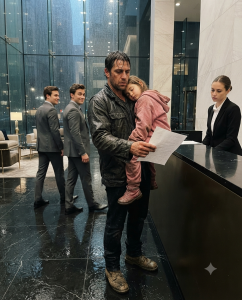
When Daniel Morales stepped into the lobby of Grupo Altamirano, he already knew he looked like the kind of man people judged in under three seconds.
His boots were split at the sides, darkened by old mud and fresh rain. His jacket had once been thick enough for construction mornings, but years of work and weather had worn it thin at the seams. In his arms, leaning against his chest with the deep, trusting sleep only a child can manage in chaos, was his seven-year-old daughter, Sofía.
Every surface around them gleamed.
Black marble reflected the chandelier light. Glass walls showed a city blurred by rain. Security guards stood straight with earpieces tucked discreetly behind polished haircuts. Men in tailored suits crossed the lobby as if they were born walking through power. Women in elegant heels moved with the calm speed of people whose time cost money.
Daniel held a damp application in one hand and tried not to leave footprints.
At the reception desk, the young woman barely hid the look in her eyes. Not fear. Not concern. Something colder than either one.
Dismissal.
“Applications go here,” she said, pointing to a tray without really looking at him.
Daniel nodded. “Thank you.”
He slid the page forward carefully so he wouldn’t wrinkle it more than the rain already had. The receptionist glanced down just long enough to register the words night janitor and the crooked handwriting squeezed into each line. She almost pushed it aside with the others.
Behind Daniel, two young executives passed and laughed under their breath.
“Now anybody gets into Grupo Altamirano,” one of them said.
Daniel pretended not to hear them.
In his arms, Sofía shifted and blinked awake. Her face was warm against his chest. “Do you have the job now, Daddy?”
He swallowed before answering. “Not yet, little one. But we knocked on the door.”
She smiled, satisfied for the moment, and laid her cheek back on him.
That smile almost broke him.
Because children could survive hunger, exhaustion, cramped rooms, and secondhand clothes better than adults ever admitted. But hope was different. Hope made promises even when life had already started taking things away.
Daniel turned and walked back toward the revolving doors, leaving a faint trail of rainwater behind him.
He didn’t know that upstairs, one glance at his name was about to reopen a buried past.
Three years earlier, Daniel had been the kind of man other workers followed without resentment.
He was a construction foreman outside Toluca, respected because he worked harder than the crews he supervised. He didn’t shout for no reason. He didn’t sit in an office while others sweated below him. If a beam had to be lifted, he was there. If fresh concrete needed leveling before sunrise, he was there. If a younger worker froze on scaffolding during high winds, Daniel climbed up himself and showed him where to put his feet.
He had unfinished engineering studies, the kind that stopped not because he lacked ability, but because life charged tuition in ways the university never could. When his father got sick years before, Daniel had left school to work full-time. He always told himself he’d go back eventually.
Then he met Mariela.
She was soft-spoken without being weak, funny in a way that arrived late and stayed with people longer than loud jokes ever could. She liked small things: clean sheets dried in the sun, hibiscus water with too much ice, potted plants, old boleros on the radio. She made their modest house feel rich even when it wasn’t.
The house had a little patch of dirt in front where she planted bougainvillea. Daniel built the metal frame for the entrance himself. Their old pickup roared like a machine held together by stubbornness, but every time it started, Mariela would pat the dashboard and say, “See? It loves us.”
Then Sofía came, and Daniel’s world became a circle small enough to fit in his hands and large enough to change every dream he had.
He didn’t need luxury. He needed enough.
Enough food. Enough work. Enough time. Enough safety.
For a while, enough seemed possible.
Then Mariela started getting tired.
At first they laughed it off. Too much work. Too little sleep. Maybe low iron. Maybe stress. Then she started losing weight. Then she fainted. Then came tests, more tests, referrals, private consultations, numbers they couldn’t pronounce, bills they couldn’t afford, and doctors who mastered the art of sounding hopeful without promising anything.
Daniel sold the pickup first.
Then some tools.
Then all of them.
He borrowed from cousins, from an uncle, from a neighbor who later stopped looking him in the eye because asking for repayment was easier than asking how Mariela was doing. Daniel signed loan papers he barely understood because every day with her felt worth another debt.
But disease has a way of humiliating love. It makes devotion look small. It turns effort into delay.
One November dawn, while the sky outside the hospital windows was still dark blue, Mariela died with Daniel’s hand in hers.
Her voice was weak, but not confused.
“Don’t let Sofía feel unwanted,” she whispered. “Promise me she’ll never have to apologize for existing.”
Daniel promised.
He meant it with his whole soul.
And then life went to work on that promise.
Without Mariela, the house no longer felt anchored. Without steady company finances, the construction firm where Daniel worked started unraveling. Delayed payments became partial wages. Partial wages became excuses. Suppliers stopped delivering. People disappeared. Rumors spread. A month later, the company collapsed under debts and investigations that never seemed to reach the right people.
Daniel tried day labor after that. Repairs. Short-term site supervision. Brickwork. Hauling material. Anything. Nothing lasted.
Bills did.
The house went next.
He and Sofía moved into a rented room in the Doctores neighborhood. The bathroom was shared. The walls were thin enough that arguments from the next room felt like they were happening in his own bed. The mattress dipped in the center. The window didn’t fully close.
His mother-in-law, Elvira, visited once and looked around with undisguised disgust.
“This is where my granddaughter sleeps?”
Daniel kept his voice even. “It’s temporary.”
Elvira’s mouth hardened. “Temporary is what poor men say when they stop knowing how to provide.”
The first time she suggested taking Sofía, she framed it as concern.
The second time, it sounded like accusation.
By the third, it was almost a threat.
“You love her, I know,” Elvira said one evening, sitting stiffly in the only chair in the room while Sofía colored on the floor. “But love doesn’t pay rent. Love doesn’t buy medicine. Love doesn’t put a child in a proper school.”
Daniel stared at the wall behind her because looking directly at her would have made his answer dangerous. “She’s staying with me.”
Elvira stood. “A judge may not agree.”
She left that sentence in the room like smoke.
A week later, in the rain, Daniel saw the hiring sign outside Grupo Altamirano.
Cleaning staff needed. Immediate hiring. Full benefits.
He stood under the awning reading it twice, then once more. Janitorial work wasn’t what he had trained for. It wasn’t what he wanted for himself. But pride doesn’t feed children. Pride doesn’t stop eviction. Pride doesn’t keep grandparents with money from trying to paint a father as unstable.
So he went in.
And upstairs, far above the lobby where he was being quietly measured and dismissed, Valeria Altamirano was ending a legal strategy meeting.
At thirty-nine, Valeria had become a symbol in business magazines and whispered conversations alike. Some called her ruthless. Others called her brilliant. Most called her both.
She had built hotels, logistics corridors, residential towers, green energy sites, and tech partnerships that men twice her age had once assured her she was too emotional to manage. She wore precision like armor. Her white suit that morning was immaculate. Her schedule had no wasted minutes. Her employees knew three facts about her with absolute certainty: she hated excuses, despised carelessness, and never allowed personal drama to touch corporate decisions.
That was the reputation.
The truth beneath it was more complicated.
Fifteen years earlier, Valeria Altamirano had not been a billionaire. She had been a scholarship student at UNAM, fighting exhaustion, class prejudice, and the suffocating expectations of a wealthy family who considered her ambitions unfeminine and embarrassing.
Her father had wanted obedience, not vision. Her brothers had treated her ideas like decorative hobbies. A fiancé chosen through business convenience had expected gratitude. The one thing Valeria wanted—to build under her own name—was the one thing everyone around her seemed determined to deny.
Back then, she spent long evenings on campus, surviving on cheap coffee and stubbornness.
That was where she met Daniel.
He wasn’t part of her social world. He was working construction on a university project while taking what classes he could when he could afford them. He smelled like sawdust and cement. He laughed with his whole chest. He treated ideas like physical things that could be built if someone stopped waiting for permission.
Their friendship began over a shared paper cup of terrible coffee and turned, slowly, into the kind of bond neither one knew what to call.
Daniel never flattered her. He challenged her. When she doubted herself, he got angry on her behalf.
“You keep asking whether they’ll allow it,” he once told her on a cracked stairwell lit by a flickering bulb. “You weren’t born to ask for permission, Valeria. You were born to build something no one can tear down.”
No one had ever spoken to her like that.
Not as a daughter to be managed. Not as a woman to be softened. As a force.
Then came the semester everything nearly ended.
Her scholarship was at risk over a financial hold she couldn’t resolve in time. Her family knew and refused to help unless she agreed to return home and abandon what they called her rebellion. Valeria said no.
Two days later, the balance was paid.
She never learned how until much later.
Daniel had sold the only asset he owned worth anything—land left from his father’s side, tiny but valuable enough to matter—and covered it without telling her. By the time she found out, he was gone.
No note. No demand. No farewell she could answer.
He disappeared from her life so completely that for years she wondered if she had invented the intensity of what had existed between them.
Then her life accelerated. Opportunity met fury. Fury met talent. Talent met discipline. She built. She fought. She won. The empire grew.
And then, on a rainy afternoon, an assistant laid the wrong folder on her desk.
“Sorry, ma’am,” the assistant said. “This was meant for Human Resources.”
Valeria reached to push it aside, but something made her open it.
One page. Then another.
And then she saw the name.
Daniel Morales.
Her pen fell from her hand.
She stared at the application until the letters blurred.
Former occupation: construction foreman.
Studies: civil engineering, unfinished.
Marital status: widowed.
Dependents: one daughter.
Current address: a crowded street in Doctores.
Position requested: night janitor.
It felt impossible and cruel all at once.
She rose so quickly her chair hit the glass wall behind her.
“No,” she whispered.
“Is something wrong?” her assistant asked.
Valeria was already elsewhere—in memory, in debt, in the part of herself she kept buried beneath schedules and contracts.
That same man. That same name. The same Daniel who had once believed in her before she believed in herself.
And he was applying to clean her floors.
“Bring him back tomorrow morning,” she said. “Personally. Nobody else interviews him.”
Her assistant hesitated. “Should I tell Human Resources—”
“No. Bring him to me.”
That night, while Valeria sat alone in her penthouse office staring at the application long after everyone else left, Daniel climbed the narrow stairs to his rented room with Sofía asleep against his shoulder.
The hallway smelled like detergent, damp concrete, and someone’s late dinner. The light overhead flickered.
Elvira stood outside his door.
Beside her was a family lawyer Daniel had seen once before at the funeral, a smooth-faced man carrying a yellow folder and an expression that suggested compassion only when legally useful.
Elvira did not greet him.
“I came for my granddaughter.”
Daniel stopped cold. “What?”
“I’ve initiated the process,” she said. “A judge will understand that a little girl should not be living like this with a man who cannot provide stability.”
Sofía shifted in his arms, murmuring but not waking.
Daniel kept his voice low with visible effort. “You came here with lawyers while she’s asleep?”
“I came because someone has to think about her future.”
The lawyer extended the folder. “Mr. Morales, this is only the beginning of a custody review. Cooperation will help everyone.”
Daniel took the folder with his free hand and opened it.
Inside were typed summaries, formal language, and then a signed witness statement that made his stomach go hard.
It claimed he had voluntarily abandoned Sofía for weeks at a time.
It claimed he left her in unsafe conditions.
It claimed he had shown emotional instability since Mariela’s death.
Daniel read it twice before the words made sense.
Then he saw the signature.
Arturo Vázquez.
His head lifted slowly.
Arturo had been an accountant tied to the construction firm that collapsed after Mariela died. Daniel remembered him too well—the oily calm, the fake patience, the late-night transfers, the numbers that never matched deliveries. Daniel had once confronted him over payroll discrepancies and been warned to mind his own business if he wanted to keep his position.
Then the company imploded, workers lost wages, and Arturo vanished.
And now his name was here. Sworn testimony. Family court. Custody.
Elvira crossed her arms. “There are people willing to tell the truth.”
Daniel’s voice came out quieter than anyone expected. “This man is a liar.”
The lawyer stepped in. “Careful, Mr. Morales.”
“No,” Daniel said, and this time there was steel in it. “You be careful.”
Elvira blinked.
Daniel looked from the signature to her face. “If Arturo signed this, someone had to find him. If someone found him, then this isn’t about my room. It isn’t about school uniforms. It isn’t about concern. It’s about making me look unfit before I say something I’m not supposed to say.”
A crack of something—fear, guilt, irritation—crossed Elvira’s expression too fast for a weaker man to miss.
Daniel saw it.
Sofía stirred. “Daddy?”
He kissed the top of her head. “I’m here.”
His phone buzzed in his pocket.
Unknown number.
He almost ignored it, but instinct made him answer.
“Mr. Morales?” a woman asked, her tone calm and trained. “This is the executive office of Valeria Altamirano. Ms. Altamirano would like to meet with you personally tomorrow at nine a.m.”
Daniel’s grip tightened around the folder.
For a second, he said nothing at all.
The name alone was enough to make the hallway seem suddenly too small.
Valeria Altamirano.
A lifetime collapsed into two words.
“Mr. Morales?” the voice repeated.
“Yes,” he said at last, barely above a whisper. “I’ll be there.”
He hung up.
Elvira’s eyes narrowed. “Who was that?”
Daniel didn’t answer.
Because in the space of a single breath, the night had changed shape.
The woman who had once vanished from his life after he made sure she could keep hers had just summoned him.
And the man tied to the company corruption he never fully exposed had just appeared inside a legal attack on his right to keep his daughter.
Those two things should have had nothing to do with each other.
Which meant they probably did.
The next morning, Daniel arrived at Grupo Altamirano in the cleanest clothes he owned: pressed as well as possible, though the cuffs were frayed and the shoes still showed hard years. Sofía was at school, left with strict instructions not to leave with anyone but him. He had not slept. He had spent half the night staring at Arturo’s signature and the other half remembering a staircase, cheap coffee, and a woman with fierce eyes who wanted to build a life no one else controlled.
At the executive floor, everything was silent enough to hear your own breathing.
Valeria stood near the window when he entered.
For a long moment, neither spoke.
Time had changed them both. Daniel was broader, more weathered, marked by grief and labor. Valeria was sharpened into elegance, every movement precise, every line of her face composed by years of command. But recognition was immediate. Brutal. Complete.
“Daniel,” she said.
He nodded once. “Valeria.”
No title. No pretense.
Her assistant discreetly closed the door behind him.
Valeria took one step closer, as if testing whether he was real. “You disappeared.”
A tired, almost disbelieving smile touched his mouth. “That’s your opening line?”
“You sold your land,” she said, emotion breaking through the polish. “You paid my balance and vanished.”
He looked away toward the skyline. “You were supposed to stay in school. That was the point.”
“That wasn’t your decision to make.”
“No,” he said quietly. “It was the only one I had.”
She studied him, and whatever anger she had kept polished for fifteen years shifted when she saw what remained in him and what had been taken.
“What happened to you?”
The answer could have taken hours, but Daniel only said, “Life.”
She saw the wedding ring no longer on his hand. “You were married.”
“My wife died.”
Valeria’s face changed instantly. “Daniel…”
He stopped her with a slight shake of his head. Sympathy was dangerous. If it reached him too fast, too directly, he might lose his footing.
So instead he placed the yellow folder on her desk.
“She’s trying to take my daughter.”
Valeria opened it and read with cold efficiency, her expression tightening line by line. When she reached Arturo’s signature, she looked up sharply.
“Where did this come from?”
“My mother-in-law. She claims I’m unstable and unfit.”
Valeria tapped the page once. “This name matters.”
Daniel watched her carefully. “You know him?”
She didn’t answer immediately. That silence was answer enough.
Years earlier, when Valeria first began building her company, one of her earliest subcontracting channels had tangled briefly with shell firms tied to a cluster of collapsing construction outfits. The names changed. The paperwork shifted. But a few operators kept resurfacing around missing payroll, fake invoices, and siphoned funds.
Arturo Vázquez was one of them.
Valeria closed the file. “Your old construction company didn’t just go bankrupt. Money was moved out before it sank.”
Daniel’s jaw hardened. “I knew it.”
“And if Arturo is willing to sign a false custody statement now, then someone either paid him, threatened him, or both.” She met his eyes directly. “Did you ever tell anyone what you saw back then?”
“Only Mariela. Then she got sick. After that, surviving the week mattered more than chasing men with accountants.”
Valeria turned to the intercom. “Get legal, compliance, and private investigations in here. Now.”
Daniel frowned. “Why are you doing this?”
She faced him again, and for the first time the billionaire disappeared. In her place was the woman from the staircase.
“Because fifteen years ago, when everyone around me wanted me small, you were the one person who refused to let me become that version of myself.” Her voice lowered. “And because whoever is coming for your daughter made the mistake of stepping into my building at the same time they stepped into your life.”
What followed moved faster than Daniel expected and slower than fear allowed.
Valeria’s legal team verified the family filing. Her investigators tracked Arturo within hours. Compliance connected his recent transactions to a consultancy used by one of Elvira’s business associates—a man who had quietly acquired distressed assets after Daniel’s old company collapsed. As the pieces surfaced, the shape of the truth became uglier.
Daniel’s old employer had been drained from the inside. Payroll diversions, sham material contracts, asset stripping. Arturo helped route money. The associate helped absorb the wreckage. And Elvira had known enough to understand one dangerous fact:
Daniel had once seen things that could threaten people with more to lose than pride.
Taking Sofía wasn’t just cruelty. It was leverage.
If Daniel were buried in family court, isolated, discredited, and desperate, he would be easier to silence permanently.
When Arturo was finally brought into a private deposition room under legal pressure, he folded faster than anyone expected. He admitted the custody statement was false. He admitted he’d been contacted through intermediaries. He admitted Daniel had raised concerns years ago about numbers that didn’t match real work. He admitted Elvira’s side wanted Daniel painted as unstable before he could become useful to any larger inquiry.
But the worst part came next.
Elvira hadn’t just doubted Daniel as a provider after Mariela’s death.
She had blamed him for refusing a “better arrangement” near the end of Mariela’s treatment—an arrangement involving signatures, insurance claims, and company funds Daniel had refused to touch when things stopped feeling legal. In Elvira’s mind, Daniel’s morality had cost them money. Money that might have preserved status, if not life.
Grief had curdled in her into resentment.
And resentment, when mixed with entitlement, had become something monstrous.
The custody hearing turned in a single afternoon.
Valeria’s legal support ensured Daniel had representation far beyond anything Elvira expected. Arturo’s sworn retraction was devastating. Financial links emerged. The judge’s tone shifted from skeptical to severe. By the end of the session, Elvira’s petition was not only weakened—it was stained by evidence of manipulation.
Outside the courtroom, Elvira tried one last time.
“I was thinking of Sofía,” she snapped.
Daniel looked at her with a weariness deeper than anger. “No. You were thinking about control.”
She opened her mouth again, but there was nothing left that sounded noble.
A week later, Daniel was formally hired by Grupo Altamirano.
Not as a janitor.
Valeria reviewed his old academic record, his site history, and the practical knowledge he’d built over years of work. She placed him first in facilities operations, then into project oversight training. He resisted at first, embarrassed by what felt like charity.
Valeria shut that down immediately.
“This isn’t pity,” she told him. “It’s delayed accuracy.”
He laughed for the first time in months.
Sofía adjusted faster than anyone. She liked Valeria almost immediately, not because she understood the history, but because children notice the truth adults hide. She saw that when Valeria looked at her father, she did not see a broken man. She saw someone who had mattered before success and still mattered after it.
Daniel and Valeria did not rush into anything beyond honesty.
Too much had happened. Too many years had passed. Too much grief stood in the room with them. But something old, interrupted rather than extinguished, began to breathe again in cautious ways—long conversations, shared silence, mutual respect stripped of illusion.
One evening, months later, Daniel stood in front of a new project site at sunset with Sofía beside him and Valeria a few steps away on the concrete platform. The steel frame was only beginning to rise, but he could already read the future in it the way only builders can.
Sofía squeezed his hand. “Are you in charge here?”
Daniel smiled. “Part of it.”
Valeria glanced at him. “He always was.”
He looked at her, then at the structure growing against the orange sky, and thought about all the things that had almost erased him. Poverty. Grief. Humiliation. Family cruelty. Corruption. Silence.
In the end, what saved him was not luck alone.
It was the fact that one act of sacrifice, done years earlier with no expectation of return, had survived time long enough to come back when he needed it most.
Some people would say Elvira was a grieving mother who went too far. Others would say grief is no excuse for trying to steal a child from the only parent who truly fought for her. Some would say Valeria should never have gotten involved so personally. Others would say power means nothing if it never protects the people who once helped build your courage.
But for anyone looking at the story honestly, the biggest red flag had been there from the start:
The moment people stopped seeing Daniel as a father and started seeing him as a man easy to erase.
They were wrong.
And that was the one mistake everything else could not survive.