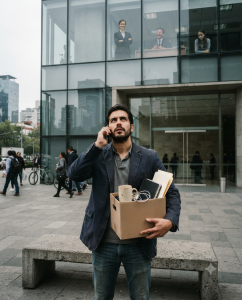
When Diego Salvatierra walked out of Grupo Salvatierra carrying a cardboard box, nobody on the twelfth floor imagined they were watching the beginning of their own downfall.
The box was ordinary, the kind handed to dismissed employees so they could remove the last evidence they had ever belonged there. Inside his were only a few things: a chipped mug, a charger, a black notebook, and a yellow folder thick enough to matter. He held it with both hands as he crossed the polished lobby, past the crystal turnstiles, past the receptionist who suddenly found her keyboard fascinating, past the security guard who avoided his eyes.
Behind him, on the operations floor, people were celebrating in the careful way office people celebrate cruelty. Not loudly. Not openly. Just enough to let one another know the deed was done.
Mariana Cárdenas watched from near the glass wall, arms folded, mouth curved in that thin, controlled smile she wore whenever she thought she had won. Raúl Ibáñez leaned against a desk pretending to scroll his phone, though his expression was almost childish with satisfaction. Patricia Mena remained seated, spine straight, eyes lowered, one hand still resting on her mouse as if she could continue working her way out of guilt.
To anyone watching from outside, Diego looked like another failed junior employee who hadn’t made it a month.
That was exactly what he had wanted them to believe.
Three weeks earlier, Diego had entered the company under the title temporary analyst. The badge he received was identical to everyone else’s. No executive access. No family connection. No hint that the name on the front of the building was also his own.
His father, Esteban Salvatierra, had insisted on the disguise.
At seventy-two, Esteban was preparing to pull back from the empire he had built over four decades. Grupo Salvatierra had started with one rented warehouse and a borrowed truck. Through discipline, stubbornness, and a near-obsessive attention to detail, he had expanded into logistics, construction, and national distribution. The company was now powerful enough that ministers took his calls and competitors studied his moves.
But success had created distance. Layers of management had formed between the boardroom and the ground floor. Reports were polished before reaching him. Complaints disappeared in formal language. Numbers looked solid, yet turnover in operations was suspiciously high. Small losses kept repeating in strange patterns. Good people were leaving. Something rotten had taken root somewhere below, and Esteban no longer trusted filtered explanations.
So he sent Diego.
Not because Diego was his son, but because Diego was the one person in the family who had refused privilege often enough to see what other people missed. He was a widower and the father of a seven-year-old daughter named Alma. Since his wife’s death three years earlier, he had learned to cook breakfasts with one hand while braiding hair with the other, to answer school messages during conference calls, to read bedtime stories after midnight and still show up composed in the morning. Loss had stripped vanity out of him. He had no patience for games, and no hunger for titles.
“What am I looking for?” Diego had asked his father on the day he accepted the role.
“The truth,” Esteban had said. “Especially the kind that hides behind good manners.”
The truth found him quickly.
The twelfth floor belonged to Mariana Cárdenas. Officially, she was head of operations oversight. Unofficially, she ruled through fear refined into etiquette. She rarely shouted. She didn’t need to. Her power came from timing and precision. She assigned impossible deadlines after hours, then questioned commitment when people failed. She edited names off reports. She redirected blame in meetings with such a calm voice that resistance sounded emotional and therefore unprofessional. By the second week, Diego noticed even senior analysts checked her face before speaking.
Raúl was her favored weapon in public. Charming upward, cruel downward. He stole ideas, mocked weaker employees, and packaged the work of others with enough polish to pass it off as leadership. He had the social instincts of a parasite. He always knew where credit was about to land and how to stand beneath it.
Patricia was more dangerous because she looked harmless. Quiet, exact, fast. She forwarded chains at strategic moments, altered wording in final drafts, and understood how a subtle change in document history could redirect ownership. If Raúl was the performance, Patricia was the mechanism.
Over twenty-one days, Diego collected patterns.
He arrived early, stayed late, and became useful without becoming visible. He cleaned up backlogged audits that should have raised alarms months before. He reassembled supplier files that had been split across folders in ways too messy to be accidental. He discovered duplicate charges hidden under revised vendor codes. Nothing large enough alone to become scandalous, but enough to reveal a culture built on concealment.
Each time he repaired something, someone else claimed it.
One supplier compliance report had been broken for months. Diego spent two nights rebuilding it from archived versions and email fragments. The next morning, Raúl presented it to management as his own recovery effort. Mariana praised him in front of the team.
Diego simply took another screenshot.
He saved timestamps, version histories, forwarded messages, login attempts, and recovery records to a personal evidence log in his black notebook and secured copies of the most important files. He was careful, methodical, and patient. He wanted proof, not suspicion.
Only one person on the floor seemed aware of how ugly things had become.
Lucía Herrera had been with the company seven years. At thirty-four, she carried herself with the permanent caution of someone who had survived too many humiliations to waste energy reacting. She was competent, fast, and almost invisible by choice. Diego noticed the way she hesitated before sending emails, re-reading every line as if one misplaced word might cost her rent.
One Tuesday morning, Mariana called her out in front of everyone for a minor formatting issue in a spreadsheet.
“If after seven years you still make mistakes like this, Lucía, I honestly don’t know what you’re doing here.”
The office went silent.
Lucía’s mouth tightened. “I’ll correct it right now.”
No one defended her. Not because they agreed, Diego realized, but because they were afraid. Fear had become the office’s operating system. Every humiliation taught the same lesson: keep your head down, accept what happens, survive until Friday.
At lunch that day, Diego found Lucía alone in the break room staring at untouched yogurt.
“You didn’t deserve that,” he said.
She gave him a tired half-smile. “Nobody does. But around here deserving has nothing to do with it.”
“Why stay?”
She looked at him then, truly looked at him. “Because some of us don’t have the luxury of leaving before we have somewhere else to go.”
That answer stayed with him longer than he expected.
By the start of the third week, Diego had enough evidence to expose document theft, intimidation, and manipulated accountability. What he had not yet proven was who was willing to cross from corruption into a manufactured legal accusation.
He got his answer on Thursday.
An email from Mariana asked him to come to her office at 4:15 p.m. Human Resources would be present.
Inside, the air was cold and over-conditioned. A woman from HR sat with a folder open in front of her. Raúl occupied a chair by the wall, pretending neutrality but unable to hide the alert satisfaction in his eyes. Patricia stood near the filing cabinet, not looking at anyone.
Mariana folded her hands over the desk. “Diego, a serious violation has been identified. According to our records, you accessed confidential client information using unauthorized credentials.”
Diego let the silence settle before answering. “Show me the access records.”
“Legal is reviewing them,” Mariana said.
“So you’re firing me before the review is complete?”
“This is a grave breach.”
“Can I appeal?”
The HR representative swallowed. “The termination is immediate.”
He looked at each of them in turn. Raúl’s confidence. Patricia’s fixed stare. Mariana’s polished certainty. Then he looked at the paper.
There it was: his name, the accusation, the language of permanent damage.
He signed the acknowledgment.
Mariana seemed almost disappointed he hadn’t fought.
As Diego packed, nobody approached. The office had already rewritten him into a cautionary tale. At the elevator, Raúl laughed and said, “Didn’t even make it a month.”
Diego did not respond.
Outside, he placed the box on a concrete bench and dialed a number saved under one letter.
His father answered on the second ring.
“Dad,” Diego said, calm and clear. “They did it.”
Esteban did not speak immediately. He didn’t need to. He had waited for this call from the day he sent his son into the building.
“What level?” he asked at last.
“Full fabrication. Security accusation. HR signed off.”
A long exhale came through the line, not of surprise but of anger finally confirmed.
“What do you have?”
“Document histories. Email chains. Restored deletions. Screenshots. Timing links between Patricia’s edits and Raúl’s presentations. Patterns of intimidation. Evidence that Mariana approved false attribution. And probably enough in the server logs to tie the accusation to them once IT freezes the floor.”
Diego looked up at the twelfth-floor windows and saw Mariana still standing there.
“Freeze every email from that floor,” he said. “Call the board. Prepare terminations.”
Then he added, with no emotion at all, “Fire everyone who was involved.”
By 4:37 p.m., the first lockout began.
Staff on the twelfth floor noticed it as an inconvenience. Shared folders stopped loading. Outgoing messages stalled in drafts. Badge access failed at two internal doors. Someone joked about a server issue. Someone else swore at the printer. Raúl announced that IT was probably doing maintenance and told everyone to relax.
Then two compliance officers stepped off the elevator with legal counsel and the head of internal security.
The room changed.
Mariana walked over, all executive grace. “Can I help you?”
“Yes,” said the lead counsel. “No one leaves this floor.”
That was when the jokes died.
Lucía looked from one face to another, confusion giving way to something she had not felt in years inside that building: hope.
Five minutes later, the executive elevator opened again.
Esteban Salvatierra stepped out personally.
People who had only seen him in framed photographs or company anniversary videos straightened on instinct. He was older now, silver-haired, shoulders slightly bent with age, but the force of him still moved through a room before he spoke. He surveyed the floor, took in Diego’s empty desk, the frozen screens, the rigid managers, and then let his gaze settle on Mariana.
“Who approved the accusation against the analyst terminated today?” he asked.
No one answered.
Mariana stepped forward. “Mr. Salvatierra, there appears to be a misunderstanding—”
He lifted a hand.
“Good,” he said. “Then the archives will correct it.”
IT had already begun restoration from backup snapshots. Deleted email threads reappeared. Version histories that had been scrubbed returned in sequence. Access logs showed the client file breach did not originate from Diego’s credentials at all. It came from a manager override terminal used after hours from Mariana’s office cluster.
Raúl’s face lost color first.
Then came the supplier report history. Dozens of revisions. Diego’s edits. Patricia’s removal of metadata. Final transfer to Raúl. Approval by Mariana. Once one thread surfaced, others followed. Reassigned tasks. Manipulated deadlines. Name deletions. Internal messages mocking employees they had sabotaged.
One recovered email from Patricia to Raúl, sent at 11:48 p.m., read: If we push security language, HR won’t ask questions. Mariana already agreed.
Nobody on the floor made a sound.
Patricia sat down very slowly, as if her knees had stopped obeying her. Raúl opened his mouth, closed it, then tried again. “This isn’t—there’s context—”
“Save it,” Esteban said.
Mariana’s composure lasted longer than the others’, but not by much. “Sir, with respect, difficult management decisions are often misunderstood by lower-level staff.”
Esteban turned toward her fully then, and the disappointment in his face was worse than anger.
“You framed my son,” he said.
The words hit the room like a physical force.
Several employees stared at Mariana. Then at the empty desk. Then at Esteban. Lucía actually took a step back.
Mariana blinked. “Your… son?”
“Diego Salvatierra,” Esteban said. “The analyst you accused, exploited, and removed.”
Raúl grabbed the edge of a desk to steady himself.
Patricia began crying without sound.
Mariana looked, for the first time, unsure. “We had no way to know.”
“That is the least important part of what you did,” Esteban replied. “You should have treated him decently even if he had been no one.”
Security moved first to Raúl, then Patricia, then Mariana. They were informed they were suspended pending formal termination and investigation. Company devices were collected. Badges were seized. Raúl protested. Patricia apologized in broken fragments. Mariana tried one final appeal to procedure, but even she heard how empty it sounded.
As they were escorted out, the floor remained silent except for the faint hum of air conditioning.
Then Esteban did something nobody expected.
He turned to the remaining employees and said, “Anyone who was threatened, erased, or silenced under this management will be heard. Starting now.”
The release of tension was visible. Some people looked down and cried. Others simply sat, dazed by the sudden absence of fear.
Lucía stood frozen until Esteban approached her directly.
“How long have you worked here?”
“Seven years,” she said.
“Did you know this was happening?”
Her eyes filled. “I knew pieces of it. Not all of it. I was afraid to speak.”
He nodded once. “Fear is expensive. This company should never have asked you to pay with it.”
That evening, Diego returned—not dramatically, not with triumph, but because Esteban asked him to join the emergency review with legal and compliance. When he stepped back onto the floor, conversations stopped again, though for a very different reason.
Lucía was the first to face him.
“I’m sorry,” she said. “I should have said something sooner.”
Diego set the yellow folder on a desk. “You survived what you could. That counts too.”
Inside the folder were printouts of the most critical sequences: task theft, manipulated revisions, late-hour traps, intimidation patterns, and the timeline leading to his false dismissal. Combined with the restored electronic records, it was more than enough to support terminations for cause and to open a broader audit into management culture.
Over the next month, Grupo Salvatierra changed faster than anyone thought possible. External investigators were brought in. HR practices were reviewed from top to bottom. Anonymous reporting was rebuilt under outside supervision. Promotions tied to stolen output were revoked. Departments once run by fear were restructured. Several senior managers beyond the twelfth floor resigned before they could be questioned too closely.
Lucía was offered interim oversight of operations process integrity, a title she initially tried to refuse.
“I’m not leadership material,” she told Diego.
“You are,” he said. “You just learned the wrong definition of leadership.”
She accepted.
As for Diego, his father offered him a permanent executive position. He declined the title at first, agreeing only to help rebuild internal accountability until the systems could stand on their own. At home, Alma asked why he came back late so many nights.
“Because some grown-ups forgot how to behave,” he told her while packing her lunch.
“Did you fix it?”
He smiled sadly. “We started.”
Months later, the company stabilized. Not perfectly, not completely, but honestly. People spoke more in meetings. Credit landed where it belonged more often. Fewer employees cried in bathrooms between calls. That mattered.
One afternoon, Esteban and Diego stood in the same lobby where the firing had begun.
“You knew they might target you,” Esteban said.
“I hoped they wouldn’t,” Diego answered.
“But you expected it.”
Diego looked toward the elevators. “People who are used to hurting the powerless always get reckless when they think no one important is watching.”
Esteban was quiet for a moment. “And what did you learn?”
Diego thought of Mariana’s smile, Raúl’s laugh, Patricia’s silence, Lucía’s trembling hands, and the terrible ease with which a lie could become policy if enough people found it convenient.
“That character shows fastest in how people treat someone who cannot benefit them,” he said.
His father nodded.
The story of what happened on the twelfth floor was never released publicly in full. Inside the company, though, it became something close to legend. Not because the founder’s son had gone undercover. Not because corrupt managers had been exposed. But because one truth had become impossible to ignore:
The worst people in a system usually believe they are safe until the day they discover the person they dismissed was never powerless at all.
And even then, that was not the real lesson.
The real lesson was harsher.
Mariana, Raúl, and Patricia did not fall because Diego was secretly important. They fell because they were cruel, dishonest, and careless with the dignity of others. His name only sped up consequences that should have come long before. The greater failure belonged to every structure that let fear pass for efficiency and silence pass for professionalism.
Maybe that is what lingers after a story like this ends. Not the satisfaction of seeing arrogant people escorted out, but the uncomfortable question that follows.
If Diego had truly been nobody, would anyone have stopped them in time?
And in a place built on fear, isn’t that the most revealing answer of all?