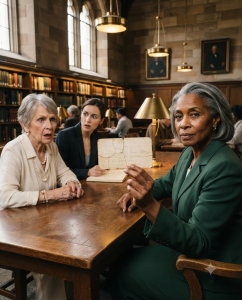
She walked back into the archives room carrying the library card they said had never existed.
Thirty-five years had passed, but the room had not changed enough to soften what it meant. The long mahogany tables still reflected the brass lamps in warm circles of light. The windows still held the late Charleston sun in a way that made dust look almost ceremonial. The portraits along the walls still wore the same composed expressions, women painted to look thoughtful, severe, and permanently correct. The air still smelled of lemon oil, old paper, and a confidence so deeply institutional it had become part of the building itself.
Celia Ward paused at the threshold for only a second.
Then she stepped inside.
She knew exactly where she had stood the last time. She knew where Imogen St. Clair had sat, where the trustees had arranged their folders, where the donors had smiled politely before the mood shifted. Memory had preserved the geography of humiliation with cruel precision. Thirty-five years had not blurred that. Time had only changed what she carried back into the room.
In 1991, she had come armed with note cards and faith.
Now she carried proof.
The Charleston Women’s Literary Society had invited her as an honored guest, a renowned historian of women’s print culture, the keynote speaker for a restoration project focused on the east stacks. Their letter had praised her scholarship in glowing terms. Their committee had called her work transformative. Their president had said it would be a privilege to welcome her into the Society’s historic reading room.
They had no idea who she was.
That had almost amused her when the invitation arrived. Almost.
Her career had taken her far from the woman they remembered, if they remembered her at all. Marriage had briefly changed her name. Widowhood had restored it. The years had replaced youthful nervousness with a steadier kind of poise. Silver threaded her dark hair now. She wore reputation differently than she had once worn hope. Back then she had believed institutions could be persuaded by evidence. Now she knew they were only ever moved by evidence when it became more dangerous to deny than to admit.
The irony was that the Society invited her because of the very kind of work it had punished her for doing.
At twenty-five, Celia had been a junior scholar with a fierce eye for what archival silence usually concealed. While other researchers chased celebrated authors and familiar names, she had become obsessed with the labor behind the objects themselves. Who stitched the bindings? Who embossed the leather? Who repaired the volumes after years of use? Who handled materials that later entered libraries stripped of the hands that made them durable and beautiful?
That obsession led her to Black women bookbinders working in the Reconstruction South, a subject so neglected that every small discovery felt both thrilling and infuriating. The more she found, the more obvious the omission became. Women’s labor had been treated as background even when it literally held the record together.
At the Charleston Women’s Literary Society, Celia had expected resistance in the mild, academic sense. Foot-dragging. Doubt. Requests for more documentation. She had not expected to stumble into institutional panic.
She found the first clue through Ruth Ellery, the Society’s retired archivist. Ruth was in her seventies then, sharp-eyed and sparing with praise, with a voice that suggested she had spent a lifetime quietly judging people who touched old paper with dirty hands. Celia met her while requesting donor files. Ruth had asked three questions, listened to Celia’s answers, and then studied her for a moment longer than was comfortable.
“You’re looking in the wrong cabinets,” Ruth had said.
That was how it began.
The east stacks were rarely used and only partially catalogued. A donor cabinet stood there behind a locked grille, packed with material that had never made its way into the official index. Ruth told Celia the cabinet held odds and ends no one had prioritized. “Things too inconveniently specific for proper institutional enthusiasm,” she called them dryly. Then she issued Celia a handwritten access card, signed it herself, and added that after-hours quiet would help more than daytime interruptions.
Celia had taken the card like a blessing.
Inside the cabinet she found far more than odds and ends. There were bindery receipts bearing women’s initials matched to workshop addresses. Notes on apprenticeship arrangements. Membership references. A ledger that recorded commissions completed under Society sponsorship. And threaded through it all was a pattern that became impossible to ignore: Black women had done skilled work for circles connected to the Society, and in at least some cases their names had once been recorded openly before disappearing from later summaries and catalogs.
One name appeared in full more than once: Eliza Bell.
Eliza was identified as a binder and finisher. She had completed restoration commissions and decorative work on presentation volumes. Several entries showed payment owed. One notation beside a later entry shifted the entire meaning of the file. It indicated that funds due after Eliza’s death had been redirected.
Redirected to whom, the ledger did not yet say.
But the question was enough.
Celia spent two years building a preliminary exhibition around the material. She cross-referenced names with church records, estate inventories, newspaper notices, and workshop supplies. She tracked evidence the way a patient person follows a frayed thread through a dark house. By the time the Society invited her to present her proposal in 1991, she was certain of two things. First, the records were authentic. Second, someone in the Society’s past had worked hard to make sure no one connected them into a public narrative.
She still believed authenticity would matter more than discomfort.
The meeting began pleasantly enough. Trustees thanked her for her diligence. A donor complimented her “refreshingly energetic approach.” A visiting lecturer from Georgetown praised the relevance of her methodology in that slightly inflated tone scholars use when trying to seem generous across rank. Celia laid out her note cards, handled her copies carefully, and began explaining the significance of the uncatalogued material.
Then Imogen St. Clair interrupted.
Imogen was already a power center then, one of those women whose authority rested not in title alone but in lineage, money, and the complete assurance that rooms would organize themselves around her preferences. She wore cream silk and a sapphire ring the size of a threat. Her voice, when she asked her question, was smooth enough to pass for innocent.
“And where exactly did Miss Ward gain access to holdings not reflected in our official catalog?”
The effect was immediate. Conversation cooled. Backs straightened. People sensed danger without yet knowing its shape.
Celia answered truthfully. Ruth Ellery had shown her the donor cabinet in the east stacks. Ruth had issued her a card. The material was legitimate. The significance was substantial.
Imogen listened with that small, attentive smile powerful people use when they are deciding how public the damage should be.
Then she lifted the library card.
It was Celia’s card. Ruth’s signature on the bottom. The same one Celia had used for months.
Imogen announced that the card was unauthorized, forged, and deeply unfortunate.
Everything after that happened with the speed of a trap springing shut. The word “forged” altered the room more effectively than any argument Celia could make. Her research ceased to be research. It became suspect access. Ambition. Impropriety. Her insistence on the material’s legitimacy was treated not as seriousness but as defiance.
Celia tried to explain, but truth was losing to hierarchy in front of her eyes. Ruth was dead. No one in power stepped forward to confirm what had happened. By the end of the hour, Celia’s proposal was suspended. Her access was revoked. Her name was being spoken with soft disappointment, which in certain circles was simply cruelty in a respectable dress.
She left with her notes and a wound she did not fully understand until years later.
Because what devastated her most was not the career setback. It was the revelation that an institution devoted to literature, preservation, and memory could choose erasure so calmly.
She did not return.
Instead she built a life elsewhere. In New York, she finished her doctorate. She published her first major paper on women printers erased from commercial archives. Then a book. Then another. Her work gained force and readership because she understood something many institutions still resisted: that archives were never neutral. Absence itself had a history. Someone often benefited from what was missing.
Over the years her name became difficult to ignore. Universities invited her. Museums quoted her. Fellows and graduate students built on her methods. She acquired the kind of recognition that institutions mistook for inevitability once it was already impossible to prevent.
Yet Charleston stayed with her.
Not as longing. As unfinished business.
The proof she needed arrived by accident, though accident was often just another word for what persistence eventually finds. The winter before the Society’s invitation, Celia was working in Savannah through the personal papers of a deceased conservator who had once corresponded with southern archives on preservation matters. Tucked into a folder of circulation copies and restoration estimates was a memo dated March 1991.
She almost missed its significance.
Then she saw her own name.
The memo referenced the east stacks cabinet, the materials under review, and “the Ward girl,” a phrase that sent cold anger through her all over again. More importantly, it acknowledged her access card as known to multiple board officers. It did not question authenticity. It discussed “interpretive risk.” It warned that a public exhibition could create “unmanageable complications” if donor-linked records were tied to a suppressed membership narrative.
Folded behind the memo was a smaller note in Ruth Ellery’s hand.
That note changed everything.
Ruth wrote that she had been instructed to deny the validity of Celia’s access after concerns were raised regarding the St. Clair donation papers. She wrote that if the ledger became public, the Society would face scandal and one family might face claims. She wrote, with unmistakable bitterness, that Imogen St. Clair knew exactly what the records implied and had chosen suppression over truth.
And in one cramped final line, she identified the hidden danger plainly: payments due to Eliza Bell’s estate had been redirected into an account tied to the St. Clair family papers.
Not rumor.
Not embarrassment.
Money.
Celia read the note three times in silence.
Then she accepted the Society’s invitation.
The present-day audience greeted her warmly as she crossed the reading room toward the podium. The Society president gave an introduction full of flattering phrases. Board members smiled. Donors leaned forward with social interest. Imogen St. Clair sat in the front row at eighty-six years old, still immaculate, still composed, her granddaughter at her side.
There was no recognition in Imogen’s face at first.
Then Celia opened the leather case and lifted the card.
“Before I begin,” she said, “I’d like to return an item this Society once insisted had never been issued.”
Recognition hit like a visible blow.
Imogen’s expression broke for one instant before she regained control. For Celia, that instant was enough. It confirmed memory. It confirmed fear. It confirmed that the past had not blurred for both of them equally.
Celia explained what the card had been used for and what claim had been made against her in 1991. Then she turned it over and displayed the second stamp on the back: the countersign for restricted after-hours access, used only by a sitting board officer.
The room went still.
She followed with the memo. She read the line about “the Ward girl.” She named the initials at the bottom: Ruth Ellery, Margaret Lyle, and Imogen St. Clair. Murmurs spread. The president looked stricken. The granddaughter stared between Celia and Imogen with mounting disbelief.
Then Celia unfolded Ruth’s note.
She read it aloud carefully, each word landing with greater force than raised volume ever could. By the time she reached the reference to the St. Clair donation papers, the room had stopped trying to preserve decorum. Women whispered openly. A trustee stood. Someone asked whether they should pause the event. The president looked as if she wanted to disappear beneath the table.
“Dr. Ward,” she said finally, voice shaking, “are you alleging theft?”
Celia looked at Imogen before answering.
“I am stating,” she said, “that a binder named Eliza Bell completed work under Society sponsorship, that payment records were altered after her death, and that the surviving notation connects those redirected funds to papers associated with the St. Clair family. Whether you call that theft, fraud, or inherited concealment will depend on how honestly you choose to proceed.”
The granddaughter rose to her feet.
“Grandmother,” she said, this time loudly enough for everyone to hear, “tell me she’s wrong.”
Imogen remained seated.
Celia had imagined this moment for years, but reality was stranger than fantasy. Imogen did not collapse. She did not lash out immediately. She sat with the cold stillness of someone who had lived too long inside control to surrender it gracefully. When she finally spoke, her voice was thin but precise.
“You have no idea what you are disturbing.”
That sentence changed the room again. It sounded less like denial than warning.
Celia answered, “No. I know exactly what I am disturbing. A lie sturdy enough to outlive the women who built it.”
Imogen’s granddaughter turned toward her in disbelief. “Did you know about the payments?”
“It was not so simple,” Imogen snapped, then seemed to realize too late what she had admitted.
The president closed her eyes briefly, as if hoping to wake elsewhere. “Mrs. St. Clair,” she said, “for the good of the Society, I need clarity.”
Imogen gave a brittle laugh. “For the good of the Society? The Society is here because women like me protected it.”
“Protected it from what?” Celia asked.
Imogen’s gaze moved to the portraits, the old tables, the donors, as though all of it were still a jury she could persuade. “From ruin,” she said. “From scandal. From men waiting for one excuse to strip us of credibility, funding, and control. We inherited a fragile institution. We made choices.”
Celia took a step closer to the front edge of the podium. “By erasing women whose labor built your collections?”
“By surviving,” Imogen shot back. “Do you think the world in 1991—or 1891—would have rewarded us for airing every compromising record tied to race, property, donor misconduct, and contested legacy? We would have been devoured.”
The granddaughter flinched as if each sentence stripped away another layer of family myth. “So you knew,” she said. “All this time, you knew.”
Imogen’s composure cracked then, not into remorse but irritation. “I knew what had to remain contained.”
That was the moment the room turned on her completely.
Not because confession suddenly made everyone virtuous, but because institutions protect power only until power becomes expensive. Donors began asking questions about liability. Trustees whispered about legal review. The president requested that the Society’s counsel be contacted immediately. Two board members walked to the podium and asked Celia whether she would permit copies of the memo and note to be examined.
“I brought certified scans,” Celia said. “The originals are already lodged with my attorney and with the university archive where my papers will be deposited.”
That ended any hope of burying it again.
What followed was not dramatic in the cinematic sense. No one overturned a table. No one shouted herself hoarse. It was messier and more revealing than that. The event dissolved into emergency procedure. The keynote was abandoned. Reporters in attendance moved with thinly disguised excitement. The Society president announced the formation of an independent review, then immediately realized how inadequate that sounded and amended it to include outside historians and counsel.
Imogen tried once more to reassert control.
She stood, one hand on the table, and said the note proved only one woman’s bitterness and another woman’s ambition. But the force had gone out of her. Her granddaughter stepped away from her rather than toward her. The gesture was small, but everyone noticed.
Celia watched without triumph. What she felt was steadier and older than that. Vindication, yes. Relief, certainly. But also grief for the woman she had been at twenty-five, standing alone in that same room while people chose convenience over truth.
The months after the exposure were brutal for the Society.
The independent review confirmed the card’s authenticity, the countersign system, and the circulation memo. Additional financial tracing through probate records and donor papers revealed a cluster of redirected payments linked to commissions attributed to Eliza Bell and at least one other Black craftswoman whose identity remained incomplete. The sums were not enormous by modern standards. Their symbolic force was devastating. It was not only labor that had been erased. Compensation had been appropriated.
The Society issued a public statement, then a second, less defensive one after the first was widely criticized. Imogen resigned from all honorary positions before the board could strip them. Margaret Lyle, long dead, became the subject of a posthumous reassessment that local historians described with unusually unsparing language. Descendants of Eliza Bell were located through church and census records with assistance from researchers Celia trusted. Legal claims proved complicated because of time and probate gaps, but restitution was established through a fund created from Society assets and matched by private contributions after public pressure mounted.
The east stacks were closed temporarily, then reopened under a new curatorial plan.
This time the first exhibition in the restored space centered Eliza Bell by name.
Her surviving work, or work tentatively attributed to her, occupied cases lit with the kind of reverence institutions always insist they meant to offer eventually. Beside the bindings stood the receipts, the ledger entries, the redirect notation, Ruth’s account, and an interpretive panel that did not hide behind passive language. It named erasure. It named exclusion. It named institutional self-protection.
Celia consulted on the exhibition but refused to let it be framed as a story about her personal redemption. “This was never only about me,” she told the curator. “I was punished for seeing the mechanism. Eliza Bell paid for it long before I did.”
The line appeared in newspapers the next day.
As for Imogen, she gave one final interview through her attorney insisting that every decision had been shaped by the constraints of an earlier era. It satisfied almost no one. Her granddaughter, however, published a public statement that was sharper than many expected. She acknowledged the evidence, apologized for her family’s role, and pledged financial support for descendant research and Black craft history initiatives in Charleston. Some called it brave. Others called it strategic. Celia suspected it was both.
Several weeks after the exhibition opened, Celia visited quietly before the room filled.
She stood in front of Eliza Bell’s case alone.
The binding tools displayed there were modest: awls, bone folders, thread samples, brass finishing stamps. Ordinary objects, except that they had survived being considered unimportant. Celia thought of Ruth Ellery, who had known enough to try, if not enough to win. She thought of her younger self, so convinced that evidence and merit would protect her. She thought of the women whose work had held books together while institutions unraveled truth around them.
A docent entered, recognized Celia, and hesitated as if unsure whether to speak.
“You got her back into the record,” the docent said finally.
Celia looked at Eliza’s name on the wall.
“No,” she answered softly. “She was always in the record. We just stopped pretending not to see her.”
When she left the building, the Charleston heat pressed close and bright around her. The city sounded alive beyond the old stone and polished wood, beyond the portrait walls and donor plaques. Justice had not arrived cleanly. It almost never did. Too much had been lost for that. Ruth was gone. Eliza Bell had not lived to see her name restored. The young woman Celia had once been did not get those stolen years back.
But the lie had finally lost its shelter.
And perhaps that was what made the aftermath linger so uneasily in everyone who followed the story. Not just the theft. Not just the erasure. It was the question underneath both: how many elegant institutions had been built not on preservation alone, but on deciding whose work could be admired once the worker herself had been removed?
That was the part people carried home.
Not whether Imogen had panicked.
Not whether the Society could recover.
Not even whether restitution had been enough.
The real aftershock was simpler and harder to escape.
How many times had respectability been nothing more than concealment with better lighting? And when the record finally speaks, who among us would admit we heard it sooner than we claimed?