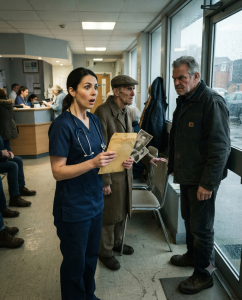
Every Monday at 8:10 in the morning, before the first rush of appointments and blood pressure checks and school physicals and anxious walk-ins, the same man entered Dr. Leah Benton’s clinic and sat down in the far-left chair of the waiting room.
He never checked in.
He never asked to see a doctor.
He never so much as unfolded a magazine.
He just sat there in a worn brown coat, holding an old black-and-white photograph in both hands, his eyes fixed on the hallway that led to exam room three.
Leah’s room.
The first time, nobody thought much of it. Maple Hollow was small, but not so small that odd things never happened. Older patients mixed up addresses. Ride services dropped people off at the wrong building. People forgot appointment dates and became offended when reality disagreed with them.
The receptionist, Dana, offered to help.
The man smiled, gentle as rain on old wood, and said, “Not today.”
Twenty-two minutes later, he stood, tucked the photograph into his coat, thanked no one and bothered no one, and left.
The next Monday, he came back.
Same time.
Same coat.
Same photograph.
Same seat.
By the fourth week, the clinic staff had started referring to him as The Monday Man.
“He’s either deeply romantic,” Carmen said while restocking tongue depressors, “or the opening scene of a documentary none of us want to be in.”
Leah rolled her eyes, but she noticed him too.
She noticed everything for a living.
He was around seventy-five. Lean, but not frail. The kind of lean that came from decades of lifting, fixing, hauling, enduring. His hands were scarred lightly across the knuckles and moved with care, as though he had once worked with tools sharp enough to punish a distracted mind. His face was lined but controlled. He did not appear confused. He appeared deliberate.
And what unsettled Leah wasn’t his silence.
It was where he looked.
Always down the hallway.
Always at exam room three.
Her room.
By the eighth Monday, curiosity outweighed politeness. Leah timed her entrance to reception for 8:11 and walked in carrying her coffee as though this were a coincidence.
The man looked up immediately.
He started to rise, then settled back down. The movement had the feeling of an aborted impulse, like someone standing for a funeral they had no right to attend.
“Can I help you, sir?” Leah asked.
He studied her face with an intensity so focused it made her skin tighten. Not flirtation. Not confusion. Recognition under pressure.
“No,” he said softly. “Not yet.”
The words stayed with her all day.
Not yet.
That suggested purpose. A timeline. A reason for waiting.
The next Monday, she asked Dana whether he had ever given his name.
“He did once,” Dana said. “Walter Cain.”
The name meant nothing to Leah.
At least, not then.
By Monday eleven, the weather had turned mean. Sleet streaked the front windows, and half the morning patients arrived late and damp. Walter came in carrying the same photograph and a paper bag from Mercer’s Bakery across the street.
“For the staff,” he told Dana. “Seems impolite to haunt a place without contributing.”
Inside were cinnamon rolls, warm enough that steam still softened the wax paper.
Carmen laughed when she saw them. “Well, that’s manipulative.”
But she ate one anyway.
So did Dana.
Even Leah, who was trying to keep a professional distance from this strange ritual, found herself wondering what kind of man brought pastries to a place he was quietly haunting.
On the twelfth Monday, she stopped waiting for answers to arrive by accident.
She came in early, poured herself coffee, then walked into the waiting room before her first patient and sat down across from Walter Cain.
Up close, he looked worse than before. Not ill, exactly. More like someone being chased by a deadline only he could hear.
“I have six minutes before I have to become competent and useful,” Leah said. “So if you’ve spent three months waiting to tell me something strange, now feels like the moment.”
Walter smiled faintly, but it didn’t reach his eyes.
Then he handed her the photograph.
Leah took it.
At first, it looked harmless. A summer porch. White railings. Screen door. Deep shadow behind a woman in a housedress. A little girl on the steps, grinning with one front tooth missing, her knees scabbed, her hair unevenly cut by loving but impatient hands.
Then Leah stopped breathing.
She knew that porch.
The crooked third step.
The fishhook wind chime.
The little crack in the railing post her grandmother used to complain about every spring and never fix.
Dry Creek.
Her grandmother’s house.
It had been torn down after a flood decades earlier, but memory hit with perfect violence. Leah didn’t consciously identify the faces at first. She felt them before she named them.
The woman was her grandmother.
The child was her.
She looked up slowly. “This was in my mother’s album.”
Walter held her gaze. “I know.”
“How do you know?”
“I took it.”
Her fingers tightened on the worn edge of the photo. In the lower right corner, almost rubbed away with time, was a date scrawled in white grease pencil.
June 14, 1987.
Leah’s stomach dropped.
The day before her mother disappeared for six hours and came home with a split lip and a lie.
She had been six years old then. Old enough to know her mother’s smile looked wrong that night. Old enough to hear cupboards closing too hard in her grandmother’s kitchen. Old enough to sense that adults were speaking around something instead of about it.
But nobody ever told her the truth.
Her mother, Ellen, had said she slipped by the creek.
Her grandmother had gone still in that dangerous way that meant fury, fear, or both.
And after that, a silence had settled over the family like dust over furniture in a locked room.
Leah looked back at Walter.
He had gone pale, but not fearful. Resolved.
Then he reached into his coat and removed a second photograph. He kept it face down for a moment, his thumb pressed over the back as if delay might still save someone.
When he turned it over, Leah saw her mother standing beside an old pickup truck.
Beside her stood a man whose face had been scratched out so violently the image had nearly torn through.
“Who did that?” Leah asked.
“Your mother,” Walter said.
The clinic around them faded. Dana’s keyboard clicks, the low buzz of the reception phone, the heater coughing against the cold—everything receded until only Walter’s voice seemed real.
“Why do you have these?” Leah asked.
“Because I was there.”
“There where?”
“At Dry Creek. That day.”
Her mouth went dry. “You knew my mother?”
Walter exhaled through his nose, a sound full of old self-reproach. “I knew what she was trying to do.”
“That’s not an answer.”
“No,” he said quietly. “It’s the beginning of one.”
Leah’s instincts split in two. The doctor in her wanted order, timeline, coherence. The daughter in her wanted the bluntest possible truth, immediately, even if it cut.
“What was she trying to do?”
Walter looked toward the hallway as if making sure no one else could hear. “Protect someone.”
“Who?”
He didn’t answer.
Carmen pushed open the hall door then, peered out, and said, “Leah? Your 8:30 is here.”
“Five minutes,” Leah said without looking away.
Carmen glanced between her and Walter, read the atmosphere instantly, and nodded before withdrawing.
Leah lowered her voice. “You have been sitting in my waiting room every Monday for twelve weeks. You brought me photographs of my own childhood and a picture of my mother next to a man she tried to erase. You do not get to speak in riddles.”
Walter nodded once. “Fair.”
“Then talk.”
His hands trembled, just once. “I’m dying.”
The bluntness of it startled her.
“Cancer,” he said. “Already farther along than they can do much about. I had time enough to think. Not enough to keep postponing this.”
Leah stared at him.
He looked down. “Your mother made me promise I would never come near you unless one of two things happened.”
Something cold passed through Leah. “What two things?”
“If she died before telling you herself,” Walter said, “or if he came back.”
Leah’s mother had died two years earlier of a stroke.
Walter had not come then.
Which meant there was only one reason he was here now.
“Who came back?” Leah asked.
Walter’s eyes flicked to the clinic windows. “I saw his truck outside Mercer’s Grocery on Thursday.”
Leah frowned. “After all these years, how could you know?”
“Because some men don’t change the things they think belong to them,” Walter said. “Same dented fender. Same custom rack welded onto the back. Same habit of parking where he can see the door.”
A memory she didn’t know she had stirred in Leah—her mother once gripping a grocery cart so tightly her knuckles turned white while a rusted pickup idled near the curb. Leah had been maybe ten. Her mother had told her to keep walking and not look.
Leah swallowed.
Walter reached into his inner coat pocket and drew out a sealed envelope, yellowed at the corners, softened by years of being handled and hidden.
“She left this with me in 1987,” he said. “Said if I ever broke my word, I had to give it to you unopened.”
Leah took it slowly.
The handwriting on the front was unmistakable.
For Leah. Only if Walter fails.
Her eyes burned.
“You kept this all these years?”
Walter nodded. “I almost brought it to your mother a hundred times. She wouldn’t take it back. Said either she’d tell you herself one day, or fate would choose.”
“Why would she trust you with this?”
Walter looked at the scratched-out face in the second photograph. “Because I was the reason she got into that truck.”
Leah looked up sharply.
He met her gaze without flinching. “And because I was the reason she got back out.”
Before she could demand an explanation, the front door opened.
Cold air swept in.
A broad man in a dark work jacket stepped inside, stamping rain from his boots. He was late sixties, thick through the shoulders, with a square jaw and a face that seemed permanently arranged against apology. His eyes swept the room lazily—then locked on Walter.
Everything in Walter changed.
Leah had spent years reading bodies for signs of collapse, pain, panic. She had never seen a person become certain so quickly.
Walter stood.
The man stared at him, then at Leah, then at the envelope in her hand.
And in a voice roughened by age but sharpened by ownership, he said, “Ellen.”
Leah felt nausea rise in one fast wave.
“Who is that?” she whispered.
Walter answered without taking his eyes off the man. “Harold Voss.”
The name meant nothing to her consciously. But something in Walter’s tone made it feel like a name her whole family had been arranging furniture around for decades.
Harold took a step toward them. “You should’ve stayed gone, Cain.”
Walter said, “You should’ve stayed buried.”
Dana had stopped typing. Carmen stood half-visible in the hall, caught between alarm and disbelief.
Harold’s gaze shifted to the envelope again. “That belongs to me.”
“It never did,” Walter said.
Leah found her voice. “Say what this is.”
No one answered quickly enough.
Then Harold turned to her, and to Leah’s astonishment he softened his tone. “Doctor Benton. Whatever story he’s giving you, remember this man was always in love with your mother. He’d say anything now.”
Walter’s laugh was brief and terrible. “Still lying with your whole chest, Harold?”
Leah looked from one to the other. “Someone start at the beginning.”
Harold spread his hands as though he were the reasonable party in the room. “Your mother got herself mixed up in family trouble that wasn’t hers. Walter made it worse. That’s all.”
Walter’s face hardened with a contempt that looked decades old. “She was your sister-in-law.”
Harold’s expression shifted a fraction too late.
Leah turned sharply. “What?”
Walter looked at her. “Your father’s older brother.”
The words detonated in silence.
Leah’s father had died when she was twelve. Quiet man. Mechanic. Kind eyes. He had never once mentioned a brother.
“He told everyone Harold left the state after a land dispute,” Walter said. “That was the official story. Easier than the truth.”
Harold’s jaw flexed. “You don’t know what he told. You were a hired hand with ideas above your station.”
Walter took one step forward. “I know what I watched.”
And then, because the room had become unbearable, because the envelope in her hand felt like it might burn through her skin if she waited one second longer, Leah tore it open.
Inside was a single folded sheet.
Her mother’s handwriting shook slightly across the page, but it was hers.
Leah began to read.
I never told you what happened that day because the wrong man wore kindness better than the guilty one ever could.
Her breath caught.
The next lines came harder.
Your Uncle Harold hurt women in small ways first, so no one called it violence. He cornered. He threatened. He borrowed fear and returned shame. When I found out what he had done to Marcy Tate behind the feed store, I said I’d tell your father. Walter heard me. He said he had proof Harold was stealing from the family land account too. I believed if we confronted him together, your father would finally see him clearly.
Leah’s hand trembled.
She read on.
Harold asked me to meet him at Dry Creek and said he’d confess if I came alone. I was stupid enough to think men feared exposure more than they feared being monstrous. Walter followed in his own truck because he didn’t trust Harold. That is the only reason I came home at all.
Leah looked up.
Harold had stopped pretending calm.
Walter stood very still, as if movement would only dilute the truth.
She kept reading.
He struck me before I got my second sentence out. He said no one would believe me over him. He said your father needed his brother and would call me hysterical before he called Harold cruel. He would have done worse if Walter had not pulled him off me.
Leah’s vision blurred.
Carmen moved closer. Dana put a hand over her mouth.
The letter continued.
Walter wanted to go to the sheriff. I wanted that too for about ten minutes. Then Harold said if I talked, he would drag your father down with him over the missing money and swear your father knew. Your father was weak where Harold was concerned. He had spent his life cleaning up behind him. I believed Harold could ruin all of us and still walk free.
So I made the coward’s choice and the mother’s choice, which are sometimes the same.
I scratched Harold out of the photograph because it was the only part of him I could destroy.
Leah stopped there, pressed her lips together, and forced herself to continue.
If you are reading this, one of two things happened. I died before I became braver, or Harold returned because men like him mistake time for forgiveness. If that day comes, do not let him tell you Walter was the danger. Walter was the witness. That is why Harold always hated him more than he hated me.
The final lines were shorter.
Your father knew some of it by the end, and the shame of not seeing sooner broke something in him that never healed. I told him to keep Harold dead to this family. He did.
If Harold ever comes back, choose daylight. Choose records. Choose names spoken plainly. Silence is the only place men like him survive.
Love you always,
Mom
No one moved.
Harold was the first to speak.
“She was dramatic,” he said. “Always was. You think a letter proves anything?”
Leah looked at him over the page. For the first time since he entered, she saw it clearly—not just menace, but the oily confidence of a man who had survived by making everyone else doubt their own instincts.
“You said family trouble,” she said. Her voice sounded strange to her own ears. Too calm. “You said she mixed herself into something that wasn’t hers.”
Harold shrugged. “People write all sorts of things when they’re angry.”
Walter spoke then, each word heavy and exact. “There’s more than the letter.”
Harold’s head snapped toward him.
Walter reached slowly into his coat. Leah tensed, but he pulled out not a weapon, only a folded copy of a bank ledger page inside a clear sleeve, the paper brittle with age.
“Your mother didn’t know I kept a copy,” he said. “The original went to your father. He burned it after he sent Harold away. But I kept this.”
Leah took it.
Numbers. Dates. Withdrawals. Transfers.
And beside two suspicious entries from the summer of 1987 was Harold Voss’s signature.
“My father saw this?” Leah asked.
Walter nodded. “The night after Dry Creek. He confronted Harold with it. Not the assault. He couldn’t make himself say that part aloud. But the money, yes. Harold panicked. Your father gave him till sunrise to disappear.”
Harold barked a laugh that cracked at the edges. “You’re all spinning fairy tales.”
“Then why did you leave town for thirty-eight years?” Leah asked.
He opened his mouth.
Nothing came out.
That silence convicted him more than any defense could have saved.
Carmen quietly stepped to the desk and picked up the phone. “Sheriff’s office,” she said into the receiver when someone answered, her eyes never leaving Harold.
Harold turned toward the door, calculating.
Walter spoke without raising his voice. “Run now and you prove every word.”
Harold looked at Leah one last time. “Your mother lied because she was ashamed.”
Leah folded the letter with shaking precision. “No,” she said. “My mother stayed silent because she thought survival required it. That shame belongs to you. And to every person who made silence look safer than truth.”
Something in Harold’s face collapsed then. Not remorse. Just the failure of control.
He took two backward steps, then stopped as the clinic’s outer parking lot filled with the wash of a patrol car’s lights against the rain.
The sheriff who entered was younger than Leah by at least ten years, but he knew her, knew the clinic, knew Maple Hollow’s habit of keeping histories buried until they turned toxic. He listened. He took the letter. He took the ledger copy. He took names.
Harold did not go quietly, but he went.
Afterward, the waiting room looked absurdly normal.
The magazines were still stacked.
The cinnamon-roll box from the week before still sat folded in the break room trash.
Dana had tears in her eyes for reasons she probably couldn’t have fully explained.
Carmen kept cursing softly under her breath as if profanity might disinfect old evil.
Leah sat down hard in the chair Walter had occupied every Monday for twelve weeks.
Walter lowered himself into the chair across from her, exhausted now that the emergency he had been carrying was finally outside his body.
“Why didn’t you tell me sooner?” she asked.
He looked down at his hands. “Because your mother asked me not to break her life open unless I had to. And because I was a coward too, in my own way. I told myself I was honoring her. Some of it was that. Some of it was not wanting to relive what I failed to stop before it started.”
“You saved her.”
“I arrived late,” he said. “That matters to me.”
Leah thought of all the patients she had ever told that survival still counted, that delayed rescue was still rescue, that guilt had a way of rewriting timelines into weapons.
“You came,” she said.
Walter’s eyes shone. “Yeah.”
She looked at him then, really looked. At the months he had spent trying to decide whether to break a promise to protect another one. At the exhaustion. At the decency. At the damage of carrying a dead woman’s last instructions in his pocket while death itself approached from his own blood.
“My mother loved you,” Leah said quietly.
Walter blinked, startled by the directness of it.
He smiled then, not with hope, not with possession, but with the ache of a thing long accepted. “Not the way stories like to tell it,” he said. “But yes. We mattered to each other.”
Leah nodded. That felt true. Some bonds never become romance, yet shape entire lives anyway.
In the weeks that followed, old records surfaced. Marcy Tate, now living in another county, gave a statement. The sheriff reopened threads no one had touched in decades. Harold Voss, confronted at last by paper, testimony, and a town no longer willing to play dumb in the name of family reputation, lost the swagger that had protected him longer than justice ever should have allowed.
Leah learned more about her parents than she had expected to survive knowing.
Her father had known enough to exile Harold and not enough to forgive himself for learning too late.
Her mother had chosen silence not because she was weak, but because she was cornered between truth and destruction and believed she was the only one who would pay either way.
And Walter had spent nearly forty years keeping watch from a distance, honoring a promise until the cost of silence became greater than the cost of breaking it.
He stopped by the clinic after that, but no longer only on Mondays.
Sometimes he came with bakery bags.
Sometimes with old stories about Dry Creek before the flood.
Sometimes just to sit for ten minutes and ask Leah whether she was eating enough for someone with her schedule.
He died the following spring.
Leah attended the funeral.
In his effects, left to her in a small box, was the first photograph—the porch picture—carefully flattened, preserved behind clean glass. On the back, in handwriting she now recognized as his, he had written:
The last day before everything changed. Also proof there was joy before it.
Leah placed it in her office, not where patients could easily inspect it, but where she could see it from her desk if she turned just slightly.
Not as a shrine to grief.
As a warning against silence.
As a memorial to witness.
As evidence that truth delayed is still truth when it finally arrives.
Sometimes she still thought about the line in her mother’s letter: the wrong man wore kindness better than the guilty one ever could.
That was the part that stayed under her skin.
Because it wasn’t only about Harold. It was about how families fail to read danger when it arrives in familiar clothes. How often the loudest red flag isn’t rage, but charm. How often the person carrying the truth looks less polished, less convenient, more burdened—and therefore easier to mistrust.
Leah had spent twelve Mondays watching a man wait in her clinic with a photograph in his hands.
She had thought he was a mystery.
In the end, he was something rarer.
He was a witness who came back before it was too late.
And if there was any aftershock left after all the revelations were spoken, it lived in one question Leah was never sure she could answer cleanly:
Who had done the deepest damage—Harold, who caused the harm, or everyone who helped silence feel like the only survivable choice?