Rena took the housekeeping job because it came with a room.
That was the truth underneath every other truth.
The motel itself was tired in the way cheap roadside places always are — sun-faded exterior, humming vacancy sign, carpets that never fully lost the smell of bleach and old cigarettes no matter how often they were cleaned. But the owner had offered something Rena couldn’t afford to turn down: a summer position, bad hours, barely decent pay, and one tiny upstairs room where she and her four-year-old daughter could stay until the end of August.
No lease.
No deposit.
No choosing between groceries and rent for at least two months.
That was enough to make it feel almost merciful.
At thirty, Rena had become practical in the way people do when life keeps removing all the sentimental options. She had two duffel bags, a daughter who still needed bedtime stories and apple slices cut into moons, and the kind of bank balance that made every errand feel like a negotiation with disaster. Ivy, thankfully, had no sense of the math. She thought staying at the motel was exciting. She thought eating cereal from paper cups on the bed was fun. She thought the highway lights outside their window looked magical.
Children can make poverty look like a game if they are still loved enough.
Ivy also carried a snow globe everywhere.
It was small and old, the glass a little clouded, the water no longer clear. Inside was a white church with a steeple that leaned ever so slightly when you looked closely. The glitter had clumped with age, so when shaken, it didn’t fall elegantly. It slid. The base had one chip along the rim. Rena had found it months earlier on a free shelf outside a consignment store and handed it to Ivy mostly to stop her from crying over a stuffed rabbit missing one ear. Ivy had loved the snow globe instantly. She called it “the shaking church” and slept with it on the nightstand like a treasure.
Rena had never imagined it belonged to anyone.
Then came the laundry room.
It was just after eight in the evening. Rena was sorting towels from sheets while Ivy sat nearby on an overturned detergent bucket, her small legs swinging, the globe tucked in her lap. The dryers thundered behind them. A vending machine buzzed in the corner. The air smelled like soap and hot fabric and metal.
Martin, the night manager, stepped into the doorway with a clipboard under one arm.
Rena knew him only in the practical, motel way. He handled late check-ins, complaints about televisions, broken ice machines, strange plumbing noises, and the occasional drunk guest who forgot where he was sleeping. He was polite but reserved, a man who seemed to have built a life around staying functional instead of comfortable. He wore his sleeves rolled to the forearms and kept touching the bare ring finger on his left hand as though habit had survived after the ring itself disappeared.
He saw the snow globe and stopped moving.
Not hesitating.
Not glancing.
Stopping.
His eyes fixed on it with a look Rena felt before she understood. Something in her body tightened at once. Martin stepped forward once, then seemed to catch himself.
“Where did you get that?” he asked.
Rena straightened. “Why?”
His gaze didn’t leave the globe.
“That snow globe was in my wife’s hospital room,” he said quietly. “The night our daughter died.”
The sentence changed the room.
The dryers still ran. Somewhere overhead, a toilet flushed. Outside, a car door slammed. But for Rena, all sound turned thin and distant.
Ivy hugged the globe closer. “It’s mine.”
Martin’s face softened and broke in the same second. “I know, sweetheart,” he said. “But it used to be hers too.”
Rena knew better than to trust dramatic coincidences. She had met enough manipulative people to be suspicious of grief performed too neatly. But Martin’s reaction had no neatness in it. It wasn’t the practiced sadness of someone fishing for sympathy. It was too immediate, too involuntary. He looked ambushed.
“What was your daughter’s name?” Rena asked.
“Beth.”
Then Ivy said, in the mild voice children use when mentioning something obvious, “She said the nurse was crying harder than you.”
Martin went white.
Rena turned to her daughter so fast she nearly knocked over the detergent bucket. “Who said that?”
“The baby girl,” Ivy answered, as if that settled everything. “At bedtime.”
A different kind of fear entered the room then.
Rena was not a superstitious woman. She was too busy surviving to indulge in theatrics. But she knew when something had moved beyond chance. Martin looked as though the floor under him had vanished.
“My wife bought that globe from the chapel gift cart,” he said, staring at the chip in the base. “She dropped it against the bedrail. It chipped right there.”
The chip was exactly where he pointed.
Ivy held the globe against her chest. “She said Mommy can keep it if you open the envelope.”
Martin made a sound like a breath trying and failing to become speech.
There was, apparently, an envelope.
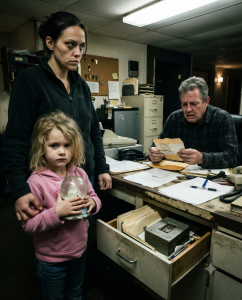
He led them to the office at the end of the hall. The room was cramped, cluttered, and too brightly lit. A faded map of local attractions hung crooked on the wall. There was a coffee maker that looked older than Rena, a mini fridge humming under the counter, and a gray filing cabinet behind the desk.
Martin stood before the cabinet for a long moment before unlocking the bottom drawer with a brass key he kept in his shirt pocket.
“When my wife left the hospital,” he said without looking at them, “she gave the nurses an envelope. Told them not to send it unless I asked.”
“Did you ask?” Rena said.
A bitter laugh escaped him. “No.”
“Why not?”
He finally looked up. Grief had aged him in a way time alone never could.
“Because I blamed her,” he said. “And blaming her was easier than reading what she wanted to say.”
The honesty of it stunned Rena into silence.
Martin pulled the envelope from beneath old receipts and motel invoices. His name was written across the front in a woman’s slanted handwriting. On the back, in smaller letters, was a message he clearly hadn’t seen before because the moment he turned the envelope, he froze.
Not your fault.
His mouth trembled.
Then Ivy said, “Don’t read the outside first. She said that’s cheating.”
Martin stared at her, then turned the envelope over again and broke the seal.
Inside were several sheets of folded paper.
He sat down heavily in the office chair and began to read.
At first, his expression held only dread. Then confusion joined it. Then a dawning horror so complete that Rena took a step closer without realizing she’d moved.
“What is it?” she asked.
Martin didn’t answer.
He read the second page, then the third. By the time he reached the bottom, tears had started slipping down his face, and still he kept reading like a man who understood too late that the thing he had avoided had been the only thing that might have saved him.
Finally, he whispered, “Daniel.”
The name meant nothing to Rena, but the way he said it made it clear the name meant everything to him.
“Who’s Daniel?” she asked.
Martin rubbed a hand over his mouth. “The doctor.” His voice shook. “The one I blamed.”
He looked back at the pages.
“My wife wrote that Beth was already gone before the delivery team could stop it. She wrote that Daniel tried to explain that over and over.” His eyes closed for one hard second. “She wrote that I wouldn’t hear him.”
Rena thought that was the revelation. The buried guilt. The years wasted hating the wrong person.
It wasn’t.
Because attached to the last page by a rusting paper clip was a tiny folded note and a faded hospital bracelet.
Martin unfolded the note with fingers that no longer seemed to belong to him.
He read it once. Then again.
His whole body seemed to go rigid from the inside.
“What?” Rena said.
He looked up, stunned. “Daniel wasn’t just the doctor.”
Rena waited.
“He was my brother.”
The office fell silent.
Martin stared at the note as if it had just reached up and struck him.
In a rush, details began to take shape. A brother he had once known well enough to destroy. A doctor present for the worst night of his life. A wife caught between them. A death no one could fix. Shame calcifying into blame. Blame hardening into exile.
“My brother and I weren’t close at the end,” Martin said, speaking more to the room than to them. “We’d been fighting for years. About our father. About money. About everything people keep pretending isn’t permanent until it becomes exactly that.” He laughed once, but there was nothing amused in it. “And then Beth died on his shift.”
Rena understood now. The scapegoat had come preselected.
“I told people he mishandled the case,” Martin said. “I said he froze. I said if someone else had been there, she might have lived.”
Rena felt sick.
“My wife wrote that Daniel kept trying to save Beth while I was screaming at him.” Martin’s hands tightened around the note. “She wrote that after they told us there was no heartbeat, he stayed anyway because he was my brother first and a doctor second.”
Ivy had gone very quiet. She stood leaning against Rena’s leg, listening with solemn eyes.
“What’s in the note?” Rena asked gently.
Martin looked at the small page.
“It’s from Daniel,” he said. “She must have asked him to write it.”
He swallowed hard and read aloud.
Martin, I know you need someone to survive this by blaming, and I know it will be me. I can live with that if you need me to. But Beth was gone before we had a chance. I need you to know your wife did nothing wrong. She loved that little girl before either of us got to hold her. Don’t make her carry your pain too.
Rena closed her eyes for a second.
The cruelty of it was almost unbearable — not the note itself, but the years stacked on top of it. Years in which Martin had apparently done the exact opposite.
“Where is your wife now?” Rena asked quietly.
Martin stared at the papers. “She died three years later.”
That landed differently.
Not fresh grief.
Compounded grief.
“She got sick,” he said. “Fast. Aggressive ovarian cancer. By then we were still married, but…” He stopped and looked away. “We weren’t kind to each other anymore.”
Rena thought of the envelope hidden in a file cabinet for years, waiting for permission from the very man who could not bear to open it.
“What happened with your brother?” she asked.
Martin gave a broken, humorless smile. “I buried him before I buried my pride.”
Rena felt her stomach drop.
“Daniel died two years ago,” Martin said. “Heart attack.”
No reconciliation, then. No scene of brothers finally crying in a hallway. No dramatic forgiveness. Just a closed door and time doing what time does best when people assume it will wait.
Martin bent over the letter as if the weight of it had become physical.
“I ruined his name in this town,” he whispered. “People believed me because I was the grieving father and he was the doctor in the room. He transferred out. We never spoke again.”
His voice cracked on the last word.
The motel office hummed around them, small and ordinary and suddenly too small to hold what had just surfaced.
Rena had no script for this. She was a housekeeper living in a summer room with a child who somehow repeated dead women’s unfinished instructions. Yet the truth in front of her was simple enough. A woman had died after trying to leave one last correction behind. A man had spent years chained to the wrong story because he needed rage more than reality. And a child with a secondhand snow globe had somehow dragged the truth back into reach.
“What else did she write?” Rena asked.
Martin looked down at the pages again.
“She wrote that she kept the globe because Beth never got a nursery, never got a crib, never got anything but one room and one night. She wrote that the church inside it made her think of holding something small and holy even if she didn’t understand why this happened.” He touched the chipped base with one shaking finger. “She wrote that if this ever reached me, I had to stop punishing the living for not defeating death.”
That sentence seemed to drain the rest of him.
Rena glanced at Ivy. “Did she say anything else to you?”
Ivy considered the question with deep seriousness. “She said he has to call the lady with the blue porch.”
Martin looked up sharply.
“The lady with the blue porch,” he repeated.
Rena saw the recognition immediately.
“My mother,” he said.
He looked almost frightened by the possibility of one more instruction.
“She lives in a blue house,” he said. “Blue porch too. Daniel was living with her before he died.”
Rena didn’t ask how long it had been since he called. She already knew the answer from his face.
Martin picked up the motel phone, then put it down. Picked it up again. His hand trembled on the receiver.
When his mother answered, his first attempt at speech failed completely.
“Mom,” he managed on the second try.
Rena turned away, giving him what little privacy the office allowed.
She heard only fragments.
I found the letter.
I know.
No, I didn’t open it until now.
I know.
About Daniel… I know.
Then silence. Long silence. The kind built of everything that should have been said years earlier.
When Martin finally spoke again, his voice had changed.
“I’m sorry,” he said.
Three words. Small. Late. Still necessary.
He listened. Closed his eyes. Let his shoulders shake once before forcing them still.
After he hung up, he sat there staring at nothing for a few seconds. Then he looked at Ivy.
“How did you know?” he asked.
Ivy looked down at the snow globe. “She was sad you made everybody lonely.”
No one in the room had an answer for that.
Martin laughed once through tears. “That sounds like her.”
He stood, walked to the tiny sink in the office, splashed water on his face, and came back looking older but somehow less haunted than before. Not healed. Nothing so easy. But cracked open in the right direction.
“What happens now?” Rena asked.
Martin looked at the letter again, then at the snow globe.
“Now I tell the truth,” he said.
And he did.
Over the next weeks, Rena watched the fallout ripple through the motel and far beyond it. Martin called the hospital administration and retracted everything he had ever formally said against his brother. He contacted people in town he had spoken to in anger years before. He visited his mother. He spent an entire Sunday at Daniel’s grave with the letter in his jacket pocket and came back looking like a man who had finally allowed grief to become grief instead of a weapon.
He also did something else.
He insisted Rena and Ivy keep the room through September on the motel’s dime.
Rena tried to refuse at first, pride flaring on instinct. Martin shook his head.
“My wife wanted that globe to find its way where it was needed,” he said. “Looks like it did.”
The snow globe stayed with Ivy, though Martin asked once if he could hold it. He stood by the office window turning it carefully in his hands, watching the glitter slide across the church roof, and smiled in that painful way people smile when they’ve recovered something they can never keep.
When summer ended, Rena found a better apartment than she thought she could afford. Martin wrote the reference that got her a steadier job at a small assisted-living facility across town. On her last day at the motel, he handed her a sealed envelope.
Inside was a short note in careful handwriting.
For whatever I failed to hear in time, thank you for bringing it back.
There was also a check large enough to cover first month’s rent and a security deposit.
Rena cried in the car after that, quietly, so Ivy wouldn’t worry.
Months later, on a cold morning in November, she took Ivy to visit the cemetery where Beth and Daniel were buried not far from each other. Ivy set the snow globe between the graves for exactly ten seconds, as if showing it to both of them, then picked it back up and said, “Okay, we have it.”
Rena didn’t ask what that meant.
On the drive home, she thought about grief, blame, and the stories people choose because they are easier to survive than the truth. She thought about a dead mother who had tried to protect the living even while breaking. She thought about a brother who had carried punishment he did not deserve. She thought about how close some people come to spending their whole lives kneeling before the wrong wound.
And more than once, she wondered what the biggest red flag had been.
Not the tragedy itself.
Not even the silence after.
It was how easy it had become for pain to feel righteous once it found the right target.
That was the part that lingered.
That was the part that hurt.
Because forgiveness, when it finally arrived, hadn’t changed what was lost.
It had only revealed how much more had been lost by waiting.