The single mother only took her niece to the emergency tailor because the flower-girl dress tore less than an hour before the wedding, but the tailor saw the little girl’s ribbon and asked why she still had the one pinned in her own daughter’s hair the day she vanished from the reception hall.
At first, Nadia thought she had misheard her.
There were too many wedding-day noises still living in her head: hair dryers, laughing cousins, zippers tugging, someone yelling for safety pins, someone else yelling for champagne, her mother insisting every problem was “beautiful chaos” as long as it was happening to someone else. She had barely gotten Lily into the tailor shop before she started apologizing.
“We just need the side seam,” she had said, holding the pink tulle away from the rip. “It split when she sat down too fast. Or breathed too hard. Or looked at the dress wrong.”
The tailor had looked up with the expression of a woman fully prepared to refuse.
Then she saw the ribbon in Lily’s hair.
Everything changed.
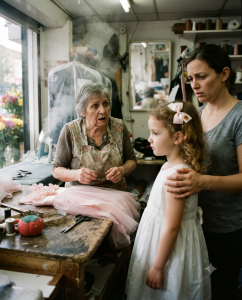
The tailor was small and wiry, with strong hands and a face that gave away nothing until that moment. Her eyes fixed on the pink satin bow clipped near Lily’s curls. Not the color. Not the shape. A tiny dark mark near the center. A burn.
“Where did she get that?” the woman asked.
The tone was wrong. Too sharp. Too shaken.
Nadia put a hand on Lily’s shoulder. “From a keepsake box. Old family stuff. Why?”
The woman’s lips parted, but it took her a second to get the words out.
“That ribbon,” she said, “was in my daughter’s hair the day she disappeared.”
Lily, who had no sense at all for the safe pacing of adult horror, reached up and touched it. “It’s pretty.”
The woman let out a breath that sounded almost painful. “She thought so too.”
Nadia tried to make it reasonable. “There must be dozens like it.”
The woman shook her head and pointed to the small singe near the center. “She leaned over a prayer candle at her cousin’s first communion and caught the edge. She cried because she thought I’d make her throw it away. I kept it.”
The shop seemed to narrow around them. Nadia noticed details she hadn’t registered before: the hum of an old ceiling fan, the hiss of a steam iron in the back room, the floral sweetness drifting in from the florist next door. Outside, wedding guests in pale colors crossed the street, carrying bouquets and schedules and insignificant disasters.
Inside, something far older had just opened.
Before Nadia could decide what to say next, Lily spoke.
“The girl said you never liked pink.”
The tailor went perfectly still.
Nadia turned to Lily. “What girl?”
Lily shrugged as if this entire conversation were inconveniently obvious. “The bride room girl.”
There was no bride room in the tailor shop. Just a cramped fitting alcove with a mirror, a curtain that didn’t close all the way, and a rolling rack of dresses waiting for rescue.
But the tailor understood immediately.
“My daughter disappeared from the reception hall dressing room,” she whispered.
That was when the torn dress stopped mattering.
Nadia looked from Lily to the tailor and felt the ordinary world sliding under her feet. “What was your daughter’s name?”
“Marina.”
Lily nodded. “She said she left because the music was too loud.”
The tailor’s hands began to tremble. “No one knew that.”
Nadia frowned. “Knew what?”
“That she hated the band. Everyone said she wandered off during the reception. But she’d been crying earlier because the speakers were too loud. I never told anyone that part.” Her voice caught. “I thought it made me sound careless.”
Lily said, “She said the note is still in the pin cushion.”
The tailor’s head snapped toward the worktable.
A tomato-shaped pin cushion sat near the sewing machine, faded with age and packed with pins. Nadia would never have noticed it except now it seemed to pulse at the center of the room.
“There was a note?” Nadia asked.
The tailor laughed once, but there was no humor in it. “After Marina disappeared, police found a scrap in her bedroom. I thought that was all. I thought maybe she’d tried to write something before…” She shook her head. “There was never anything else.”
“Not that note,” Lily said softly.
Children sometimes say things in ways that make adults project depth onto nonsense. Nadia knew that. She knew how exhausted little minds create stories, how weddings overstimulate them, how the pressure of adults can turn imagination into apparent certainty.
But then the tailor walked to the pin cushion, lifted it with both hands, and found the hidden seam.
The note inside was folded into something no bigger than a thumb joint.
Old paper. Child handwriting.
Don’t let him take me home. He said don’t tell because it will ruin the wedding. He said wait in the sewing room.
The room went so quiet Nadia could hear traffic outside.
The tailor read it three times. By the third, she was no longer reading like a grieving mother hoping. She was reading like a witness who had just been told the official story of her life was wrong.
“Who is him?” Nadia asked.
The tailor pressed the note to the table to steady her hands. “There was a family friend that day. One of the groomsmen’s uncles. He was around all afternoon, helping with parking, carrying boxes, checking the side corridors. Everyone trusted him.”
“What was his name?”
“Victor Hale.”
The name meant nothing to Nadia, but the tailor’s expression made it feel poisonous.
“He said he saw Marina near the back corridor,” the woman continued. “He said she must have slipped outside while people were dancing. Police spoke to him once. He was calm. Helpful. Respectable.” Her mouth hardened around the last word. “The kind of man people believe because he never looks flustered.”
Lily stared at the mirror in the fitting alcove. “She says he wasn’t helping.”
The tailor closed her eyes briefly.
Nadia crouched to meet Lily’s gaze. “Sweetheart, who’s telling you this?”
“The girl.” Lily pointed to the mirror. “She was there when I fixed my shoe. She said her mama still works with needles and would know how to find the paper.”
Nadia looked at the mirror. It reflected the narrow shop, hanging dresses, and her own uneasy face. Nothing else.
She did not believe in ghosts.
But she did believe in the note now resting on the worktable.
And that changed the math on everything.
The tailor introduced herself then, like they had somehow skipped the ordinary order of human contact. “My name is Elena.”
“Nadia.”
Elena nodded once. “I know how this sounds.”
Nadia surprised herself by saying, “I don’t think either of us has time to worry about that.”
Her phone buzzed in her purse. Her brother. Then her mother. Then the bride’s group chat. She ignored all of them.
Elena sat down slowly on the stool by the machine, staring at the note. “They told me Marina probably got lost, got scared, wandered into the parking lot, maybe climbed into a stranger’s car. Every version required her to make a choice that didn’t sound like her, but when enough officials repeat something long enough, it starts to feel arrogant to question them.”
Nadia leaned against the counter. “Did anyone ever search the sewing room?”
“This isn’t the original shop,” Elena said. “Back then I worked in a prep room attached to the old reception hall. Temporary alterations, emergency hems, bridesmaid disasters. After Marina vanished, I couldn’t bear to stay. I took what tools I could and opened here.” She looked at the pin cushion. “I must have packed it without ever checking.”
The note changed what the disappearance meant, but not where Marina had gone. They still lacked the part that mattered most.
Then Lily whispered, “She says he came back.”
Elena stood. “Back where?”
Lily’s face tightened with concentration, as if she were listening to someone far away. “After everyone went outside with sparklers. He came back to the sewing room and told her her mama was crying and she had to stay hidden a little longer.”
Elena put a hand over her mouth.
Nadia asked quietly, “Did the reception have a sparkler send-off?”
Elena nodded. “Yes. Early evening. Everyone went outside for photos.”
“Then there was a window,” Nadia said. “A gap where the room was less watched.”
Lily continued, still staring at the mirror. “She says someone else saw. A man with flowers in his pocket. He kept saying it wasn’t his business.”
Nadia looked toward the front window, past which sat the florist display next door.
Elena turned too. “The old hall shared a service corridor with the florist loading area. There was an assistant back then. Young man. Thin. Always smelled like wet stems.” Her breathing sharpened. “He moved away not long after.”
The possible shape of the past widened in front of them. A trusted man. A hidden child. Another witness who chose silence. A mother left with guesswork for years because the truth was too inconvenient for a wedding.
Nadia’s phone rang again. She answered without looking.
“Where are you?” her brother demanded. “The ceremony starts in twenty minutes.”
Nadia looked at Lily, then at Elena, then at the note.
“We’re delayed,” she said.
“Delayed? Mom says you’re at some tailor shop having a breakdown over stitching.”
“It’s not about stitching.”
“Then what is it about?”
Nadia paused. “Something more important than the wedding.”
He started to protest, but she ended the call.
For a moment, no one moved.
Then Elena said, “I’m calling the police.”
Nadia nodded. “And I think we should walk next door first.”
The florist, a heavyset man in his forties with tired eyes and green smudges on his sleeves, looked up when they entered. His expression shifted uneasily when he saw Elena.
“Can I help you?” he asked.
Elena did not waste words. “Did you work at the Bellehaven Reception Hall eighteen years ago?”
His face lost color. Not all at once. Enough.
“I worked a lot of venues,” he said.
“Did you see my daughter with Victor Hale?”
He stared at her, then at the child beside Nadia, then at the ribbon in Lily’s hair.
That was answer enough.
He backed into the edge of a refrigerator case. “I didn’t know what I was seeing.”
Elena took one step forward. “Then tell me now.”
The florist’s name was Owen. He talked the way people do when they have been silent too long and every sentence has to break through years of self-justification first.
He said he had gone into the service corridor for more ribbon and floral wire. He heard crying in the sewing room. He saw Marina inside with Victor, who was crouched beside her, speaking low and urgently. Marina looked terrified. Owen asked if everything was all right.
Victor smiled and said the girl was overtired, embarrassed, refusing to come back out because she had wet the hem of her dress. Marina started to say something, but Victor cut across her, joking that children would rather die than admit an accident in front of fifty relatives.
Owen had laughed awkwardly.
“It sounded possible,” he said, already hating himself. “I didn’t want to challenge him in front of her.”
“Did she ask for help?” Elena’s voice was so controlled it frightened Nadia.
Owen’s eyes filled. “She looked at me. That’s what I remember. Not words. Just the way she looked.”
He had gone back to work. Told himself it was family business. Told himself respectable men didn’t abduct children from reception halls. Told himself if there was a problem, someone else would step in.
Later, during the sparkler send-off, he saw Victor lead Marina through the rear loading area wearing a cardigan over her dress. Her ribbon was gone. Victor told Owen he was taking her to Elena because she’d gotten sick from the noise.
“I knew by then something was wrong,” Owen said. “I knew. But the bride was outside, people were calling my name, and Victor looked straight at me like he knew I wouldn’t make a scene.” Owen broke then, openly. “I was twenty-three. Cowardly. Stupid. I let him walk out.”
Elena went pale but did not collapse. Nadia had never seen grief turn so completely into purpose. “Why didn’t you come forward after?”
Owen wiped at his face with the back of his hand. “By the time I heard she was missing, Victor had already told people she must have wandered. I imagined saying I saw them and everyone asking why I hadn’t stopped him. Why I waited. I kept thinking I’d go to police the next day, then the next. Then it was months, and I told myself it was too late.” His voice cracked. “But it was never too late for you. Only easier for me.”
Elena called the police from the florist counter while Owen sat there shaking.
Victor Hale was seventy-two now and still lived one town over.
Police moved fast once they heard about the note and the witness statement. They moved even faster when Owen remembered one more detail: Victor had been obsessed with the old maintenance cottages behind a shuttered church camp where his brother once worked.
By nightfall, officers were searching the property.
Nadia never did return Lily to the wedding on time. Her family reacted exactly how families do when their perfect event is interrupted by the reality that the world contains bigger things. There were offended texts, confused calls, accusations of dramatics. Nadia ignored all of them until much later. Some silences deserve to be chosen.
Lily, for her part, remained eerily calm. She sat in Elena’s shop with a packet of crackers and a half-repaired flower-girl dress while the adults around her entered the kind of day that splits life into before and after.
“Is the girl gone now?” Nadia asked her quietly.
Lily looked toward the mirror and then nodded. “She says her mama knows where to look.”
They found Marina’s remains just after midnight in a shallow grave near the collapsed foundation of one of the camp cottages.
The confirmation came two days later.
Victor denied everything at first. Then he said Marina had come willingly. Then he said it was an accident. Then, under the weight of the note, the witness statement, and decades of contradictions, he finally admitted what he never believed anyone could prove: Marina had tried to hide in the sewing room after he frightened her. He found her there, convinced her to come with him, and took her through the rear corridor while the guests were outside celebrating.
He had counted on the perfect setting for concealment: loud music, formal clothes, distracted adults, and an event everyone wanted preserved as beautiful.
The ribbon had slipped from Marina’s hair in the corridor.
Someone must have found it later among leftover wedding things and tossed it into a family keepsake box with no idea what it was.
That box passed through years, houses, and hands before landing in Nadia’s closet.
And eighteen years later, a seven-year-old flower girl clipped it into her hair and walked into the one shop where the right woman could recognize a burn mark no one else would have noticed.
At Marina’s memorial, Elena wore black and carried the note folded in a locket close to her chest. She thanked Nadia in a voice so steady it nearly broke Nadia’s heart.
“I didn’t get her back,” Elena said. “But I got the truth back. That matters.”
Owen testified. He did not ask for forgiveness. No one offered it.
Victor died in prison less than a year after sentencing.
As for Lily, she remembered less as time passed. Within months, the details blurred the way children’s impossible moments often do. She still remembered a “sad girl near a mirror,” but the sentences faded. Nadia never pushed. Whatever had happened in that shop had happened. Demanding a framework for it would not make it cleaner.
The wedding photos, when they finally surfaced in the family album, carried their own strange afterimage. There was the bride smiling under sparklers, the groom grinning at relatives, flower petals on polished floors, glasses raised in celebration. A beautiful day, people still called it.
But Nadia could never look at them without thinking about the older wedding that had hidden a child’s terror behind music and speeches and centerpieces while adults chose convenience over discomfort.
That was the part she couldn’t stop returning to.
Not just Victor’s cruelty. Not only Owen’s silence. But how easily a room full of good people can miss the one face that matters when they are busy protecting the mood.
And once you see that, you start wondering what the real red flag was—the man everyone trusted, the witness who looked away, or the terrible fact that a child had to hide a note in a pin cushion because she already knew no one in that building was listening closely enough.