Dale Mercer had delivered mail in Crow Creek County for thirty-one years.
He knew every gravel road, every broken mailbox, every dog that pretended to sleep until you turned your back.
But on his very last day — the day his boots finally wore through for the last time — he found something in the bottom of his bag that had no business being there.
A pale blue envelope.
Hand-addressed. A little sunflower drawn in the corner in pencil, the petals carefully shaded like someone had taken real time with it.
The name on the front said *Margaret Elaine Cotter.* Route 9, Box 14. Sweetgrass Hollow.
Dale knew that road. He’d driven it a thousand times.
He also knew that address had been stamped UNDELIVERABLE since 1994.
—
He almost tossed it in the dead letter pile. Lord knows he had enough to do on a last day — the cake in the break room, the card everyone had signed sideways, Linda from sorting trying not to cry.
But something stopped him.
Maybe it was the sunflower.
Maybe it was the postmark — *June 3, 1994* — which meant this letter had been sitting somewhere in the system for thirty years, just waiting.
He put it in his coat pocket.
—
The drive out to Sweetgrass Hollow took forty minutes on a good day. That afternoon the clouds were coming in low and the aspens were turning, and Dale drove slow because he wasn’t in any hurry to be done being a mail carrier.
Box 14 didn’t have a mailbox anymore. Just a post. And beyond the post, a house he’d never seen before — or maybe never noticed — a small white farmhouse with a covered porch and yellow curtains in the windows.
A light was on inside.
He sat in the truck for a moment.
*Thirty years,* he thought. *What are the odds anyone’s home?*
He walked up anyway.
—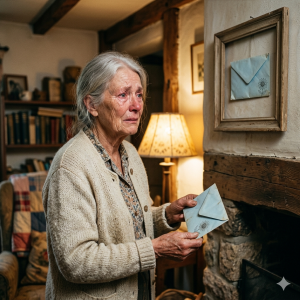
The woman who answered the door was maybe seventy, silver-haired, wearing a cardigan the color of old cream. She had the look of someone who spent a lot of time reading and not enough time sleeping.
“Can I help you?” she said.
“Ma’am, I know this is strange,” Dale said, “but — are you Margaret Cotter?”
She went very still.
“I haven’t been called that in a long time.”
He held out the envelope.
The pale blue one. The sunflower in the corner.
She looked at it the way you look at something you thought you’d lost. Not surprised exactly. More like… recognized.
Her hand came up slowly to take it.
“Where did you find this?” she whispered.
“Bottom of my mail bag. Last day on the job. I can’t explain it.”
—
She invited him in without another word.
The living room was warm. Books everywhere. A quilt on the rocking chair. And on the wall above the fireplace, in a simple wooden frame —
Dale stopped walking.
He actually stopped mid-step.
Because there, framed and hanging like a piece of art, was an envelope.
Pale blue.
A sunflower drawn in pencil in the corner.
*The exact same envelope.*
—
“That’s — ” he started.
“I know,” Margaret said quietly.
“But I’m holding — ”
“I know.”
She was looking at the one in her hands. The one he’d just delivered. Running her thumb along the edge like she was checking it was real.
“I wrote that letter in 1994,” she said. “I wrote it to someone I never got to say goodbye to. I mailed it.” She paused. “Three weeks later it came back to me. Return to sender. Address unknown.”
She looked up at him.
“I framed it. Told myself it was a reminder that some things just don’t get delivered. That you have to make peace with that.”
Dale looked at the framed one on the wall.
Then at the one in her hands.
Same envelope. Same sunflower. Same careful pencil shading on the petals.
“Margaret,” he said slowly, “if that one’s been hanging on your wall since 1994…”
She was already walking toward the fireplace.
Toward the frame.
Her hands — steady, careful — lifted it off the nail.
Turned it over.
And then she made a sound Dale would never forget for the rest of his life.
Not a cry. Not a gasp.
Something quieter than both.
Because written on the back of the framed envelope, in handwriting she said was hers —
Were four words.
*He found it anyway.*
—
Dale stood very still.
Margaret stood very still.
The aspen leaves outside tapped against the window glass like they had something to say.
“I didn’t write that,” she said, but her voice had no force in it. It was the voice of someone watching their own certainty dissolve. “I have looked at this frame for thirty years. There was nothing on the back.”
Dale didn’t say anything. There wasn’t much to say.
She set the framed envelope on the mantle carefully, the way you set down something that might shatter, and then she looked at the one still in her hands — the one Dale had brought, the one with the postmark from June of 1994. She turned it over too.
Blank.
Of course blank. It had never been opened. Still sealed, the glue gone brittle and brown at the edges the way old glue does, but holding.
Margaret sat down in the rocking chair. Not because she chose to. More like her legs made the decision for her.
“His name was Thomas Wick,” she said.
—
She didn’t look at Dale when she said it. She looked at the sealed envelope in her hands.
Thomas Wick had been her neighbor growing up. Not a romantic thing, she was quick to say — or maybe she said it too quick, Dale thought, and let it go. They had been friends since they were seven years old. The kind of friends who don’t need to explain themselves. He knew she was afraid of storms and she knew he couldn’t stand the smell of gasoline and they had spent twenty years just being in the world together without ever making a fuss about it.
In the spring of 1994, Thomas was diagnosed with something that moved fast and didn’t negotiate.
“He didn’t want a lot of visits toward the end,” Margaret said. “He was proud. You know the type.”
Dale nodded. He knew the type.
She had respected it. Stayed away when he asked her to. Written the letter instead — everything she wanted to say, the whole accumulated weight of a friendship she’d never properly named — and mailed it to his sister’s address in Billings where he’d gone for his last few months.
The sister had moved. The letter came back.
Thomas died eleven days later.
“I never got to say any of it,” Margaret said. “For thirty years I have walked past that frame every single morning and reminded myself that some things just don’t arrive in time. That you have to accept that. Make peace with the silence.” She paused. “I got very good at making peace with the silence.”
—
Dale looked at the four words on the back of the frame.
*He found it anyway.*
He thought about his mail bag. Thirty-one years of lifting it, carrying it, setting it down at night. He thought about how a bag like that accumulates things — not just letters, but the residue of a life spent in motion between people who needed to reach each other. Slips of paper. Rubber bands. The occasional coin. Things that fall out of envelopes in the sorting room, get wedged into seams, travel years in the dark before someone’s hand finds them.
He thought about the pale blue envelope appearing on the very last day, in the very bottom of the bag.
He was not a mystical man. Thirty-one years of mail service will cure you of magical thinking fairly efficiently. Things get lost in the system. Things travel strange routes. A letter misrouted in 1994 could bounce between regional facilities for decades, filed wrong, overlooked, pulled out during some renovation or equipment replacement, sent along again out of bureaucratic inertia with nobody ever reading the postmark closely enough to be alarmed.
He knew all that.
He also knew what the back of that frame said.
And he knew it hadn’t said it yesterday.
—
“Are you going to open it?” he asked.
Margaret looked at the sealed envelope for a long time.
“I wrote it,” she said. “I know what’s in it.”
“Maybe you do.”
She looked at him.
He shrugged. He was just a retired mail carrier sitting in a warm living room in Sweetgrass Hollow on a Tuesday afternoon in October. He didn’t have any authority here. But he’d driven forty minutes and he thought she ought to open it.
She slid her thumbnail under the flap.
The old glue let go without much argument.
—
The letter was three pages, written on the same pale blue stationery as the envelope, in a handwriting that was smaller and rounder than the handwriting on the frame but unmistakably the same hand — younger, maybe, more careful, the letters of someone who wanted to get each word right.
Dale did not read it. He looked at the curtains. He looked at the quilt on the arm of the couch. He gave her all the privacy he could inside a room that size.
He heard her breath catch once, somewhere in the middle of the second page.
Then silence for a long time.
Then she folded it back along the original crease lines, slowly, like she was refolding something sacred. Tucked it into the envelope. Set it on her knee.
“I’d forgotten some of it,” she said. “How particular it was. The specific things.”
She didn’t elaborate and he didn’t ask.
“I told him he was the best person I knew,” she said. “Not the kindest, not the smartest. The best. There’s a difference.” She touched the edge of the envelope. “I meant it. I still mean it.”
The room was quiet.
Outside, the clouds had opened up just enough to let some late afternoon light through, the gold kind that only happens in October, and it came through the yellow curtains and lay across the floorboards like it had been invited.
—
Margaret got up eventually and made coffee. Dale didn’t need to be anywhere. He sat at her kitchen table and they talked for two hours — about Thomas, about the county, about thirty-one years of other people’s mail and what you learn carrying it. She had taught high school English for thirty-five years and they discovered, slightly to both their amusements, that they had exactly one person in common: a boy named Curtis Freed who had been her worst student in 1987 and who Dale had delivered a registered letter to in 2019 when Curtis was, against all available odds, a state legislator.
“Lord,” Margaret said.
“I know,” Dale said.
She laughed. A real one, full and unguarded. It sounded like someone opening a window.
—
He left when the light was going.
At the door she shook his hand, and then thought better of it and hugged him instead, briefly, the way practical people do — efficiently, without ceremony, meaning it completely.
“Thank you for driving out,” she said.
“Thank you for letting me in.”
He was halfway to the truck when she called after him.
“Mr. Mercer.”
He turned.
She was standing on the porch in her old cream cardigan with the letter in one hand and the frame in the other, and the last of the October light was doing what October light does.
“Thirty-one years is a good long time to do something well,” she said.
He thought about that for a second.
“Yes ma’am,” he said. “I believe it is.”
—
He drove home on the long way.
Not because he was lost. Because he wasn’t in any hurry to stop moving just yet.
He thought about Thomas Wick, who had died without reading the letter and had also, somehow, on the back of a frame in a warm living room, left four words for the woman who’d written it.
He thought about the difference between things that don’t arrive and things that arrive late.
He decided, somewhere on the long straight stretch of county road with the aspens burning gold on both sides, that the difference mattered. That it was maybe the whole thing.
—
He got home at dusk. His wife was in the kitchen. He hung up his coat — the one with the empty pocket now, the letter finally where it belonged — and he stood in the doorway for a moment watching her without her knowing.
Thirty-four years. Same as the route, near enough.
She turned around and saw his face.
“Well,” she said. “How was the last day?”
Dale Mercer thought about a pale blue envelope. A sunflower drawn with real care. A woman who had learned to make peace with the silence and then, on a Tuesday in October, didn’t have to anymore.
“It was a good one,” he said.
And he meant it more than she knew.