
Every Tuesday, he stopped at the same shelf.
Margaret had noticed him for weeks before she ever learned his name.
He’d come in during his break — still in his gray work uniform, pushing that big yellow mop bucket into the hallway just outside the gift shop door — and he’d stand there for exactly five or six minutes, picking up that old paperback, turning it over, setting it back down.
*Where the Red Fern Grows.*
The copy was in rough shape, honestly. Dog-eared corners. A cracked spine. The kind of worn-soft that only happens when a book has been loved hard by small hands. Margaret had worked as a school librarian in Amarillo for thirty-one years. She knew what a well-read children’s book looked like.
She’d almost pulled it from the shelf to donate it out.
She was glad she hadn’t.
The first Tuesday she noticed him, she didn’t say anything. She just watched. He read the back cover like he’d never seen it before, even though she was pretty sure he had. He opened to the first page. Closed it again. Set it back on the shelf between a ceramic cardinal figurine and a get-well balloon weight.
Then he went back to work.
The second Tuesday, same thing.
The third Tuesday, Margaret quietly moved the book to the back of the shelf so it wouldn’t accidentally sell.
She couldn’t have explained why, exactly. Thirty-one years of watching children reach for the same book over and over again — you develop a sense for when a story belongs to someone.
By the sixth week, she’d started holding it behind the counter.
His name, she finally learned, was Darnell. One of the nurses mentioned it in passing. “That’s just Darnell,” she said warmly. “He’s been here four years. Sweetest man.”
Margaret believed it. She’d seen him stop to help an elderly visitor who’d dropped her purse. She’d seen him hold the elevator for a family who was clearly having the worst day of their lives. He did it all quietly, without any fuss, the way people do when kindness is just their nature and not a performance.
But every Tuesday, he came back to that book.
And every Tuesday, he put it back.
One morning, Margaret opened the cover — just to flip through it, the way she used to do with library copies, checking condition.
That’s when she saw it.
Written in soft pencil on the inside front cover, in a child’s careful print:
*Marcus.*
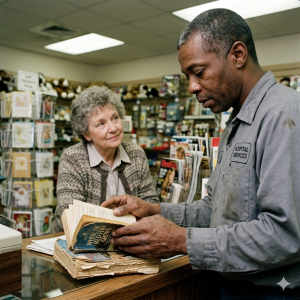
Just the one name. No last name. Written the way kids write their names in their things so nobody takes them. Written like it mattered.
Margaret stared at it for a long moment.
Then she closed the book and set it back under the counter.
She didn’t mention it to anyone.
But she thought about that name. *Marcus.* She thought about it on her drive home past the flat Texas horizon. She thought about it while she watered her tomatoes. She thought about it the way you think about something when some quiet part of you already knows it means something — you just don’t know what yet.
The following Tuesday, Darnell came in at his usual time.
And this time, Margaret picked up the book and held it out across the counter before he could even reach the shelf.
“You keep coming back to this one,” she said. Simple. No pressure in her voice. Just the gentle directness of a woman who’d spent a lifetime helping people find what they were looking for.
Darnell stopped.
He looked at the book. Then at her. Then at the book again.
“I can’t afford it right now, ma’am,” he said quietly. “Things are a little tight.”
“I didn’t ask you to buy it,” Margaret said.
She set it on the counter between them.
He picked it up slowly — the same way he always did — but this time he opened it.
And she watched his face change.
He went very still.
His thumb traced the penciled letters on the inside cover, light as anything, like he was afraid to smudge them.
The gift shop was quiet. Someone’s monitor beeped faintly down the hall. The little carousel of greeting cards turned slowly in the air conditioning.
Darnell looked up.
His eyes were wet.
And in a voice that was barely above a whisper, he told her that the name written inside that book —
*Marcus* —
was his son’s name.
And that his son had been looking for this exact copy — not just any copy, but *this one* — for three years.
Ever since the night their house burned down and they lost everything.
—
Darnell didn’t tell it all at once. It came out in pieces, the way things do when the telling is hard.
The fire had started in the kitchen. Electrical, the fire marshal said. One of those things. Nobody’s fault and somehow that made it worse. It was November, late, and Marcus had been asleep in his room with the book open on his chest — he’d fallen asleep reading, the way he always did, the way Darnell used to have to come in and turn off the lamp and set the book on the nightstand.
That night, Darnell had grabbed Marcus first. Then his wallet, his phone. They stood in the yard in the cold in their socks and watched the house go.
Afterward, once they were safe and staying with Darnell’s sister over in Lubbock, Marcus didn’t cry much about the clothes or the toys or any of it. He was nine years old and he had a nine-year-old’s toughness about him, the kind that breaks your heart.
But he cried about the book.
He’d gotten it from his third-grade teacher, Ms. Okafor, as a reading award. His name was already written inside when she gave it to him — she’d put it there herself, in pencil, during a quiet moment before class, because she said a book that belonged to you should know it belonged to you.
He’d read it four times.
“He told me it still smelled like our house,” Darnell said. He had to stop for a second. “He meant that as a good thing. The way kids do.”
Margaret had her hand flat on the counter. She didn’t say anything. She just listened.
Darnell had tried to find another copy, of course. That was easy enough. But Marcus didn’t want another copy. He wanted his copy. The one with his name in it, in Ms. Okafor’s handwriting, on the first page.
“I told him, son, that book is gone,” Darnell said. “I told him probably a hundred times. He’d just nod like he understood. But every now and then he’d get real quiet, and I knew.”
They’d eventually moved back to Amarillo. Darnell had gotten the job at the hospital. Life had kept moving, the way it does whether you’re ready or not.
And then one day, walking past the gift shop on his lunch break, he’d seen it.
He’d almost kept walking. There were thousands of copies of that book in the world. He knew that.
But something made him stop.
He picked it up. Turned it over. Set it back down. Told himself it was foolish.
Came back the next Tuesday anyway.
“I knew it probably wasn’t his,” Darnell said. “I knew that. But I couldn’t quite make myself open it and find out for sure.” He gave a short, quiet sound that was almost a laugh. “Figured as long as I didn’t look, it could still be.”
Margaret understood that completely. She’d been a librarian. She knew exactly what it meant to need a story to still be possible.
She asked him one question: where had they lived before the fire?
Darnell told her. A neighborhood on the east side of Amarillo. A street name she recognized.
She asked him what Marcus’s teacher’s name had been.
“Ms. Okafor,” he said. “Third grade. Emerson Elementary.”
Margaret nodded slowly.
She turned the book over in her hands, thinking.
The gift shop received its donated inventory from two places: the hospital’s own lost-and-found, after items went unclaimed, and a twice-yearly donation drive the hospital ran in partnership with three elementary schools in the area.
One of which was Emerson.
She didn’t say any of that to Darnell right then. She didn’t want to build something up that she hadn’t yet confirmed. She just looked at him and said, “Can I hold onto this one more day?”
He looked uncertain.
“I’m not going to sell it,” she said. “I promise you that.”
He nodded.
He went back to work.
And Margaret picked up the phone and called the hospital’s donation coordinator, a woman named Phyllis who kept meticulous records in a binder that Margaret had always privately found excessive and now found herself deeply grateful for.
It took Phyllis about twenty minutes to call back.
The book had come in through the Emerson Elementary drive. Eighteen months ago. Donated by a family clearing out a storage unit — the inventory note said “children’s books, assorted, good condition.”
There was no way to know for certain. Phyllis said that right away. No way to trace it back further than that.
But Margaret already knew.
She knew the way she always knew, the way thirty-one years in a library teaches you to know things — not with proof, but with the specific, settled certainty that comes from paying attention to people long enough.
This was Marcus’s book.
It had come from a storage unit, which meant someone had found it in the wreckage, or picked it up somewhere in the aftermath the way things scatter after a fire, and held onto it, and eventually let it go, and it had made its way here, to this shelf, in this hospital, where his father pushed a mop bucket past it every Tuesday.
Some people would call that a coincidence.
Margaret was not those people.
—
The next morning she came in early. She sat at the little desk behind the counter and she took out a notepad and thought for a while.
Then she wrote a short letter. She kept it simple, the way you do when the thing you’re trying to say is already big enough on its own.
She said that this book had been waiting. She said that she hoped it found its way home. She signed it with just her first name.
She folded it and tucked it inside the front cover, just behind the page with Marcus’s name on it.
Then she wrapped the book in a piece of the cream tissue paper she kept under the counter for wrapping ornaments, and she tied it with a piece of the thin blue ribbon from the spool by the register.
She set it on the counter.
When Darnell came in that morning — it wasn’t a Tuesday, it was a Wednesday, but she’d left word with the nurses’ station — he stopped in the doorway when he saw it.
He looked at her.
“It’s not for sale,” she said, the same way she’d said it the day before. Same voice, same steadiness. “It’s just yours.”
He crossed the room and picked it up.
He held it for a moment without opening it.
“Ms. Margaret,” he started.
“Don’t,” she said kindly. “Just take it home to your boy.”
He stood there another moment. She could see him working to hold himself together, and doing a decent job of it, the way a person does when they’ve had enough practice at hard things.
Then he tucked the book carefully under his arm, against his chest, the way you carry something you don’t want to drop.
He thanked her. He went back to work.
—
She found out what happened next from one of the nurses, the same one who had first told her his name.
Darnell had finished his shift, driven home, and given Marcus the wrapped package without any explanation. Just set it on the kitchen table and said, open it.
Marcus was twelve now. Three years older than the boy who had lost it. Old enough to have started to let go of things, the way you have to.
He unwrapped it.
He went quiet for a long time.
Then he opened the cover, and he saw his name.
The nurse said Darnell told her he didn’t try to explain it. Didn’t say much of anything. Just sat at the table with his son while Marcus held the book in both hands and looked at his own name, written there in second grade, in a teacher’s careful handwriting, announcing that this belonged to him.
They sat there for a while together.
That was all.
That was the whole story.
—
Margaret kept working her Tuesdays at the gift shop for another two years, until her knees got to the point where the standing wasn’t worth arguing with anymore.
On her last day, she found something on the counter when she came in to open up.
A copy of Where the Red Fern Grows. A new one, the spine still stiff, the corners still sharp.
The inscription on the inside front cover was in a teenager’s handwriting now, a little less careful than it had been, the letters bigger and more confident.
It said: *For Ms. Margaret, who knew.*
And underneath, in smaller letters: *This one’s yours to keep.*
She stood there in the quiet of the gift shop for a moment, with the little carousel of greeting cards turning in the air conditioning.
Then she put it in her bag to take home.
She was already thinking about where she’d put it on her shelf.