
She didn’t cry when he handed her the divorce papers at the podium.
She smiled.
And every woman in that banquet hall who watched Margaret Elaine Coulter smooth the front of her blue crepe dress and lift her chin — they didn’t know yet what that smile meant.
But they were about to.
—
Margaret had been a florist in Savannah for thirty-one years. Gardenias for funerals. Peonies for June weddings. Those small ivory envelopes, tucked into every arrangement she’d ever made, with her careful cursive on the front — *With love. With gratitude. With hope.*
She knew how to make something beautiful look effortless.
She also knew how to make something devastating look the same way.
—
Gerald Coulter had been Chatham County Commissioner for eighteen years. Handsome in that silver-haired, glad-handing way that photographs well on campaign mailers. The kind of man who called his wife *Maggie* in public when he wanted her to seem small.
The retirement gala was held at the Savannah Marriott Riverfront. Four hundred guests. White tablecloths. That particular kind of Georgia evening where the heat finally breaks and the air smells like the river and something sweet you can’t quite name.
Margaret had helped plan every detail.
She’d also set every table.
—
Before the guests arrived, while the catering staff was still arranging the bread baskets, Margaret had walked the room quietly.
Table by table.
She placed one small ivory envelope beside every dessert plate.
Folded into each one’s linen napkin, the way she’d done ten thousand times with wedding bouquet cards. Familiar. Unremarkable. The kind of thing a florist’s wife would do for a retirement dinner — a sweet parting note, people assumed. A memory card. A poem, maybe.
Nobody opened them.
Not yet.
—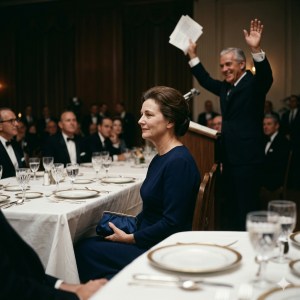
Gerald took the podium at eight-fifteen.
He thanked the mayor. He thanked the county. He made three jokes that only the men at the front tables laughed at.
And then he reached under the podium, pulled out a manila envelope, and said — and Margaret would hear these words for the rest of her life, not with pain, but with a calm, clarifying fury — he said:
*”I’d also like to take this moment to make a personal announcement, because I believe in being honest with the people of this community. Maggie, honey — you’ve been served.”*
He held up the pre-signed divorce decree.
Someone at table seven actually laughed. A short, confused sound, quickly swallowed.
Margaret sat very still.
She had known this was coming. Not the public part — even she hadn’t imagined the public part — but the divorce, yes. She’d known for four months. Since the afternoon she’d found the second set of books for the Gerald R. Coulter Community Foundation, folded into a manila envelope almost exactly like the one he was currently holding over his head like a trophy.
Sixteen years she’d been his bookkeeper.
Sixteen years of donor receipts, grant disbursements, charitable contributions that went *in* and then went somewhere Gerald never quite explained.
She had been very thorough.
—
The applause for his speech was still going — that uncomfortable, uncertain applause where no one is sure what they’re clapping for — when Margaret reached into her clutch.
Not for a tissue.
She touched the single item inside. Smooth. Rectangular. No bigger than her thumbnail.
A USB drive.
There was one beside every dessert plate in the room.
Tucked inside every small ivory envelope, sealed with her familiar florist’s sticker — a white gardenia on cream paper, the kind she’d used since 1993.
She had placed four hundred and twelve of them.
One for every donor, every board member, every city official, every person who had written a check to the Gerald R. Coulter Community Foundation and believed their money went where Gerald said it went.
—
She waited.
Gerald was still at the podium, accepting congratulations from the men nearest the stage.
Margaret looked across the room at the head table.
She found the mayor’s eyes.
And she nodded.
—
It was a small nod. The kind she used to give her assistants when a bride was about to walk down the aisle and everything needed to happen exactly on cue.
The mayor frowned. He looked down at his place setting. He picked up the ivory envelope — *her* envelope, the one she’d addressed in her careful cursive — and he turned it over.
He opened it.
He slid out the drive.
He read the single word printed on the label in Margaret’s careful florist’s hand.
*Gerald.*
His face went the color of old ash.
She watched him reach under the table, angling the drive away from the man beside him, and she watched his jaw go tight, and she watched him look up — slowly, the way men do when they’re calculating — and find her face across four hundred guests and thirty-one years of silence.
Margaret Elaine Coulter smoothed the front of her blue crepe dress.
She picked up her clutch.
And she smiled at him the same way she’d smiled at Gerald.
The same way she smiles when something beautiful is about to bloom.
—
She walked out of the Savannah Marriott Riverfront at eight thirty-seven in the evening.
She did not run. She did not look back over her shoulder. She walked through the lobby the way she had walked into every church and reception hall and cemetery chapel for three decades — with her shoulders back and her hands easy at her sides and the quiet authority of a woman who has already done the work and knows it.
The Uber was waiting exactly where she’d arranged it. A young woman named Destiny, per the app, with a pine tree air freshener and Beyoncé playing low on the radio. Margaret got in. She said good evening. She watched the riverfront lights slide past the window as they pulled away.
Her phone began to buzz at eight forty-two.
She turned it face-down on the seat.
—
What happened inside that ballroom in the minutes after she left — she would piece together later, from the accounts of women she trusted, and from one or two men who had the decency to be ashamed of themselves.
The mayor had not put the drive away. He had held it in his closed fist for approximately four minutes, long enough for the woman beside him, Alderman Patricia Reyes, to notice the way his knuckles had gone white around something small. Patricia had a habit of noticing things men tried to hide. It had served her well for twenty-two years in city government.
She asked him what it was.
He didn’t answer fast enough.
She asked him again.
By the time Gerald worked his way back from the podium — still shaking hands, still performing the retirement of a man beloved — six people at the head table had seen a drive. Four of them had their phones out. Two were already whispering.
Gerald’s smile, witnesses said later, faltered for just a moment when he reached the table. Just a flicker. A man recognizing, for the first time all evening, that something had gotten away from him.
He looked at Margaret’s empty chair.
He looked at the small ivory envelope still sitting beside her untouched dessert plate.
He picked it up.
He read the front, in her careful cursive.
*Gerald. With love.*
—
The drives contained three things.
The first was a spreadsheet. Sixteen years of Foundation transactions, two columns side by side — what the books showed, and what the bank records showed. The gap between those two columns, totaled at the bottom in Margaret’s precise bookkeeping hand, came to just over $1.2 million.
The second was a folder of scanned documents. Donor receipts. Wire transfers. A lease agreement for a condominium in Hilton Head, paid for eleven consecutive months through a Foundation vendor account, for a woman named Courtney Brianne Holt, twenty-nine, who worked, until recently, as a receptionist in the county commissioner’s office.
The third was a letter.
One page. Margaret’s handwriting, which anyone in that room who had ever received a floral arrangement from Coulter’s Blooms on Abercorn Street would have recognized instantly.
It began: *To the donors, board members, and community partners of the Gerald R. Coulter Community Foundation — you deserved to know where your money went, and I am sorry it took me this long to be the one to tell you.*
It ended: *The full records have already been provided to the Georgia Bureau of Investigation, the Chatham County District Attorney’s office, and the Savannah Morning News. Tonight you are receiving them as well, because Gerald believed in being honest with the people of this community. I thought we should take him at his word.*
It was dated that morning.
It was signed, in full: *Margaret Elaine Coulter, Bookkeeper, Gerald R. Coulter Community Foundation, 2008–2024.*
—
Patricia Reyes read it standing up, right there at the head table, with Gerald less than six feet away.
She read it twice.
Then she set it down, picked up her phone, and made a call that would last eleven minutes. When she hung up, she touched the arm of the man beside her — the Foundation’s board chairman, a retired pediatric surgeon named Dr. Howard Bell — and she showed him her screen.
Gerald was still talking. Still working the room. He had not yet opened his own envelope.
Howard Bell read Patricia’s screen. He looked up at Gerald. He looked back down.
He said, quietly, to no one in particular: “Lord have mercy.”
—
Gerald opened the envelope at eight fifty-one.
A woman named Suzanne Tatum, who had been Margaret’s closest friend since the second grade at Savannah Christian Preparatory School and who had specifically positioned herself at a table with sightlines to the head table for this exact purpose, described it this way:
“He read it standing there in his tuxedo and his face just — it didn’t fall, exactly. It locked up. Like something went out of him all at once and whatever was left just kind of froze in place. And then he looked around the room, real slow, and I think he was counting. I think he understood, right then, how many of those envelopes there were.”
Someone touched his arm. He didn’t move.
His phone, in his breast pocket, began to ring.
—
He stepped outside to take the call. He did not come back.
The gala continued for another forty minutes in the particular stunned, electric way of an event where everyone present understands that something historic has just happened and nobody quite wants to be the first to leave. The shrimp and grits were served. The band played. The conversations at every table had the low, urgent quality of people trying to understand exactly what they were holding in their hands.
By ten o’clock, three local news crews were in the parking lot.
By midnight, the Savannah Morning News had posted its first story online.
By the following Thursday, a Chatham County grand jury had been convened.
—
Margaret was home by nine-fifteen.
She’d asked Destiny to stop at the Publix on Habersham on the way, and she walked in still wearing the blue crepe dress and her good heels and bought two things: a bottle of sparkling water and a bunch of white peonies from the bucket by the door, because they were beautiful and they were on sale and she had always thought peonies deserved to be in every room.
She put them in a cut-glass vase on her kitchen table.
She sat down.
She turned her phone back over.
There were forty-seven missed calls. Eleven from numbers she didn’t recognize. Several from people whose names she knew. Two from the Savannah Morning News. One from a number with an Atlanta area code she understood, without answering, to be an attorney she had spoken to three weeks prior and whose retainer she had already paid.
One from Suzanne Tatum, which she answered.
“Maggie.” Suzanne’s voice was the particular texture of a woman trying very hard not to cry. “Maggie, I just — I need you to know that every woman in that room stood up when you left. I don’t know if you saw that. But they did. They just stood up.”
Margaret was quiet for a moment.
She looked at the peonies.
“I didn’t see that,” she said.
“Well,” said Suzanne. “Now you know.”
—
Gerald Coulter was indicted on seven counts of wire fraud, four counts of tax evasion, and two counts of misappropriation of nonprofit funds thirteen months later. His attorney negotiated a plea agreement that kept him out of prison but cost him the entirety of the Foundation’s remaining assets, a significant portion of his personal savings, and what his own sister described to the Savannah Morning News as “every friend he ever thought he had.”
The divorce was finalized on a Tuesday in March, in a Chatham County courtroom, in about eleven minutes.
Margaret wore a pale green dress. She described it later as the color of new things.
—
Coulter’s Blooms on Abercorn Street is still there.
She repainted the front door a deep blue last spring. She hired a second full-time assistant and started doing corporate accounts she’d always turned down before because Gerald said they were beneath the brand.
She still uses the ivory envelopes. Still writes in the same careful cursive.
*With love. With gratitude. With hope.*
She means all three of them.
She always did.
—
Suzanne Tatum told this story at a church auxiliary luncheon in October, which is how it began to travel. Each woman who heard it told two more, and those women told their daughters, and somewhere along the way someone wrote it down and it found its way here, to you, reading it on whatever screen you’re reading it on.
People keep asking: how long had she been planning it?
The answer, from Margaret herself, in the one interview she gave — to a reporter at the Savannah Morning News, a young woman named Aaliyah, who sat with her for two hours at the kitchen table among the peonies — is this:
“I wasn’t planning anything for most of those sixteen years. I was just doing my job. I believed in the work. I believed in him. And then one afternoon I found something I couldn’t explain, and I sat with it for two weeks, and then I started making phone calls to people who knew more than I did about what options I had. And once I understood my options, the rest of it was just — organization. Attention to detail.”
She smiled.
“Florists are very good at attention to detail.”
Aaliyah wrote that down.
Then she looked up from her notebook and asked: “The smile. The one when he handed you the papers at the podium. What were you thinking right then?”
Margaret thought about that for a moment. She turned her coffee cup in her hands.
“I was thinking about the envelopes,” she said. “I was thinking about all those people opening them. I was thinking about how I’d spent thirty-one years learning to make things beautiful. And I thought — ” she paused, the way she did, the way Suzanne had always said she did when she was choosing her words the way she chose flowers, for what they meant and not just how they looked — “I thought: this is the most beautiful thing I’ve ever arranged.”
She set her coffee down.
Outside the kitchen window, the Savannah summer pressed its green weight against the glass.
The peonies opened a little more, the way peonies do, quietly and all at once, as if they were simply finishing something they had already decided to do.