
She didn’t cry when she found the deed transfer. She just reached into her apron pocket, touched the old pink message slip, and started making a list.
That’s the thing about spending thirty years as a county clerk in Ravalli County, Montana. You learn that paper tells the truth even when people won’t.
—
Dale Whitmore had been her husband since 1993. Thirty-one years of branding cattle together in the June heat, of patching the guest cabin roof in October sleet, of building something real out of rocky soil and stubbornness.
The Whispering Pines Ranch wasn’t just property.
It was her mother’s quilt on the spare bed. It was the porch swing she’d painted herself three times over. It was thirty years of guest books filled with handwriting from families who came back summer after summer because they said it felt like home.
Dale signed it away on a Tuesday.
To a woman named Krista.
And then he filed for divorce, telling his attorney — and eventually a judge — that the ranch had “always been his separate property.” That Ruth had “no documented claim.” That her name wasn’t on the original deed from before their marriage.
He wasn’t wrong about the deed.
He just didn’t know what Ruth knew.
She reached into her apron pocket again, the way she’d been doing all week without even thinking about it. The slip was soft now, worn thin at the fold. Pale pink, the kind they didn’t even make anymore. While You Were Out. The message was faded but she didn’t need to read it. She had it memorized.
She just wasn’t ready to explain it yet.
—
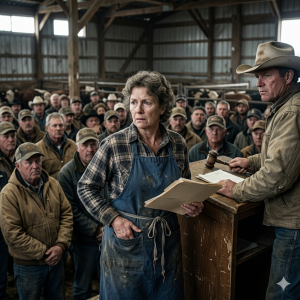
The auction was held on a Friday morning at the Stevensville Livestock Exchange. Dale had moved fast — she had to give him that. Once the divorce filing hit, he’d listed the livestock, the equipment, the barn contents, everything right down to the vintage Powder River chutes her father had helped them install.
Two hundred people showed up. Ranchers, neighbors, a few people she recognized from her years at the courthouse. Some came to buy. Some, she suspected, came to watch.
Ruth arrived alone.
She wore her good boots and her everyday apron — the blue one with the worn strings — because she was not going to pretend this was a special occasion. She was not going to dress up for Dale’s yard sale.
She had one thing with her.
A manila folder, letter-sized, unremarkable. The kind she’d filed ten thousand of in her years behind the county counter.
She touched her apron pocket once more before she walked in.
The slip was there.
—
Dale was standing near the back, laughing with someone she didn’t recognize. He went still when he saw her. Just for a second. Then he looked away, like she was a weather system he’d decided to ignore.
The auctioneer, a barrel-chested man named Gary Stills who’d been running sales in this valley for twenty years, gave Ruth a long look when she approached the podium.
“Ruth.”
“Gary.” She set the manila folder on his podium. “Before you open bidding, I need you to read what’s in here. All of it. Out loud.”
He looked down at the folder. Looked back at her.
“Ruth, this isn’t really the place for—”
“It’s exactly the place,” she said quietly. “This is where he’s selling what belongs to me. So this is where it gets read.”
Gary was a fair man. She’d known him since his boys were in 4-H. He looked at the folder for a long moment, then at the crowd that was already going quiet around them, then at Dale across the room.
He nodded once.
“Let me get everyone settled.”
—
Ruth stepped to the side and folded her hands in front of her apron. Somewhere under the worn blue cotton, in the pocket she’d sewn herself, the old pink slip waited.
She thought about the day she’d taken that message. The voice on the other end of the line. The way her heart had hammered even then, all those years ago, because she’d known — even at twenty-six, even before she understood fully what it meant — that she should keep it.
She’d kept it for thirty-seven years.
She thought she might finally be done carrying it.
Gary Stills opened the manila folder.
The room had gone the particular quiet that only comes over a crowd when everyone simultaneously decides to stop breathing.
He read the first page. Then the second. He turned to the third and his jaw shifted in a way she recognized — she’d seen it on judges, on lawyers, on grown men who thought they understood how something worked until they found out they didn’t.
He looked up.
Found Dale’s face across the room.
And said, in a voice that carried to every corner of that livestock barn —
“Sir, I’m going to need you to step outside before I read this aloud.”
—
Dale didn’t move at first.
He was the kind of man who filled a room, always had been. Six-two, wide through the shoulders, the sort of face that photographed well and charmed easily. He’d been charming people in this valley his whole life. He clearly thought he could charm his way through this too, because he laughed — a short, dismissive sound — and said, “Gary, whatever Ruth brought in there, it doesn’t change anything that’s already been filed with the court.”
Gary looked at him steadily. “Dale.”
“I’m serious. My attorney has already established—”
“Dale.” Gary’s voice dropped. Not louder. Quieter. The way a man gets when he’s not asking anymore. “Step outside.”
The laugh died.
Ruth watched her husband of thirty-one years read something in Gary Stills’s expression that finally made him understand this was not going to go the way he’d planned. She watched him set down his coffee cup on the railing beside him, very carefully. She watched him straighten his jacket.
And then she watched him walk to the side door, and she felt — not triumph, not grief. Something older and quieter than either. Something that felt like the moment a fever finally breaks.
Two of Dale’s friends followed him. His attorney, who had driven up from Missoula and was standing near the livestock pens looking at his phone, looked up and then followed too, moving quickly.
The door swung shut.
Gary looked out at the two hundred people who had come to watch a ranch get auctioned and were now watching something they hadn’t expected.
“Give me a few minutes,” he said into the microphone. “We’ll be starting late.”
—
What was in the manila folder was three things.
The first was a recorded document from Ravalli County — filed in March of 1993, four months before Ruth and Dale’s wedding — in which Dale’s father, Harold Whitmore, transferred the deed to Whispering Pines Ranch not to Dale, but to Dale and to a family trust. Harold had done it quietly, on the advice of an estate attorney, because he’d had doubts about his son’s financial judgment and wanted to ensure the land stayed in the family. The trust had two trustees. Dale was one.
The other was Ruth.
Not Ruth Whitmore. She wasn’t Ruth Whitmore yet in March of 1993. She was Ruth Calloway, twenty-six years old, working the front desk at the Ravalli County Clerk and Recorder’s office. She and Dale had been together eight months. They weren’t engaged.
But Harold Whitmore had called the clerk’s office on a Thursday afternoon in March when Dale was out of town. He’d asked to speak to whoever was available. Ruth had picked up the phone.
He’d spent forty minutes on that call. He told her he was sick — he’d been diagnosed in January and didn’t expect to make it to fall, which turned out to be accurate. He told her he’d watched her with his son for the better part of a year and she was the most sensible person Dale had ever brought around. He said the ranch had been in his family for sixty years and he needed it to be in steady hands.
Then he asked if she would be a trustee.
She’d said she needed to think about it.
He said he understood, and that his attorney would be in touch.
She’d taken the message on a While You Were Out slip. Written his name, his number, the date, the time, the word “trust” with a question mark. Tucked it in her desk drawer. Gone home that night and sat on the steps of her apartment and looked at the Bitterroot Mountains until it got dark.
She’d called back the next morning and said yes.
She’d never told Dale. Harold had asked her not to, not until the time was right, not until Dale had grown into himself a little more. She’d planned to tell him after the wedding. Then life kept moving and the moment kept not being right and the pink slip moved from her desk drawer to a shoebox to an apron pocket because she worked better when she kept important things close.
And Dale had never discovered it because Dale, in thirty-one years, had never once looked at the underlying trust documents. He’d inherited the surface of the ranch. He’d never gone deeper.
His attorney hadn’t found it either. Attorneys look for what they think to look for.
Ruth had spent thirty years as a county clerk. She knew exactly where to look and exactly what it meant.
—
The second thing in the folder was a letter.
Harold Whitmore had written it before he died in September of 1993 — two months after the wedding, as it turned out. He’d left it with his estate attorney with instructions to hold it until it was needed.
The attorney, a man named Vernon Schulz, had retired in 2011. His practice had been absorbed by a firm in Hamilton. Ruth had written to that firm in the week after she found the deed transfer. She’d explained who she was. She’d cited the trust by its filing number — she had that memorized too.
The letter arrived by FedEx on a Thursday. She’d read it standing at the kitchen counter in the house she was no longer sure she’d be allowed to stay in, and she had cried then, finally — not from grief but from something that felt like being handed back a piece of herself she hadn’t known was missing.
Harold had written: I don’t know when you’ll read this or what the circumstance will be. But if you’re reading it, you needed it. You’re the one I trusted, Ruth. Not because you’re a woman or because my son loves you, but because you listened to an old man for forty minutes on a Tuesday and asked smart questions and called back the next morning. That’s the kind of person land should belong to. Take care of it.
He’d spelled her name right. Dale, even now, sometimes wrote it with an e on the end.
—
The third thing was the deed transfer itself.
The one Dale had filed. The one conveying Whispering Pines Ranch to a woman named Krista.
Ruth had pulled it from the county records herself. She’d stood at the counter where she’d worked for three decades and requested her own file and read it carefully. And she had found what she expected to find, because thirty years of reviewing documents teaches you to see not just what’s there but what’s missing.
Dale had transferred his interest in the trust.
He couldn’t transfer Ruth’s.
He didn’t have the authority. He’d never had the authority. The trust required both trustees to act on any transfer of real property. Both signatures. Both notarizations.
There was one signature on the deed.
It was not valid. It had never been valid. The ranch had not actually moved anywhere.
Krista — whoever she was, wherever she’d come from — did not own Whispering Pines Ranch.
She owned nothing.
—
It took eleven minutes outside for Dale’s attorney to read the trust documents and confirm what Gary Stills had already concluded from his own reading. Ruth knew this because she counted. She stood near the podium with her hands folded and she counted and she listened to the restless shuffling of two hundred people who had stopped checking their phones.
A woman named Deb, who had bought a calf from Ruth and Dale six years ago and sent a Christmas card every year since, crossed the room and stood next to Ruth without saying anything. After a moment she put her hand on Ruth’s arm.
A minute later, Roy Hennessey from up past Corvallis came and stood on the other side.
By the time the side door opened again, Ruth had a small quiet crowd around her that she hadn’t asked for and didn’t need to acknowledge because it was simply, plainly there.
Dale came back into the room looking like a man who had aged several years in eleven minutes. His attorney walked behind him, already on his phone, already managing the next problem that was about to become several problems.
Dale looked at Ruth.
She looked back at him.
He opened his mouth and she thought he might say something — an apology, a justification, one last attempt at rearrangement. He was always good at rearrangement. Thirty-one years of watching him talk his way around things had taught her the particular set of his jaw that meant words were coming that she wouldn’t be able to trust.
He closed his mouth.
He picked up his coffee cup from the railing. Set it down again. And then he walked out the front door with his attorney, and the door swung shut behind him, and the room exhaled.
—
Gary Stills stepped back to the microphone.
“The auction is postponed,” he said. “Per advice of counsel.” He paused. “The property listing is being withdrawn.”
There was murmuring. A few people asked questions Gary answered carefully and briefly. The crowd began to loosen and move.
Deb squeezed Ruth’s arm once and then let go. Roy Hennessey nodded at her the way ranchers nod when they’re saying something they don’t have the words for.
Ruth reached into her apron pocket.
She took out the pink slip. She held it for a moment — the soft worn paper, the faded ink, the fold that had gone white from being opened and closed so many times over so many years. While You Were Out. Harold Whitmore. March 11, 1993.
She had carried it through branding seasons and roof repairs and three paintings of the porch swing. Through thirty guest books and thirty sets of returning families and thirty Octobers of sleet. She had carried it through thirty-one years of a marriage that had been, for most of its length, a real one — and through the part at the end that wasn’t.
She thought about Harold, who had been a quiet man and a fair one, who had trusted her before she’d given him any particular reason to, who had died in September having met his grandchildren only in the abstract, as a hope.
She thought she’d done all right by him.
She folded the slip one last time and tucked it into the front pocket of her jeans, where it would stay. She wasn’t ready to let it go. Maybe she never would be. Some things you carry not because you have to but because they’re yours.
—
The court proceedings took four months.
Dale’s attorney was thorough. He found three different arguments and pursued each one until it collapsed. The trust was unambiguous. The transfer was void. Ruth remained a co-trustee with full authority over any disposition of real property, which meant the ranch could not be sold, transferred, subdivided, or encumbered without her agreement.
Krista — who turned out to be a woman from Spokane whom Dale had met at an industry conference, who had understood herself to be purchasing a legal and legitimate property and was as surprised as anyone — received a full refund of her earnest money and the sincere sympathy of the court, which is not worth much but is something.
The divorce was finalized in November. Montana is an equitable distribution state, which meant the court looked at thirty-one years of contributions — cattle worked, roofs patched, guest books filled, a ranch built from rocky soil and stubbornness — and distributed accordingly.
Ruth kept the ranch.
She kept the porch swing and the spare bed with her mother’s quilt and the guest books going back to 1994. She kept the vintage Powder River chutes her father had helped install. She kept the cabin where families came back summer after summer because it felt like home.
She sold Dale’s share of the livestock, which was fair, and she used the money to hire a part-time hand named Garrett, who was twenty-three and serious about the work in the way young people sometimes are when they’ve chosen something deliberately.
She painted the porch swing herself, for the fourth time. Dutch Boy, the same shade of green she’d been using since 1998, because some decisions don’t need to be revisited.
—
The following June, the first family of the season arrived on a Friday afternoon: a couple from Bozeman with three kids and a dog that Ruth allowed on the porch but not in the cabin, which had always been the rule. The youngest child — a girl of about seven, red-haired, serious — walked straight to the guest cabin and stood in the doorway looking at the quilt on the spare bed.
“Did someone make that?” she asked.
“My mother,” Ruth said.
The girl considered this. “Is your mother still alive?”
“No, sweetheart.”
The girl nodded, absorbing it. Then she stepped inside and touched the edge of the quilt very carefully, with one finger, the way children touch things they recognize as old and important.
“It’s pretty,” she said.
Ruth said, “Yes it is.”
She stood in the cabin doorway in her everyday apron — the blue one, the worn strings — and watched the family settle in, and listened to the Bitterroot River