She retired from the post office on a Friday, and by Tuesday she was already back on the road.
Not delivering mail. Just driving the same 47-mile route she’d driven for 31 years — because some habits don’t retire just because you do.
That’s when Darlene started leaving the packages.
Small ones. Wrapped in brown paper, tied with kitchen twine. No return address. No name on the front. Just a porch, a doorstep, a spot she knew would be found before noon.
She never told a single soul what was inside.
—
The folks on Rural Route 9 had known Darlene Kowalczyk longer than they’d known most of their neighbors. She’d watched their kids grow up through the slot of a mailbox. She’d held the certified letter that broke a family’s heart and the one that put a daughter through college. She knew who got seed catalogs and who got medical bills and who hadn’t received a personal letter in eleven years.
That last part is what started the packages.
“Everyone deserves to open something that was meant for them,” she told her sister once. Her sister thought she was talking about Christmas.
She wasn’t.
—
Inside each package: something small. A paperback novel someone might like. A jar of honey from her cousin’s farm. A pair of warm socks in the right size because Darlene remembered things like that.
And tucked beneath the item, every single time — a faded index card.
Printed in plain block letters. Just one word.
A different word every time.
BRAVE.
SEEN.
ENOUGH.
HOME.
Nobody knew where the words came from. Darlene never explained them. The Hendersons on mile marker 14 kept theirs on the refrigerator. Old Carl Pruett on the north ridge said he carried his in his shirt pocket until it fell apart in the wash. A woman named Betty Ostrowski called the post office once — the actual post office — asking if someone had started some kind of program.
They had no idea what she was talking about.
The cards became a quiet legend on Route 9. People started comparing notes at the feed store. What was your word? Mine said HOLD ON. Mine said WORTHY.
No one could figure out the pattern.
No one could figure out Darlene either, but that was nothing new.
—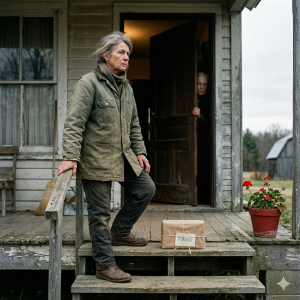
She’d been at it for almost three years when she turned down the long gravel road toward the old Mercer property.
She almost didn’t stop.
The house had been empty since 2013. She knew that because she’d watched the mail slow to a trickle after Patricia Mercer passed, then stop altogether. The estate had never settled properly. The family scattered. The property just… sat.
She’d driven past it a hundred times on her Tuesday rounds without a second thought.
But that morning something made her pull over.
Maybe it was the way the porch looked swept. Or the single pot of geraniums — deep red, recently watered — sitting by the front door like someone had just set it there.
Darlene sat in her truck for a long moment.
Then she reached into the back seat and pulled out a package she hadn’t planned to leave anywhere in particular that morning. Small. Brown paper. Kitchen twine.
She walked up the porch steps slowly, the gravel quiet under her boots.
She set the package down.
She tucked the index card underneath, the way she always did.
She stood up.
And that’s when she saw it.
A light on inside. Not sunlight through a window. A lamp. Warm and yellow and on.
Darlene stood very still.
The house had no active utility account. She knew because her nephew worked for the county and she’d heard him mention the Mercer property at Thanksgiving. Still sitting there, still dark, he’d said. Not worth the back taxes.
Her heart was doing something unfamiliar.
She told herself it was probably nothing. A solar light, maybe. A timer someone had set years ago and forgotten.
She was halfway down the porch steps when she heard it.
A sound from inside.
Not a creak. Not the house settling.
A footstep.
Darlene turned around slowly.
The door opened just an inch.
A face appeared in the gap — pale, cautious, watching her with eyes that had clearly learned to be afraid of whoever stood on the other side of a door.
And Darlene Kowalczyk, who had carried 31 years of this county’s secrets in a mail bag, felt the blood leave her face entirely.
Because she knew that face.
Not from Route 9. Not from the feed store or the Lutheran church or the Tuesday morning coffee at the Sinclair station.
From a flyer.
A missing-persons flyer she had carried in her mail bag — and delivered to every single house on this road —
Exactly eleven years ago.
Her eyes dropped to the index card still sitting on the porch at her feet. The one she’d left without thinking. The word she’d printed that morning without knowing why.
It said FOUND.
—
The name on that flyer had been Jessie Mercer.
Patricia’s granddaughter. Eighteen years old when she disappeared, which would make her twenty-nine now. The flyer had shown a school photo — dark eyes, dark hair pulled to one side, a half-smile that looked like it was being offered reluctantly. MISSING SINCE OCTOBER 14TH. LAST SEEN LEAVING WORK AT THE SINCLAIR STATION ON RT. 9.
Darlene remembered delivering those flyers. She remembered the weight of them, the slightly waxy paper, the way her hands had known before her brain did that this was one of the bad ones.
She also remembered — and this was the part nobody had ever talked about much — that Jessie had not had an easy life inside that house. Not with Patricia Mercer. Not with the man Patricia had been with for a while in those years. The county knew things. The county stayed quiet. That was the way things worked sometimes, and it was one of the facts of rural life that had kept Darlene awake more than once over 31 years.
She looked at the face in the gap of the door.
Jessie Mercer looked back at her.
Neither of them spoke for a full ten seconds.
Then Darlene said, in the same voice she’d used ten thousand times handing over a package that required a signature, calm and plain and carrying no judgment whatsoever: “I’m not going to do anything. I just came to drop something off.”
The door didn’t open further.
But it didn’t close either.
“I know who you are,” Darlene said. “I’ve known this road my whole working life. And I don’t know what brought you back here or how long you’ve been here, and I’m not asking.”
A pause.
“I just want you to know that whoever put that pot of geraniums out did a nice job with them.”
—
The door opened four more inches.
Jessie Mercer was thin in the way that comes not from dieting but from forgetting. Her hair was shorter now, cut bluntly, the way you’d do it yourself without a mirror. She was wearing a flannel shirt that had belonged to her grandmother — Darlene recognized it, which was a strange and specific kind of grief — and she was holding a small kitchen knife loosely at her side, not threatening, just held, the way you’d hold a flashlight in the dark.
“She died,” Jessie said. Her voice was rough from disuse.
“I know,” Darlene said. “2013. I delivered the notice to the county office myself.”
Something in Jessie’s shoulders dropped about a quarter inch. A very small release.
“The water’s still running,” she said. “Spring-fed tank out back. I didn’t turn any utilities on. The lamp runs off a battery I found in the barn.”
She said it the way you say something to a person you expect to report you. Explaining. Pre-defending.
“I’m not a utility inspector,” Darlene said.
She looked down at the package on the porch between them.
“That’s for you. I didn’t know it was for you when I wrapped it. I don’t always know. I just drive the route and something tells me where to stop.”
Jessie stared at the package.
“You can open it or not,” Darlene said. “Either way.”
—
She opened it.
Inside was a small thing, like always. A folded wool scarf the color of pine trees. It had been in Darlene’s hall closet for two winters, belonged to no one in particular, never found its occasion. She’d grabbed it that morning without thinking.
Jessie held it for a moment.
Then she picked up the index card from beneath the tissue paper and read it.
FOUND.
She stood there long enough that Darlene began to wonder if she should leave.
Then Jessie Mercer looked up, and her face was doing several things at once, and she said, “I’ve been back here for four months. I came back because I didn’t have anywhere else and I thought the house was still empty and I just needed somewhere to be still for a while.”
“Okay,” Darlene said.
“I’m not — I didn’t do anything. When I left. I just left.”
“I know,” Darlene said. “You were eighteen.”
Another quarter inch from Jessie’s shoulders.
“I don’t want to be found,” she said. “Not by — I don’t want anyone called.”
Darlene thought about that for a moment.
“You’re twenty-nine years old,” she said carefully. “There’s no one who has any legal claim on you. The missing-persons case on an adult is a different matter than on a child. You can be un-missing just by being somewhere and being alright.”
Jessie hadn’t known that. You could see it land.
“The property’s in estate limbo,” Darlene continued. “My nephew at the county would know more about that than I do. I’m not promising anything about anything. I’m just saying that being found and being taken isn’t the same thing. Not anymore. Not at twenty-nine.”
Jessie looked down at the scarf in her hands.
“I don’t know how to do any of it,” she said quietly. “Any of the normal stuff. I’ve been — gone a long time. I worked. I moved around. I never stayed anywhere long enough to have a last name again, really.”
“That sounds exhausting,” Darlene said.
It was such a simple thing to say. But Jessie’s chin crumpled for a half second before she got it back under control.
“Yeah,” she said. “It really was.”
—
Darlene did not call anyone that day.
She did come back the following Tuesday. She brought a box — not a small package this time, no brown paper or twine. An actual cardboard box, the kind from the grocery store. Soup cans. A bag of rice. Coffee. A box of powdered milk. An extension cord and a box of long-burning candles. A paperback she thought Jessie might like.
She left it on the porch, knocked twice, and got back in her truck.
When she looked in the rearview mirror, the door was already open.
The Tuesday after that, she brought the soup cans and the coffee again, and also her nephew’s phone number written on a notecard. Not an index card. Just regular notepaper. She wrote: He’s good people. He doesn’t talk. This is just information.
The Tuesday after that, she knocked and Jessie opened the door all the way.
They sat on the porch for forty minutes. Jessie asked questions about the county, about what had changed, about whether the Sinclair station was still there. Darlene answered them all without asking anything in return.
When Darlene stood up to leave she said, “You don’t have to explain yourself to me. You never do. But I want you to know you can.”
Jessie nodded.
“Same word for everyone?” she asked, glancing toward Darlene’s truck. “The cards.”
“No,” Darlene said. “Always different.”
“How do you know which one?”
Darlene thought about it a moment, the way you think about something you’ve never actually put into words before.
“I just think about the person,” she said. “Or I think about the house. Or sometimes I just think about what I know about a life from the outside — from 31 years of watching what people send and receive and what goes silent. And then the word comes.”
Jessie was quiet.
“What did you know about me?” she asked. “That made you write that one.”
Darlene looked at her for a long moment.
“Nothing, yet,” she said. “I think that one was from me to me.”
—
By autumn, Jessie Mercer had a legal ID again. Darlene’s nephew had been, as promised, good people who didn’t talk. The property question was still unsettled — it would take a while — but there were options, and Jessie was starting to understand them.
She got a job at a greenhouse two towns over. She was good with plants. The geraniums had been a tell.
She was still in the house on the Mercer property the last Tuesday of October when Darlene pulled up the gravel drive and came up the porch steps and knocked. Jessie opened the door with dirt on her hands and something close to ordinary in her face.
Darlene handed her a small package. Brown paper. Kitchen twine.
“I thought we were past the packages,” Jessie said.
“Almost,” Darlene said.
Jessie untied the twine. Inside was a jar of honey from her cousin’s farm, same as any package on the route. Same as everyone else got, in their own time, in their own season.
She lifted the index card.
One word.
STAY.
Jessie stood there for a moment. Then she put the card on the windowsill next to the geraniums, where she’d been keeping it for weeks already, in her own way, without the word for it.
“You want coffee?” she said.
“I’d love some,” said Darlene.
—
The folks on Rural Route 9 never did figure out Darlene’s system.
They still compare notes at the feed store sometimes. Still talk about the words. The Hendersons still have theirs on the refrigerator. Carl Pruett got a new one after the first fell apart, and he keeps this one in a little plastic sleeve now, like he’s learned his lesson about things worth keeping.
What they don’t know is that after almost four years of driving that route on Tuesdays, Darlene finally left a package for herself.
She wrapped it in brown paper. Tied it with kitchen twine. Set it on her own kitchen table.
Inside: a jar of honey. A good paperback. A pair of warm socks.
And a card.
One word.
ENOUGH.
She sat at the kitchen table for a long time after she read it.
Then she made herself a cup of coffee and started thinking about Wednesday.