
She walked back into Patsy’s Diner on a Tuesday morning, ordered black coffee, and slid a piece of paper across the counter to the woman who’d fired her twenty years ago.
That’s the ending.
Now let me tell you how she got there.
—
Her name was Lynn Kowalski, and in the summer of 1987, she was twenty-four years old, working double shifts at Patsy’s in Millhaven, Ohio, wearing a yellow apron with a grease stain on the pocket that never fully washed out.
She wasn’t just a waitress, though Donna Patsy — the owner, the boss, the woman whose name was on the sign — made sure everyone forgot that fact regularly.
Lynn had ideas.
She had notebooks.
And she had one small, folded index card she kept tucked into that apron pocket every single day. She’d written something on it years before she even started working at Patsy’s. Wrote it, folded it, never showed a soul.
The regulars noticed it. “What’s on the card, Lynn?” they’d tease. She’d just smile and refill their coffee.
Donna noticed it too. And Donna did not like things she couldn’t read.
—
The firing happened on a Friday in August.
Lynn had made the mistake — and it was considered a mistake in Millhaven in 1987 — of saying out loud what she wanted.
She’d been talking to the breakfast crowd, the way she always did, and something slipped out. A dream. A plan, really. Specific, detailed, bigger than anything a girl from Millhaven was supposed to say with a straight face.
Donna heard it from the kitchen.
And Donna laughed first.
The whole counter laughed, the way people laugh when someone gives them permission to. Not cruel, exactly. Just the particular sting of a small town deciding you’ve forgotten your place.
“Lynn, honey,” Donna had said, loud enough for every stool at that counter to hear, “girls like you don’t do things like that. Now go clear table six.”
Lynn untied her apron.
Set it on the counter.
Walked out.
The index card went with her, still folded, still unread by anyone but her.
—
The next twenty years are a long story for another day.
What matters is this: Lynn left Millhaven. Lynn struggled. Lynn failed twice, rebuilt once, failed again, and then — quietly, steadily, the way water moves under ice — Lynn succeeded.
Not in a loud way. Not in a way that made the news.
In a way that accumulated.
In a way that let her, on a Tuesday morning in 2007, sit across a mahogany table from a commercial real estate attorney and sign paperwork on a building on Route 9 in Millhaven, Ohio.
The building with the hand-painted sign out front.
She bought it through a holding company. Paid cash. Asked specifically that her name not appear on anything Donna would see before closing.
She wanted to deliver that news herself.
—
The bell above the door jingled at 9:15 a.m.
Patsy’s Diner looked exactly the same. Same vinyl stools, same laminate counter, same coffee smell soaked into the walls like it had been there since before any of them were born.
Donna was behind the register. She was sixty-three now, slower, but the same eyes.
She looked up.
She went still.
Lynn sat down at the counter. Same counter. Same spot she’d sat a thousand times before.
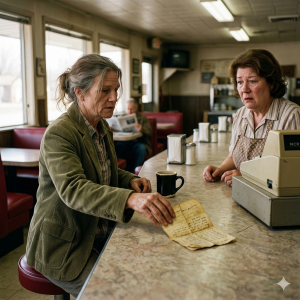
“Coffee,” she said. “Black.”
Donna didn’t move for a moment. Then she poured it, hand steady, face unreadable.
They didn’t speak while Lynn drank it. The diner was quiet, just two other customers at a corner table, and a young waitress who’d stopped pretending to wipe down the pie case.
Lynn set down her mug.
Reached into her jacket pocket.
And she pulled out a folded piece of paper — worn soft at the creases, slightly yellowed, the top right corner missing — and set it on the counter between them.
Donna stared at it.
“What is that,” she said. It wasn’t really a question.
“You always wanted to know what was on the card,” Lynn said.
She pushed it forward with two fingers.
“Go ahead.”
—
Donna’s hands were not steady when she picked it up.
The woman on the stool beside her — a stranger, just passing through — reached out and touched her arm without thinking, because the color left Donna’s face so fast it looked like something medical.
Because written on that index card, in young Lynn’s handwriting from 1987, in ink that had faded to the color of old rust —
was the exact thing Lynn had said out loud at this counter.
The thing the whole room had laughed at.
The thing Donna had spent twenty years assuming Lynn had long since given up on.
And it wasn’t a dream.
It wasn’t a wish.
It was a date.
A number.
And a name.
This name.
This building.
Donna’s mouth opened.
—
What Lynn had said out loud that Friday morning in August of 1987, to the breakfast crowd at Patsy’s Diner, was this:
That she was going to own a restaurant in Millhaven someday. Not just any restaurant. She’d said she wanted to buy the building on Route 9, the one everybody knew, the one with the good bones and the bad plumbing and the hand-painted sign that had been there since 1961. She’d said she had a number in mind — the price she believed the property would be worth in twenty years, based on nothing more than instinct and a clipping from a regional business magazine she’d read at the library. She’d said she planned to do it by 2007.
She’d even said the name she would keep on the sign.
Because she liked the name. Because it was a good diner name. Because changing it would be the kind of petty thing a small person would do, and Lynn had never wanted to be small.
That was what they laughed at.
The specificity of it. The date. The number. The part where she said she’d keep the name.
That last part, especially, had made Donna laugh the hardest. “You’d keep my name on your restaurant.” She’d said it like a punchline.
“Yes,” Lynn had said, simply, and that was when Donna told her to go clear table six.
—
The index card had the date written at the top. September 2007, which was close enough to make the stranger at the counter press her hand to her mouth.
Below the date was a number with a lot of zeros in it. The actual sale price, when it came through the holding company, had been within four thousand dollars of what twenty-four-year-old Lynn had written down.
And at the bottom, underlined twice in that rust-colored ink:
Keep the name.
Donna read it three times.
She set it down on the counter.
She put both her hands flat on the laminate, the way a person does when they need something solid beneath them.
The young waitress by the pie case had given up all pretense entirely. She was just standing there.
“Lynn,” Donna said finally. Her voice had changed. Something had gone out of it. “How long have you had this.”
“Since I was nineteen,” Lynn said. “Wrote it at my mother’s kitchen table. Folded it up. Put it in my apron pocket the first day I started here.”
Donna looked at her. “Every day.”
“Every day I worked here. And in my wallet after. In my jacket pocket today.”
The coffee sat between them, still faintly steaming.
“You came back to show me I was wrong,” Donna said. It was not defensive. It was just the plainest possible thing to say.
Lynn was quiet for a moment.
“I came back because the sale closed yesterday,” she said. “And because you poured good coffee. And because I’ve been carrying that card for twenty years and I thought it was time somebody else saw it.”
She paused.
“And yes,” she said. “Because you were wrong.”
—
Donna didn’t cry. She wasn’t that kind of woman, and Lynn had never expected her to be.
What she did was straighten up. Pull herself back together the way older women from that part of Ohio do — visibly, deliberately, with a kind of dignity that is its own form of grace. She picked up the coffee pot and refilled Lynn’s mug without being asked.
“The building needs a new water heater,” Donna said.
“I know,” Lynn said. “The inspector flagged it.”
“The booth by the window rocks. Left rear leg.”
“I’ll have it looked at.”
Donna set the coffee pot down. She looked at the card still lying on the counter between them.
“Are you keeping me on,” she said.
And that was the question nobody in that room had seen coming, including, maybe, Lynn.
She’d thought about it. Of course she’d thought about it. Donna was sixty-three, and the diner was her life’s work, and whatever she had done or not done or laughed at or failed to see twenty years ago, she had kept this place alive through three recessions and a highway rerouting and the year the furnace gave out in February.
Lynn looked at her.
“Do you want to stay,” she said.
Donna met her eyes. Whatever was moving behind Donna’s face was complicated and old and not entirely readable, which was maybe how it should be.
“It’s my diner,” Donna said, and then she stopped, because it wasn’t anymore, and she knew it.
“It’s Patsy’s Diner,” Lynn said quietly. “It’s always going to be Patsy’s Diner. I wrote that down when I was nineteen years old.”
Something in Donna’s face shifted.
“Same wages,” Lynn said. “Better health coverage, because I’m going to fix that for everybody here. You’d run the floor the way you always have. I don’t want to come in here and change the coffee or move the pie case or repaint anything. I just want it to keep being what it is.”
The stranger at the counter had completely stopped eating. The two customers in the corner had been pretending to look at their menus for several minutes.
Donna Patsy looked down at the index card one more time.
Then she picked it up and held it out to Lynn.
Lynn took it and folded it back along its original creases, soft and practiced, the way you fold something you’ve folded ten thousand times.
“I’ll think about it,” Donna said.
“That’s all I’m asking,” Lynn said.
—
She left a five-dollar bill on the counter for the coffee.
She stood up, buttoned her jacket, and walked toward the door. The bell above it jingled when she pushed it open.
She paused with one hand on the frame. The September air came in, cool and smelling like the end of summer in Ohio, like cut grass and car exhaust and something faintly sweet from the bakery two blocks over.
She didn’t turn around.
“Lynn,” Donna said.
She waited.
“The coffee,” Donna said. “You always did take it black.”
It wasn’t an apology. Donna Patsy was not going to make a speech. She was not going to enumerate her failures or weep or ask for absolution.
But it was something. It was the acknowledgment that she had seen Lynn every day, had known her every preference, had known exactly who was standing in front of her — and had laughed anyway.
Lynn let out a breath.
“I know,” she said.
And she walked out into the morning.
—
Donna stayed on at Patsy’s Diner.
She worked there until she was seventy-one, slower every year, handing things off the way you do when you finally make peace with time. The young waitress who’d been frozen by the pie case that Tuesday morning — her name was Becca, she was twenty-two — worked her way up over the years and eventually became the floor manager. Lynn gave her that job herself.
The water heater got replaced. The booth by the window got a new leg.
The sign stayed the same.
Lynn came in most Tuesday mornings when she was in Millhaven. She always sat at the counter. She always ordered black coffee.
And she always brought the index card with her, tucked into her jacket pocket.
She never needed to show it to anyone again.
But she liked having it there.
Some things, once written down, become more true the longer you carry them. Not because you forced them into being. But because you refused, on every ordinary Tuesday of your life, to let anyone else decide what was on the card.