Sophie only stopped at the diner because her daughter was hungry and the rain wouldn’t let up.
If the storm had been lighter, if Mia had lasted another twenty minutes, if the highway hadn’t dissolved into a gray smear of water and brake lights, Sophie would have driven right past the place and never thought about it again. But Mia had gone quiet in the backseat, and Sophie had learned to fear that kind of silence more than crying.
At five years old, Mia had two different kinds of quiet. The first came with sleepiness, when she leaned her head against the car window and watched the world blur by. The second came when she was overloaded, frightened, or trying hard not to ask questions she could already sense were dangerous. That second silence was the one filling the car now.
So when the old roadside diner appeared through the rain, all weak yellow bulbs and a flickering sign, Sophie pulled in.
Inside, the place was nearly empty. A trucker in a vinyl booth by the window. An elderly couple sharing pie. A waitress in orthopedic shoes and a pale pink uniform. The air smelled like burnt coffee, soup, and damp jackets. It should have felt depressing. Instead, after three days of driving, it felt safe.
The waitress didn’t ask why Sophie looked exhausted or why Mia was clutching a stuffed rabbit so tightly. She just gave them menus and told Mia the grilled cheese was good.
That kindness almost undid Sophie.
She had left Ohio three days earlier with whatever she could fit into the car.
The decision had not been sudden. It had been built over months, maybe years, in all the tiny humiliations people on the outside never really count. Her husband had not turned into a monster in some cinematic burst. He had become dangerous by erosion. First came the missing money and lazy lies. Then the way every disagreement ended with Sophie apologizing to keep the peace. Then the holes punched in doors, the shattered glass, the long speeches about how stress made him act out, how she made things harder, how she was lucky he stayed.
At some point, she stopped measuring her life in days and started measuring it in moods.
Could she ask a question without starting something?
Could Mia laugh too loudly?
Would tonight end with silence, sulking, or rage?
The moment that finally broke her had happened a week earlier. Her husband came home furious about something at work, something Sophie never even understood. Mia was in bed. Sophie tried to keep her voice level. He shouted. She stepped back. Then, in the hallway outside Mia’s room, he slammed his fist into the wall so hard the plaster cracked while their daughter cried on the other side of the door.
He never touched the child.
That sentence had tried to comfort Sophie for months.
After that night, it disgusted her.
He didn’t have to cross the last line for her to know he was walking straight at it.
So she waited until he left the house, packed quickly, took the cash she’d hidden in an oatmeal box, grabbed paperwork, medications, clothes, and Mia’s stuffed rabbit, and drove. She told no one except her older sister, Rachel, in Vermont. Rachel had said, “Get here. We’ll figure out the rest later.”
Since then it had been motels, gas stations, bad coffee, and smiling for Mia whenever the child asked if they were on an adventure.
“Sort of,” Sophie always said.
Mia accepted that. Children are often willing to accept survival if adults decorate it with the right tone.
The food came. Tomato soup, grilled cheese, crackers. Mia brightened enough to ask for crayons. The waitress brought a small plastic cup full of them and a paper placemat. Sophie’s phone buzzed with Rachel’s name, so she stepped outside beneath the awning.
Rain struck the parking lot hard enough to splash upward. Sophie shivered and hunched over the phone.
“Where are you now?” Rachel asked.
“Still on the road. Somewhere in New York. Maybe forty minutes from Albany. We stopped to eat.”
“How’s Mia?”
“Quiet.”
Rachel paused. “And you?”
Sophie looked at the rain and lied. “Fine.”
Rachel did not challenge her. She just said, “Get here. Lock the doors when you stop. Call me before you sleep.”
Sophie promised she would, ended the call, and took one slow breath before heading back in.
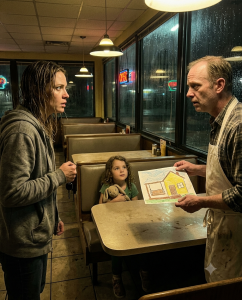
That was when she saw the man standing beside their booth.
He was holding Mia’s drawing.
He looked around forty. Broad shoulders. Dark hair going gray at the temples. Strong hands, one of them resting against the table as if he needed support. A white line circled his ring finger where a wedding band used to be. His face had gone almost bloodless.
Mia was smiling up at him.
“That’s my house,” she said proudly.
The man looked at Sophie. “Where did she see this house?”
Every warning signal in Sophie’s body lit up at once.
“Why?” she asked.
The drawing itself was simple. A child’s square yellow house with two windows, a porch, a tree, and a stick figure in the upstairs window. Sophie had seen dozens of Mia’s dream-house drawings over the last few months. She never studied them closely anymore. But the man was studying this one as if it had reached into his chest.
He pointed to the porch.
“The swing,” he said. “Why did she draw it there?”
Sophie stepped closer.
The swing hung from the left side of the porch roof.
The man swallowed. “I grew up in that house.”
Sophie’s first reaction was pure rejection. Towns all over the country had yellow houses. Children made things up. Memory loved patterns.
“That doesn’t prove anything,” she said.
He pointed again, this time near the chimney. “That line there. Lightning struck the chimney when I was a kid. It left a scar in the siding. My father never fixed it properly. And the swing only hung from the left because the right beam was weak. No one would know that by guessing.”
Mia looked delighted rather than frightened. “You know my dream house?”
The word dream changed something in his face.
He did not laugh. He did not roll his eyes.
Instead he asked, almost too quickly, “Has she seen it before?”
Sophie hesitated.
For months, Mia had described the same place. A yellow house. A porch swing. A girl in the upstairs window. Sophie had assumed it was imagination, then routine, then maybe a comfort fantasy caused by all the tension at home. But the details had only gotten stranger.
Last week, in a cheap motel outside Albany, Mia had woken in the dark crying. Sophie turned on the bedside lamp and held her until the sobbing eased.
“What happened?” Sophie whispered.
Mia had buried her face into the stuffed rabbit and said, “The girl said she’s still waiting.”
Sophie had blamed the stress, the move, the disrupted sleep. She had not told Rachel.
Now, in the diner, that memory returned with uncomfortable clarity.
“She talks about it sometimes,” Sophie admitted.
The man sat down across from them as if pulled by some force stronger than manners.
“My name is Caleb,” he said. “How old is your daughter?”
“Five.”
His throat moved. “What’s her birthday?”
Sophie gave it to him.
Caleb closed his eyes. Not dramatically. Just for a second. But when he opened them again, she understood before he even spoke that whatever came next would be bad.
“My sister died in that house,” he said quietly. “She was five.”
The room seemed to tilt.
Mia dropped a crayon. Sophie shot to her feet.
“We should go.”
Caleb did not block her. He didn’t try to touch Mia or persuade Sophie to sit. He just placed the drawing carefully on the table.
“I would tell you to leave too,” he said. “Except there’s one problem.”
Sophie grabbed her keys. “What problem?”
His eyes lowered to the stuffed rabbit under Mia’s arm.
“The rabbit,” he said. “My mother buried one exactly like that with my sister in 1994.”
Sophie laughed in disbelief. “No.”
“I’m serious.”
“I bought this at a gas station in Pennsylvania four days ago.”
Caleb didn’t blink. “Blue ribbon around one ear. Different button eyes. Left paw repaired by hand because my sister ripped it on a nail.”
Sophie stared at him.
Slowly, she took the rabbit from Mia.
The ribbon was faded blue. The eyes didn’t quite match. Her fingers traced the left paw and found uneven stitches she had never paid attention to before. Not machine-made. Hand-done.
Her mouth went dry.
“Come with me,” Caleb said.
Everything in her wanted to refuse. Yet she followed him to a tiny office behind the kitchen. He opened a dented filing cabinet, took out an old album, and flipped quickly through worn photographs until he found one.
He pushed it across the desk.
The little girl in the picture stood on the porch of a yellow house. She was smiling into the camera. One hand held the porch rail. The other clutched the same rabbit.
Same faded ribbon. Same mismatched eyes. Same clumsy stitch.
Sophie gripped the desk to steady herself.
“What was her name?” she whispered.
“Emily,” Caleb said.
Mia came close enough to see the photo and touched the image with one finger. “That’s the girl in the window.”
Caleb made a broken sound and turned away.
Sophie’s pulse pounded in her throat. “What do you mean, girl in the window?”
Mia looked up at her mother, puzzled by the panic. “In my dream. She’s always upstairs. She says she can’t come downstairs.”
Caleb lowered himself into the chair as if his legs had stopped working. “Did she tell you why?”
Mia nodded. “She said nobody believed her because he cried after.”
The office went still.
Caleb’s face changed in a way Sophie would remember for the rest of her life. It was not ordinary grief. It was recognition breaking through years of denial.
“When Emily died,” he said carefully, staring at nothing, “my father said she fell down the stairs. I wasn’t home. I was staying at my aunt’s. That’s what everyone believed.”
Mia shook her head. “No. Not stairs.”
Sophie stared at her daughter. “Then where?”
“In the room,” Mia whispered. “She said it hurt, and then it got quiet. Then he moved things.”
Caleb leaned forward. “Moved what?”
“The boards.”
It was absurd. Impossible. Yet every person in the room reacted as if they knew absurdity had ended the moment the rabbit matched the photo.
Caleb stood and reached for his keys. “We need to go there.”
Sophie should have said no. She had a child. She was running from one dangerous man already. Following a stranger into a storm because of a dream should have been unthinkable.
Instead she looked at Mia.
Her daughter was pale, frightened now, not dramatic or excited. She was hugging the rabbit as if it were also afraid.
“Will the girl be there?” Sophie asked.
Mia gave a tiny nod.
That was enough.
The house stood thirty minutes away at the edge of a road Caleb knew from muscle memory. The rain had weakened by then, but the night remained black and slick. Caleb drove ahead in his pickup. Sophie followed in her car, her headlights bouncing off wet branches and broken fences.
When they finally turned into the long gravel drive, the yellow house emerged like something waiting to be remembered.
It was smaller than Sophie expected. Sadder too. The paint had peeled almost gray in places. The porch sagged on one side. But the swing still hung from the left beam exactly as Mia had drawn it.
Caleb got out first and stood staring.
“My father died twelve years ago,” he said when Sophie joined him. “I sold the place, but the buyer backed out after inspection. Said it felt wrong inside.” He gave a humorless breath. “I never argued.”
Mia remained between them, holding Sophie’s hand.
They entered with flashlights. The house smelled like dust, damp wood, and old neglect. The beam of Sophie’s light passed over wallpaper curls, a cracked mirror, a staircase disappearing into darkness.
Mia stopped at the bottom of the stairs.
“She’s up there,” she whispered.
Caleb’s jaw tightened. “Emily’s room was the first one on the left.”
The upstairs hallway groaned beneath their steps. Sophie hated every second of it. The bedroom door was half-open. Inside, faded wallpaper with tiny flowers peeled from the walls. Rain tapped at the window. A child’s room stripped of childhood long ago.
Mia walked to the center of the floor and pointed.
“There.”
The boards looked no different from the others.
Caleb stood frozen. Sophie handed him the flashlight and grabbed the rusted fireplace poker leaning in the hallway. He hesitated only once before dropping to his knees and driving the metal between two floorboards.
The first board lifted with a shriek of nails.
Beneath it was darkness and dust.
Under the second board they found a narrow cavity between joists.
Inside lay a small bundle wrapped in what had once been white cloth.
Caleb didn’t touch it at first. Sophie saw his hands shaking again.
Finally he unwrapped it.
There were children’s hair ribbons. A broken charm bracelet. A tiny sock yellowed with age. And beneath them, folded many times over, a page torn from a spiral notebook.
Caleb opened it slowly.
The handwriting was large and uneven, clearly a child’s.
Daddy got mad because I told Mom.
He pushed me.
My head hurts.
He said say I fell.
I don’t want to.
Caleb tell Mom I didn’t fall.
Below the words was a crude drawing of a man, a girl, and a staircase crossed out with angry pencil lines.
Sophie felt the air leave her lungs.
Caleb made no sound at all.
That silence was worse than sobbing.
After a long moment he said, “My mother died believing it was an accident.”
Mia suddenly turned toward the doorway.
Sophie followed her gaze.
Nothing was there.
Yet the room felt different, lighter somehow, as if a pressure that had sat undisturbed for decades had shifted.
Mia smiled through tears she hadn’t realized were falling. “She says thank you.”
Caleb folded inward then, one hand over his eyes, the other gripping the note so tightly Sophie feared it would tear. All those years, all those family stories, all the accepted grief — rebuilt in an instant around a lie told by a father who had cried afterward and been believed.
The next days unfolded with the strange momentum that follows buried truth. Caleb contacted the sheriff. Because the house had changed ownership and the note was discovered after a direct statement from a child, the authorities reopened the file long enough to document the evidence and formally amend the circumstances surrounding Emily’s death. Her father was long dead, which spared him punishment but not exposure. The note was authenticated against Emily’s schoolwork stored in an old memory box from Caleb’s aunt. The details fit old inconsistencies no one had pushed hard enough to question.
Caleb called surviving relatives. Some refused to accept it at first. Others wept and said they had always wondered. Emily’s death, once wrapped in family tragedy, became what it had likely been from the beginning: a fatal act of rage hidden beneath a rehearsed story.
Sophie and Mia did not stay beyond the initial statements. She had her own life to salvage. But before she left, Caleb met them outside the sheriff’s office and handed Mia a new stuffed rabbit.
Not identical. Not an imitation. Just soft, clean, and ordinary.
“She doesn’t need to carry the old one anymore,” he said.
Mia looked down at the original rabbit tucked under her arm. For a second Sophie thought she might refuse. Instead she smiled sadly, as if understanding more than a five-year-old should, and placed the old rabbit into Caleb’s hands.
“That one belongs to Emily,” she said.
Caleb nodded once, too overcome to answer.
They buried it beneath a tree beside Emily’s grave a week later.
Sophie did make it to Vermont. Rachel opened the door and wrapped them both in such fierce relief that Sophie nearly collapsed from it. The legal process with her husband was ugly, but distance gave her strength she hadn’t been allowed to keep. She filed reports. She documented everything. She stopped minimizing what had happened in her own house.
Sometimes, late at night, she still thought about the storm, the diner, the drawing on the placemat. She thought about how close she had come to driving on. How many truths in this world sit waiting because the right frightened woman and the right tired child haven’t crossed paths with the right grieving stranger yet.
Mia stopped talking about the yellow house after that night. The dreams ended. She slept more peacefully. When Sophie asked once whether she still saw the girl in the window, Mia shook her head and said, “No. She went with the rabbit.”
Years later, Sophie would still be unsettled by that answer.
Not because she doubted it.
Because part of her didn’t.
The official story of Emily’s death changed too late to save anyone, too late to confront the man who caused it, too late to give her mother peace while she was alive. But it did something that mattered almost as much. It restored the child’s truth. It gave a name to what had been hidden beneath grief and performance. It forced a family to look directly at the difference between sorrow and innocence.
And for Sophie, the hardest part was not wondering whether ghosts were real.
It was realizing how often the living get away with things simply because they know when to cry, when to sound broken, when to look like the victim instead of the danger.
That was the red flag she would never ignore again.
Not the shouting.
Not the apologies.
Not even the fist through the wall.
The tears after.
Those were what almost fooled everyone.