The town of Black Hollow decided to divide Eveina Cross’s seven children before they even dared look her in the eye.
That was the first thought that stayed with her as she stood in Mayor Gerald Holt’s office with cold seeping through the soles of her boots and grief packed tight behind her ribs like a stone she could not cough loose. Edmund had been dead twenty-three days. She knew the number because every morning since his fever took him, she woke in the dark and counted from the moment she last heard his breathing.
Twenty-three days since his body had been wrapped in the good quilt.
Twenty-three days since Elias, only fifteen, had broken frozen earth with a pickaxe because no one else in the family was strong enough.
Twenty-three days since Eveina had made herself stop crying before the children saw.
In a two-room house with seven children and winter settling in for the long hold, tears were a luxury with no practical use. They did not split wood. They did not stretch flour. They did not stop little fingers from going purple in the morning.
She had forty pounds of cornmeal left, a strip of salted bacon hanging in the pantry, two jars of beans, and Edmund’s rifle. The rifle leaned near the door where he had always left it, and every time she looked at it she felt the same thing: not comfort, not protection, but absence. In Edmund’s hands it had been purpose. In hers it was a reminder of all the things she had never learned because she assumed there would be time.
Ruth, fourteen, had taken over slicing the bread into painfully thin pieces. She never complained. That made it worse. Elias hauled water and chopped wood with a hard, set face that was too much like his father’s when he was angry. Owen counted logs every evening before bed. Henry carved tiny animals out of scraps with a pocketknife Edmund had given him. Bess tried to act cheerful and failed. The twins, Sam and Clara, asked questions no one could answer.
“Will Papa come back when spring comes?”
Eveina had no room left in herself for lies, but no cruelty in her either, so she would kiss their heads and say, “No, baby. But he loved you enough to stay in this house even after he was gone.”
She did not know if that was true.
She only knew the house still felt full of him.
When the food stores shrank enough to make denial ridiculous, Eveina put on her coat, wrapped a scarf around her hair, and walked into Black Hollow to ask Garfield’s store for credit.
She did not ask for charity.
She asked for winter.
Garfield sent her to the mayor.
Gerald Holt received her with a face arranged into sympathy. It was neat sympathy, controlled sympathy, the kind a man wears when he wants to appear humane without taking on the inconvenience of feeling too much.
“Edmund was a good man, Eveina.”
“He was,” she replied. “That’s why I came for time. Not favors. Time.”
Holt folded his hands. “The town wants to help.”
She already disliked the sentence before he reached the end of it.
“How?”
“The Brands might take the younger two. Tom Ruger has use for a strong boy at the mill. The Hendersons could receive Ruth. Reverend Morrison believes he can place the rest where they’ll be fed until spring.”
She stared at him long enough to make him shift in his chair.
“My children are not parcels.”
“No one said they were.”
“Then stop speaking as if they’ve already been assigned.”
A flicker of irritation crossed his face. “The council discussed contingencies.”
“You discussed my family without me.”
“We had to be prepared.”
“No,” she said quietly. “You had to wait until I became desperate enough to thank you for taking them.”
Holt’s silence told her she had struck the truth squarely in the chest.
He gave her a week.
One week to somehow create food out of nothing, heat out of bare walls, hope out of a grave so fresh the dirt was still hard and uneven.
Eveina left the office feeling as if she had been skinned somewhere no one could see. On the street, snow gusted across the boardwalk in dirty swirls. She should have gone home. Instead, she heard voices coming from the meeting hall and recognized the rhythm of public concern—that hateful tone people used when discussing another person’s suffering as though it were a logistical challenge.
She stepped inside and remained near the back, hidden in shadow.
Dale Ferris argued that no family in Black Hollow could be expected to carry seven extra mouths. Reverend Morrison talked about Christian mercy without offering his own table. Tom Ruger said Elias was big enough to work and ought to be grateful for the chance. Someone else suggested splitting the girls among households where they could be “made useful.”
“The widow will object,” one man muttered.
“When there’s no food left, she’ll stop objecting,” Holt replied.
Eveina clenched her hands until her nails bit skin.
Then Ferris said a name that changed the room.
“What about Maddox?”
Silence followed like a dropped curtain.
Everyone in Black Hollow knew Thorn Maddox, though almost no one knew anything real about him. He lived on the north slope alone, came to town irregularly, traded hides and smoked meat, bought what he needed, and left before anyone had the nerve to ask direct questions. Rumor had done the rest. He had killed a man. He had buried a family. He had hidden gold. He had no mother, no wife, no church, no softness. Children were warned about him as if he were part man, part weather.
“Not suitable,” Tom Ruger said first. “He’s half wild.”
“He has food,” Ferris countered. “And room.”
“He has a reputation.”
Black Hollow’s reputations were often built by the people least burdened by truth.
Holt slammed his palm against the table. “Even if he agreed, I would not put a widow under a stranger’s roof.”
The door burst open then, so suddenly the lamps trembled.
A man had to lower his head to clear the frame. Snow and wind came in with him. Thorn Maddox wore an old coat, heavy boots glazed with ice, and a rifle across his back. He looked over the room once, and the whole meeting seemed to shrink around him.
“You’re discussing Edmund Cross’s family.”
Holt stiffened. “This is council business.”
“Then I’ll be brief.”
Maddox set a canvas bundle on the table. Inside were dressed rabbits, a slab of venison, dried beans, and smoked meat.
The message was obvious.
He had not come to debate hunger.
He had come to expose it.
“You aim to split those children apart,” he said.
“We are considering options,” Holt answered.
“No. You are waiting for their mother to be too hungry to refuse.”
Nobody rushed to disagree.
“If you have something useful to add,” Holt said sharply, “say it.”
Maddox turned his head toward the back of the room. His eyes found Eveina in the shadows at once. She had the uncanny feeling he had known she was there from the second he entered.
“I’ll take them,” he said. “The widow and all seven children. My cabin. Through the winter.”
It took several seconds for the room to understand what had just happened.
Holt recovered first. “Absolutely not.”
Maddox looked at him once. “You had no trouble sending her children to seven different doors.”
“That is not the same.”
“No. It’s worse.”
Eveina stepped out from the shadows because there was no longer any point hiding.
The room shifted its attention toward her, but she only looked at Maddox.
He was larger up close than she expected, but it was not size alone that unsettled her. It was control. He did not fidget, did not fill silence to make others comfortable, did not look away from difficulty. A scar marked one side of his jaw. His coat was worn but clean. His face had the roughness of weather, not vice.
“You’d take all eight of us?” she asked.
“Yes.”
“Why?”
For the first time, his expression moved.
“Years ago, your husband pulled me from a river after my horse threw me. Water was fast. I’d have drowned. He never told anyone. Never took payment. Never used it to make me beholden in town.” Maddox paused. “I owe him.”
Eveina had been married to Edmund for seventeen years. She had never heard that story.
That alone told her it was probably true. Edmund had never advertised his good deeds. He mistrusted men who did.
“And what do you want in return?” she asked.
“Whatever work you can give honestly. Respect for my house. No lies to your children.” Then he added, “And no one touches my locked shed.”
A murmur ran through the room.
Tom Ruger smirked. “What’s in the shed?”
Maddox turned slowly toward him. “Something that belongs to me.”
The smirk died.
Eveina should have been alarmed. Instead, she found herself watching the reactions in the room. The same men who wanted to parcel out her children were now scandalized by the idea of mystery. It told her almost everything she needed to know about where danger actually lived.
Holt tried again. “This is not proper.”
“Hunger isn’t proper.”
The reverend opened his mouth, then shut it.
Eveina stood very still and thought with brutal clarity. If she refused, what then? Another week, perhaps two. Then the flour would be gone. The bacon gone. The children thinner. Ruth sent elsewhere “for her own good.” Elias to the mill. The little ones to homes that would call them blessings in public and burdens in private.
If she accepted, she would be stepping into uncertainty with a man everyone mistrusted.
But he was also the only person in that room who had spoken about keeping her family together.
“When?” she asked.
“At first light,” he replied.
Reverend Morrison protested. “You must pray over this.”
“I have been praying,” Eveina said. “This is the first answer that came with food.”
So at dawn she loaded everything they had left into Maddox’s wagon. The children climbed in wrapped in quilts and patched coats. Townspeople watched from porches, pretending not to stare. Eveina saw pity on some faces, satisfaction on others, and on Holt’s face something she could not place then but would later recognize very clearly: worry.
The road to the north slope took most of the day. Gradually the town disappeared behind pines and ridges. The air sharpened. Snow deepened. Sam and Clara dozed against Ruth. Henry held a small carved fox in one fist. Bess whispered questions to Owen. Elias watched Maddox in suspicious silence.
At one point Bess asked, “Do mountain men eat children?”
Before Eveina could answer, Maddox said, “Only loud mayors.”
The wagon erupted in startled laughter.
The sound shocked Eveina more than the joke.
It had been so long since her children laughed all at once.
The cabin stood on a shelf of land cut into the mountain, backed by pine and open enough in front to watch the approach road. It was larger than Eveina expected, built sturdy and practical. There was a porch, a smokehouse, stacked wood, a hand pump, a barn, and farther off, partly tucked behind a drift and stand of trees, a separate shed with a thick iron lock.
Maddox noticed her glance.
“Later,” he said.
Inside, the cabin was warm.
Not merely warmer than outside. Warm.
Stew simmered over the fire. Blankets had been laid out. Extra pallets were ready. There were nails at child height for coats. Water had already been drawn. It was the work of someone who had spent hours preparing for their arrival.
Eveina turned in the center of the room and felt a strange rush of unease. A careless man did not prepare like this. A cruel man did not either. But a man expecting something—something specific—might.
During supper, the children ate with the dangerous hunger of the underfed. Maddox never once acted as if he were doing them a favor. He refilled bowls. He slid bread toward them. He spoke little, but when he did, he spoke to them directly, not around them. That won him points with Elias, though not enough to soften him.
Afterward Eveina reached for the bowls, but Maddox stopped her.
“Not tonight. You’re worn through.”
“I can still wash dishes.”
“I know. That isn’t the point.”
It was such a small exchange, yet it stayed with her. Most men ordered. Most men assumed. Maddox observed.
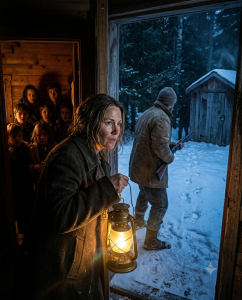
Night settled quickly. Wind pressed against the walls. The children began to sag from exhaustion. Eveina was lifting Clara from the bench when the little girl looked toward the window and whispered, “Mama… who’s that?”
Every head turned.
A shape moved in the yard near the locked shed.
Maddox reacted instantly. One moment he was beside the fire, the next he had the lantern in one hand and the rifle in the other. His face changed completely. Whatever patience or reserve he normally wore vanished beneath something sharper.
“Stay inside,” he said.
He stepped into the snow and pulled the door shut behind him.
For a few seconds they could only watch his lantern beam sweep the yard. Then the shadow near the shed bolted toward the tree line. Maddox shouted. The figure slipped, regained footing, and vanished into the dark.
No shot came.
Only crashing through snow. Then silence.
When Maddox returned, he barred the door immediately. There was frost in his beard and a dark stain on one sleeve.
“Are you hurt?” Elias asked.
“No.”
But Eveina’s eyes locked on the stain. Blood.
“Who was it?”
Maddox looked toward the shed before answering. “Someone looking for something.”
“What something?”
He said nothing.
That was when Eveina understood the locked shed was not merely a curiosity. It was the center of whatever danger had followed them here.
The younger children were sent to bed while Ruth settled them under blankets. Elias refused to leave. Owen stayed too, trying not to shake. Henry sat close to the hearth hugging his carved fox. Eveina remained standing.
“Tell me now,” she said. “You brought my children into this place. If someone is prowling your yard, I have a right to know why.”
Maddox reached into his coat and removed a key. Heavy iron. He looked at it before looking at her.
“Your husband found something on this mountain two winters ago.”
She stared at him. “No.”
“He did.”
“He would have told me.”
Maddox’s expression changed again, this time with something like regret. “He tried.”
Outside, a branch snapped.
Then came another sound from farther down the slope.
Voices.
More than one.
Moving upward through the dark.
Maddox crossed to the window and peered through the frost. “They came faster than I thought.”
“Who?” Elias demanded.
Instead of answering, Maddox took the lantern and gestured toward the back room. “Wake Ruth. Quietly. Bring the little ones.”
Eveina stepped in front of him. “No more half-truths. What did Edmund find?”
Maddox held her gaze. Then, perhaps because there was no time left for careful withholding, he finally spoke.
“There used to be a mine above the north ridge. It failed before the war and everyone forgot it. Most folks thought it was empty. It wasn’t.” He swallowed once. “Edmund found ledgers. Land deeds. payment books. Records hidden in a steel chest.”
Eveina frowned, not yet understanding why papers mattered enough to draw men into the snow after dark.
Then Maddox continued.
“The books prove that half the property in Black Hollow was stolen. Widows forced off land. Taxes invented. Signatures forged. Mine shares taken from men who could not read. Gerald Holt’s father started it. The current mayor has been protecting it ever since.”
The room seemed to tilt.
“No,” Eveina whispered. “Why would Edmund hide something like that?”
“Because when he found it, he came to me first. Said if those papers reached the wrong hands, they’d vanish. Said he needed time to decide who could be trusted.”
“Trusted with what?”
“With enough proof to ruin the men who built this town.”
Her mind raced backward through every strained conversation Edmund had brushed aside over the past year. The night he came home later than usual with mud to his knees. The time she found him staring at a folded sheet by lamplight and he tucked it away when she entered. The arguments he avoided with Holt. The odd look on Gerald Holt’s face at the funeral.
“He was going to tell me,” she said again, but it sounded smaller now, less certain.
Maddox did not answer. That hurt more than contradiction.
A hard knock struck the cabin door.
Everyone jumped.
Then Holt’s voice carried through the wood, controlled and formal as ever.
“Mr. Maddox. We know you’re awake. Open the door. We only wish to speak.”
Maddox’s mouth flattened. “He brought company.”
Another voice called out—Tom Ruger’s this time. “No need to make trouble over papers that don’t belong to you.”
Eveina felt the blood drain from her face.
Papers.
So that was it.
The council had not simply prepared to divide her children because she was poor. They had moved quickly because Edmund had died before telling anyone where he put the proof. They assumed hunger would scatter the family, expose the house, and make searching easier.
All at once the mayor’s urgency, the town’s rehearsed concern, even Thorn Maddox’s sudden intervention aligned into one terrible shape.
“They think Edmund told me,” she said.
Maddox looked at her. “Did he?”
She almost said no.
Then memory flashed—not as a full answer, but as a fragment.
The last week of Edmund’s life, fever already on him, he had gripped her wrist with frightening strength and said, If anything happens, don’t trust Holt. Don’t let them put the children where they can watch you.
She had thought delirium was speaking.
Now she knew better.
Another knock hit the door, harder this time.
“We can do this peacefully,” Holt called.
Maddox moved to the hearth, lifted one of the floorboards with the toe of his boot, and pulled out an oilskin packet. He handed it to Eveina.
“Take the children through the root cellar passage behind the pantry,” he said. “It leads to the barn. From there you can reach the ravine.”
“You have a passage?”
“I have reasons.”
She clutched the packet. “What about you?”
“I’ll slow them down.”
Elias stepped forward at once. “I’m staying.”
“No,” Eveina snapped.
Maddox crouched just enough to look the boy in the eye. “Your job is your mother, your sisters, and your brothers. If you stay, she has one less shield. If you go, she has another man walking beside her.”
Elias swallowed hard.
He nodded.
The door rattled under a shove from outside.
Ruth emerged carrying Clara, Sam close behind her, eyes wide with sleep and fear. Owen grabbed Henry’s hand. Bess was pale but steady.
Eveina looked around that room once—the warmth, the stew pot, the care laid out in quiet preparation—and realized Thorn Maddox had expected this possibility from the moment he offered them shelter.
“Why help us?” she asked one last time, because she needed the truth.
Maddox glanced toward the door where Holt and the others were beginning to lose patience.
“Because Edmund saved my life,” he said. “And because men like Holt count on everyone decent being too tired or too afraid to stand in the way.”
The crash of a shoulder against the cabin door shook the frame.
Maddox handed Eveina the key to the locked shed.
“If I don’t make it to the barn,” he said, “go there before dawn. What’s inside will prove everything.”
She stared down at the iron key, feeling its weight settle into her palm like fate.
Another crash.
A splinter.
Tom Ruger shouting.
Maddox lifted the rifle.
Eveina gathered her children and backed toward the pantry, the packet under one arm, the shed key in her fist, fear climbing high and hot in her throat. As she pulled the hidden latch and the dark mouth of the passage opened, she heard Holt call from the front room in a voice stripped at last of all practiced kindness.
“Bring me the widow first.”
The passage smelled of earth and roots and old cold. The children stumbled in single file, clutching one another. Eveina followed last, and before she closed the panel she looked back once.
Thorn Maddox stood alone in the firelit room with Edmund’s debt in one hand and his own past in the other, waiting for the men of Black Hollow to break through the door.
The first board gave way with a crack.
Eveina pulled the panel shut and led her children into the dark.
They reached the barn with the sounds of shouting behind them. Snow blew through the broken boards. She wanted to run at once, but then she looked at the oilskin packet and at the key.
If the papers in that packet were copies, then the originals might still be in the shed. If the town got them, the truth would die again. If she fled with only her children, Holt might hunt them forever. If she went back, she might lose everything before morning.
Ruth touched her arm. “Mama?”
Eveina looked at all seven of them—hungry, exhausted, frightened, together.
That was when she understood the choice in front of her was no longer the one Black Hollow had tried to force on her. It was not safety or danger. It was silence or truth.
She kissed each child once, fast, hard, memorizing every face.
Then she turned to Elias.
“You’re the man of this family until I return.”
His face went white. “Mama—”
“I am coming back,” she said, whether it was promise or prayer she did not know. “Take them to the ravine and wait by the old split cedar. No matter what you hear.”
She gave Ruth the packet.
She kept the key.
Then Eveina Cross, widow of Edmund Cross, walked back into the storm toward the locked shed, toward the men who had tried to divide her children before the grave dirt settled, toward the truth her husband died trying to protect.
Inside the shed she found not gold, not stolen silver, not weapons.
She found the steel chest.
And beneath it, wrapped in cloth, a letter in Edmund’s hand.
My Eveina,
if you are reading this, then Holt moved faster than I hoped. Trust Maddox. Burn no papers. Take them to the state marshal in Briar County. And know this above all else: I kept the truth from you only to keep you safe, and I was wrong. The worst danger was always silence.
She read it with shaking hands while voices searched the yard.
Then she lifted the chest.
And for the first time since Edmund died, she did not feel like a woman waiting for mercy.
She felt like the one thing Black Hollow had failed to calculate.
A mother with nothing left to surrender.
By dawn, Gerald Holt was in chains, Tom Ruger had broken his wrist trying to flee, and Reverend Morrison had discovered that sermons about mercy sounded different when spoken under oath. Thorn Maddox survived the night with a knife wound to the arm and a split above one eye. The papers reached Briar County by noon under state escort. Within weeks, claims were reopened, old land thefts exposed, and names people thought untouchable were dragged into daylight.
Black Hollow never looked the same again.
Some said the town had been betrayed.
Others said it had finally been forced to meet its own reflection.
Eveina and the children remained on the north slope through the rest of winter, not because they had nowhere else to go, but because for the first time in months they slept under one roof without fear of being separated by smiling people with lawful words. By spring, the state granted Eveina control of a tract of land that had once belonged to Edmund’s father before it was stolen on paper decades earlier.
As for Thorn Maddox, the stories about him changed slowly, and only because truth is stubborn when it survives. He was not half wild. He was simply a man who had seen what respectable men could do while wearing clean collars and shaking hands in public.
Sometimes that was the harder thing to forgive.
Years later, when people retold the story, they always spoke about the mountain man’s offer as if that had been the miracle.
It wasn’t.
The miracle was that Eveina understood in time what kind of danger deserved fear and what kind deserved defiance.
The biggest red flag was never the locked shed on the mountain.
It was the polished sympathy in town.
And if she had trusted that instead, her children might have been fed for a season and lost for a lifetime.