
They said Darlene Fitch had nothing left after the divorce.
Gary made sure of it.
Thirteen years of marriage, two decades of building his dealership from a single used-car lot on Route 9 into something people in three counties actually respected — and when it was over, Darlene walked out of that courthouse with a settlement so thin it barely covered first and last month’s rent on her apartment above the dry cleaner on Elm Street.
She remembered the exact moment.
Gary’s attorney had held up a small brass key on a worn leather cord — the kind of key that doesn’t look like it opens anything important — and Gary had actually smiled when he said it.
*”This opens nothing worth keeping.”*
The judge had agreed. The key went to Darlene. Everything else went to Gary.
That was seven years ago.
—
Tonight, the banquet hall at the Marriott on Cloverfield Road was packed.
Fitch Automotive Group’s retirement party for Gary Fitch — founder, president, the man whose face was on forty-seven billboards between here and the state line — had drawn every dealer, every vendor, every golf buddy Gary had collected over thirty years.
White tablecloths. Open bar. A slideshow running on loop that somehow managed to tell the entire history of Fitch Automotive without featuring Darlene once.
She noticed.
She also noticed the way the room went quiet — not all at once, but in a wave — when she walked through the door at 7:14 p.m.
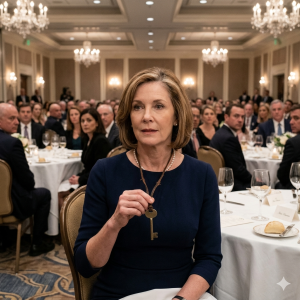
Darlene Fitch was wearing a navy sheath dress and low block heels. Nothing flashy. Her hair was the same honey-brown she’d always kept it, maybe a little shorter now. On her right hand, the cubic zirconia ring Gary had held up in the settlement meeting and called *”a convincing imitation of something real”* — she’d kept wearing it all these years, on purpose.
But tonight it was flanked by two other rings.
Nobody in that room could quite figure out what they were looking at. The stones weren’t diamonds. They weren’t sapphires. They caught the light in a way that made people squint and lean toward their neighbor and whisper.
And around her neck, on the same worn leather cord, the brass key.
Plain as the day Gary had dismissed it.
She touched it once, at the door, like a person checks a compass before walking into unfamiliar territory.
Then she smiled at Gary’s assistant — sweet Patrice, who had always been kind to her — and she found her seat at table eleven.
—
Gary saw her from across the room.
To his credit, he recovered quickly. A man who’d sold cars for thirty years knew how to keep his face neutral when something surprised him.
But his business partner, Dale Hendricks, leaned in and said something. Gary shook his head. Whatever Dale had heard, Gary wasn’t ready to believe it.
Darlene accepted a glass of water from a passing server and did not look at Gary Fitch once.
She’d had seven years to practice that.
—
Here is what most people in that room did not know:
For the past two years, a mid-sized acquisition firm called Cornerstone Automotive Holdings had been quietly purchasing distressed dealerships across the region.
Buying them at fair prices. Keeping the staff. Upgrading the service departments. Turning them around.
Nobody had met the principal owner in person. All communication went through attorneys and a very calm, very competent woman named Susan Park who returned calls within the hour.
Cornerstone had acquired nine of Gary’s eleven locations before anyone inside Fitch Automotive understood what was happening.
The other two had come in the last sixty days.
—
At 8:30 p.m., the speeches were supposed to start.
Instead, a man Darlene had never seen before — mid-fifties, navy suit, reading glasses pushed up on his forehead — stepped to the microphone at the front of the room and cleared his throat.
The slideshow stopped.
The bartenders stopped pouring.
Gary Fitch stood up from his chair.
“I’m sorry to interrupt the evening,” the man said, and his voice was the practiced calm of someone whose whole job is delivering information in rooms where the information is unexpected. “But there are some legal matters that were scheduled to be finalized tonight, per the agreement signed in March, and I’ve been asked to make a brief announcement before the formal program begins.”
Someone at Gary’s table said something low and urgent.
Gary did not sit back down.
“Fitch Automotive Group,” the man continued, “has completed its acquisition process as of close of business today. Per the terms of the sale, I’m here to confirm the transfer of final assets.” He looked down at his papers. Looked back up. “All eleven locations transfer today to the sole bidder.”
And every head in that room turned toward table eleven.
Toward the woman in the navy dress.
Toward the cubic zirconia ring that had once been called a convincing imitation of something real.
Toward the plain brass key on the worn leather cord.
Darlene reached up.
Slowly.
And closed her fingers around it.
—
She did not stand up.
She did not make a speech. She did not look over at Gary with triumph on her face. She was not that kind of woman, and she had not spent seven years becoming that kind of woman.
What she did was look at Patrice.
Sweet Patrice, who had answered Gary’s phones for eighteen years and had sent Darlene a sympathy card — unsigned, but Darlene knew the handwriting — after the divorce was finalized. Patrice, who had called in sick on the day Gary held his big “fresh start” party and had never explained why.
Darlene looked at Patrice, and she nodded once. That was all.
Patrice pressed her fingers to her mouth and looked away.
—
The man at the microphone said a few more sentences about transition timelines and HR communications and the fact that all employment contracts would be honored through the end of the calendar year. His name was Robert Ellison. He was a partner at the firm that had handled the acquisition on Darlene’s behalf, and he was very good at his job. He wrapped up in under four minutes and stepped away from the microphone without fielding a single question, because fielding questions was not what he had been retained to do.
The room did not immediately recover.
People looked at their neighbors. They looked at their drinks. A few people looked at Gary, who was still standing, and then quickly looked somewhere else, the way you look away from a car accident once you’ve confirmed no one is badly hurt.
Gary’s face had gone the specific color of a man who has just understood something he cannot yet admit he understood.
Dale Hendricks had sat down.
—
Here is what the key actually opened.
In the summer of their fifth year of marriage, Gary and Darlene had gone to an estate auction in Harding County — one of those Saturday afternoon things where a farm family sells off three generations and strangers pick through the pieces. They’d gone because Gary had heard there might be a vintage truck worth looking at.
There was no vintage truck worth looking at.
But there was a small lockbox, olive green, military surplus, the kind that had been sitting in someone’s barn since 1974. The auctioneer had held it up and said the key was missing and opened the bidding at five dollars. Nobody moved. Darlene had raised her hand.
She’d paid seven dollars for it.
Gary had teased her about it the whole drive home. What are you going to do with a locked box you can’t open? She’d said she’d figure it out. He’d said that was exactly the kind of thinking that would drive him crazy for the rest of his life.
She’d smiled. She’d meant it as a compliment to herself.
That night she’d spent two hours with a piece of wire and a YouTube video and she’d gotten the box open.
Inside was a brass key on a worn leather cord, a folded piece of paper with a name and an address and the words “deed of trust” written in pencil, and a photograph of a man and a woman standing in front of a building neither of them recognized.
The paper turned out to be nothing actionable, legally speaking. The building in the photograph was a grain co-op that had burned down in 1981.
But Darlene had kept the key because she liked the weight of it. She’d worn it around her neck sometimes when she was working in the garden. It became a habit the way small physical habits do — not meaningful, exactly, but attached.
When Gary’s attorney held it up in that courthouse, Darlene had felt something that was not quite anger and not quite grief. More like the particular humiliation of having something private made public and then dismissed in the same breath.
She’d taken the key and put it back around her neck on the drive home.
She had not taken it off since.
—
At the courthouse, seven years ago, Gary had also signed over — as a kind of parting gesture of contempt, his attorney framing it as generosity — a small storage unit on the far side of Millhaven Road. Unit 114. The kind of place where people put things they don’t want anymore but can’t bring themselves to throw away.
The unit contained twelve boxes of Darlene’s personal items that Gary had packed after she moved out, three pieces of furniture she’d brought into the marriage, and a filing cabinet with a lock.
The filing cabinet key was on the same worn leather cord as the brass key from the lockbox.
Nobody had noticed.
Gary’s attorney had been looking at the brass key, not the smaller silver one threaded on the same cord above it.
The silver key had been there for six years by then. Darlene had stopped noticing it herself the way you stop noticing something you’ve looked at every day.
Inside the filing cabinet, in a manila folder with Darlene’s handwriting across the tab, were the original financial records from Fitch Automotive’s first three years — the years before Gary had hired an accountant, the years when Darlene had been the bookkeeper, the office manager, the person who answered the phone and swept the showroom floor and drove the courtesy shuttle on Saturdays.
Not copies. Originals.
Gary had put them in the cabinet himself, years ago, when he’d been reorganizing the office and decided the old paper records were clutter. He had forgotten they existed.
Darlene had not known they were there until she opened the cabinet, two weeks after the divorce, in the dusty heat of storage unit 114. She’d sat down on a folding chair she didn’t remember owning and read through every page.
She was in there for four hours.
When she came out, she called her sister in Dayton and said: I need you to recommend me a good accountant. Not a tax person. A forensic one.
Her sister had said: Darlene, what happened?
She’d said: Nothing yet. But I think I’m going to need about five years.
It had taken seven.
—
The records showed what Darlene had long suspected and never been able to prove during the marriage: that the dealership, in its earliest years, had been capitalized in part by an inheritance from Darlene’s grandmother that Gary had reclassified, quietly, as a personal loan he had repaid to himself. Forty-three thousand dollars. In 1997, that was real money. By the time of the divorce, with interest and with the value it had seeded, a forensic accountant named Howard Briggs had told Darlene it represented a traceable contribution to what the business eventually became.
Not enough, by itself, to reopen the divorce settlement.
But enough to use.
Not as a hammer. Darlene wasn’t interested in a hammer.
As a door.
—
She had spent five years learning the automotive industry. Not from the outside — she’d been on the inside for two decades, she already knew the inside. She learned acquisitions. She learned how distressed dealerships got bought and sold and what made them turn around. She took a certificate program at the community college in commercial real estate. She read everything Howard Briggs told her to read.
She had started small. One location, in Belton, that had been mismanaged by a family in the middle of its own inheritance dispute. She’d bought it for less than it was worth, kept every employee, hired a service manager named Terri Voss who turned out to be extraordinary, and within fourteen months had turned a profit.
Then another.
Then she’d met Susan Park at a regional business conference, and Susan had said, very directly, over mediocre conference coffee: I’ve been watching what you’re doing. I think you need a partner who can run point on negotiations so your name stays out of it.
Darlene had thought about that for two days.
She’d called Susan and said: There’s a specific portfolio I have in mind.
Susan had said: I figured.
—
Gary walked over at 9:05.
The room had partly recovered by then. The bar had reopened. There was the low murmur of people having urgent conversations in careful voices. The slideshow had not resumed.
Gary walked over alone, which told Darlene that Dale had advised him not to and he’d ignored it. Gary had always ignored Dale.
He pulled out the empty chair across from her — table eleven had largely cleared, politely, people finding reasons to be elsewhere — and he sat down without asking.
Darlene looked at him directly for the first time in seven years.
He looked older. Well, they both did.
He said, “You could have just called me.”
She considered that for a moment. “You disconnected the number.”
“You could have had your attorney call my attorney.”
“I could have,” she agreed.
He looked at the key. His jaw tightened. “That was supposed to be a joke. My attorney thought it was funny.”
“I know.”
“It was nothing. There was nothing on that cord worth anything.”
She didn’t correct him. She just looked at him the way you look at someone when you’ve decided that explaining is no longer necessary.
He was quiet for a moment. Gary Fitch was not a stupid man. He had built something real over thirty years, whatever else he was. She had watched him understand things quickly for a long time.
He was understanding something now.
“The filing cabinet,” he said.
Not a question.
“The filing cabinet,” she confirmed.
He sat with that.
“What happens now?” he asked. “To the locations.”
“The same thing that already happened to nine of them,” she said. “Same staff. Better service departments. Reasonable management.” She paused. “I’m keeping the name off the buildings, Gary. It’ll be Cornerstone.”
Something moved across his face. She wasn’t sure if it was relief or a different kind of loss.
“And me?” he asked.
“That’s not my business anymore,” she said, and she meant it without cruelty. “You have the retirement payout from the sale. You have the house on Birchwood. You have your golf.”
He looked at his hands. Then back up at her. “Thirteen years, Darlene.”
“Twenty, if you count the dealership,” she said. “I always counted the dealership.”
He didn’t have an answer for that.
Nobody had an answer for that.
—
She stayed until ten o’clock because she didn’t want people to think she’d come only for the announcement. She had a conversation with a fleet sales manager named Rick Polito who was worried about his job and needed to hear directly that his contract was being honored. She spent fifteen minutes with Gary’s parts manager, a quiet man named Ed who had worked Route 9 since the beginning, who shook her hand and didn’t say much but held on for an extra second.
She hugged Patrice at the coat check.
Patrice said, “I never told him anything. I want you to know that.”
Darlene said, “I know. I always knew that.”
Patrice looked at the key. “What does it open?”
Darlene smiled. “It came from an old lockbox I bought at an estate auction in Harding County. About twenty-two years ago now.”
Patrice waited.
“It doesn’t open anything anymore,” Darlene said. “The box fell apart years ago. But I kept the key because —” She stopped. Thought about it honestly. “Because it reminded me that I was the one who figured out how to open it. Gary thought it was worthless. I thought it was interesting. And that difference turned out to matter.”
She said goodnight.
She walked out through the lobby of the Marriott on Cloverfield Road at 10:04 p.m. The air outside was cool and smelled like October, that particular combination of woodsmoke and dead leaves that makes everything feel like something is ending and something else is deciding whether to begin.
She sat in her car for a minute before starting the engine.
The two rings flanking the cubic zirconia were from Howard Briggs’s wife, a jewelry maker who worked in labradorite — that was the stone that had caught the light so strangely, that had made people squint and lean and whisper. Howard had introduced them at a Christmas party three years ago. The rings had been a gift. A real one. From someone who knew the difference.
Darlene looked at them in the dark of the car.
She thought about the woman who had paid seven dollars for a locked box at a county estate auction because she thought it was interesting.
She thought about