Seven years earlier, Donna Prewitt left Calvary Baptist Church carrying a cardboard box full of office supplies, framed scripture cards, and the remains of a life she had thought would last.
By the time she reached her car, she was trembling so badly she had to set the box on the hood before she could find her keys. Her eyes burned. Her throat hurt from holding back words that would not have changed a thing even if she had spoken them. She had just been dismissed from the church where she had worked for eleven years, and everyone involved had managed to make it sound like her humiliation was an unfortunate administrative necessity.
They did not accuse her of lying.
That was the cruelest part.
No one ever said she was wrong. They simply said she had made things difficult.
On the passenger seat, she dropped the box, slid behind the wheel, and stared straight ahead until the parking lot blurred. Only then did she feel something hard in the pocket of her coat. She reached in and pulled out a plain brass key hanging from a worn leather fob.
For a second she did not understand why it was there.
Then she did.
The records cabinet.
The one in the back room behind Pastor Whitfield’s study. The one that held old budgets, contract files, restricted donations, and certain folders that were never discussed in front of the wider finance committee. The one Gary had once jokingly called “the church vault,” though there was nothing joking about the way he would shut the door before opening it.
Donna almost got out of the car and walked it back inside.
Instead, she closed her hand around it, started the engine, and drove home.
She told herself she would return it later.
Later stretched into seven years.
Before her life split open, Donna had been content in the quiet, practical way some women are. She did not need attention. She liked order, numbers that balanced, and routines that made sense. At Calvary Baptist, she handled books, payroll records, donor logs, utility schedules, and the endless stream of details that kept the church functioning while more visible people took credit for leadership.
She knew who gave generously. She knew who promised generously and never followed through. She knew which expenses were necessary and which were vanity. Over time she learned something more dangerous: she knew how easily trust could be used as camouflage.
At first the irregularities were small. A transfer from building maintenance into general operations, then back again a month later. A reimbursement that lacked receipts. A delay in recording a memorial gift until after a quarterly report. When she asked questions, the answers were always plausible on the surface.
Pastor Whitfield would smile and say, “Temporary hold. We’re smoothing timing issues.”
Gary, who served on the finance committee and seemed to enjoy being the man who knew confidential things, would tell her not to worry. “All churches move money around. You’re seeing pieces, not the whole picture.”
Donna wanted to believe him. At that point Gary was still her husband, still the man she had spent years cooking for and sharing a bed with, still the person whose voice could calm her just by entering a room. If he said it was complicated, she assumed it was.
Then the roof started leaking again.
Calvary Baptist’s old stone building had been beautiful for longer than anyone in town had been alive. It sat at the center of Harlan like a memory built from limestone and stubborn faith. People were baptized there. Married there. Buried from there. But beautiful old buildings are hungry, and that church needed money almost constantly.
The congregation had been raising funds for roof repairs for years. Special offerings. Memorial gifts. Pledge drives. Quilt raffles. Harvest Gala speeches full of urgency. Donna handled every contribution herself. She knew exactly how much had been given for restoration and exactly how much should have remained.
The numbers did not match.
She stayed late one evening and pulled archived statements. Then she unlocked the records cabinet with the brass key and found what she had not been meant to find: signed transfer authorizations moving money out of the roof fund and into accounts with vague labels, then onward into reimbursements and consultant payments she had never processed personally. Some carried finance approvals. Some carried initials. More than once, she saw her own name typed beneath a line she had never signed.
She sat in that back room until the sun went down, staring at pages that made her scalp prickle.
When Gary came looking for her, she showed him one document with shaking fingers.
He shut the file immediately.
“Put that back,” he said.
Donna stared at him. “My name is on this.”
“It’s bookkeeping shorthand,” he snapped. Then, softer, “Donna, listen to me. Some things get structured certain ways so the church doesn’t look unstable on paper. If people panic, giving dries up. You know that.”
“That isn’t what this is.”
He looked toward the open door, lowered his voice, and said something she would replay in her head for years. “You do not understand how much damage you can do by being righteous at the wrong time.”
He made her put the files away.
For weeks after that, Donna lived in a state of raw inward pressure. She tried to act normal. She cooked dinner. Folded laundry. Entered payroll. Sat through Sunday services while Pastor Whitfield preached about stewardship with his hand lifted dramatically over the pulpit.
Everywhere she turned, she felt surrounded by language that had become hollow.
Then came the Annual Harvest Gala.
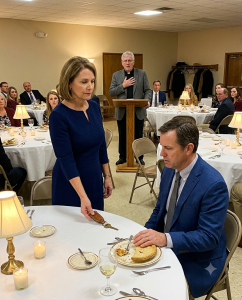
The fellowship hall was full that night, warm with conversation and the smell of roast chicken, coffee, and pie. White tablecloths softened the folding tables. Deacons laughed too loudly. Donors were thanked by name. Gary wore his blue blazer, the one that made him look especially respectable.
Donna had promised herself she would say nothing.
Then someone near the front joked about how the church would need divine intervention to keep rain out another winter. There was laughter. Someone else said the congregation had to “step up more.”
Donna looked across the room at faces glowing in chandelier light and realized she could not stand another second of hearing the blame redirected onto people who had already given what they could.
“The giving isn’t the problem,” she said.
The words carried farther than she intended.
Conversations stopped. The room tilted toward her.
“The problem,” she continued, “is that money raised for repairs has been moved and hidden.”
No scream. No pounding fist. Just the truth set down in the middle of the table like a lit match.
Pastor Whitfield recovered first. He smiled a brittle little smile and suggested everyone return to their dessert. Gary’s face went hard. The deacons exchanged the sort of looks men share when they are already deciding which story will survive.
Before pie was served, Pastor Whitfield took Donna into the hallway.
“Donna,” he said gently, “you are upset, and I understand that. But public accusations do tremendous harm.”
“I didn’t accuse. I stated what the records show.”
“Records can be misunderstood.”
“Not when my name is forged on them.”
At that, something passed through his expression too quickly for most people to catch but not too quickly for Donna. Fear.
He placed one pastoral hand on the air between them without touching her. “Come by Monday. We will discuss a transition.”
A transition.
That was how her decade of loyalty ended.
Gary did not defend her. He did not confront the pastor. He did not even ask whether she was all right on the drive home. He stared at the road and left her alone beside him in a silence so absolute it felt like the beginning of a funeral.
Two months later, he filed for divorce, citing irreconcilable differences.
The phrase would have been funny if it hadn’t shattered her life.
By spring, Donna left Harlan.
Cincinnati gave her anonymity, which at first felt like grief and then slowly became relief. She found work at a medical billing office where nobody quoted scripture while lying about money. She rented a small apartment and learned how to be quiet without feeling erased. She cried less each year. She built routines. She bought her own furniture. She discovered that peace can feel almost suspicious when chaos has been your normal.
And every morning she reached into her coat pocket and touched the key.
At first it was habit. Then ritual. Eventually it became something steadier than either: a reminder that what happened had been real, even if everyone back in Harlan had chosen to bury it.
She heard news from home in fragments. Calvary Baptist was struggling. Attendance was down. Repairs had been delayed again. Gary had remarried. Pastor Whitfield was still preaching. The town still spoke of the church as if it were immortal despite the water stains spreading through the sanctuary ceiling.
Then the official notice came.
The county had determined the building was no longer structurally safe enough to ignore. Without serious funds or a sale, Calvary Baptist faced condemnation. Developers were interested. One proposal would preserve the exterior and gut the inside into an event venue with a bar.
Donna read the article twice.
The old church had failed her. The men who ran it had humiliated her. Her husband had betrayed her. Rationally, there was no reason for her to care what happened to that building.
But memory does not ask permission from reason.
She could still picture the sanctuary on winter mornings, pale light moving through stained glass. She could still hear her mother’s voice there from years before. She could still remember being a girl in patent shoes, believing houses of worship were where truth was safest.
The church had been used by flawed people, but it had not created them. The building itself was not guilty.
She set the article beside the brass key and sat in silence until a thought arrived with astonishing clarity.
They almost let the building die to protect the lie.
That was when her plan began.
Donna had not become wealthy in Cincinnati, but she had done well. She had lived simply, invested carefully, and inherited a modest amount after an aunt passed away. On its own, it was not enough to purchase and restore a historic church. But when she met with an attorney and explored financing structures, donor trusts, and preservation grants, she realized something startling:
It might be enough after all.
She arranged a private trust through a Cincinnati law firm. She negotiated the sale quietly. She added legally binding conditions: the property must remain a house of worship for fifty years, restoration funds would be restricted and independently overseen, and future disbursements would require transparent public accounting.
No one in Harlan knew who was behind it.
When the attorney’s letter arrived in late September, the town reacted exactly as Donna expected. Gratitude first. Speculation second. Pastor Whitfield announced the miracle from the pulpit with tears in his eyes. People started speaking again about divine intervention. No one guessed the woman they had pushed out was the one who had stepped in to save the place from being turned into a cocktail venue.
That alone might have been enough for some people.
It was not enough for Donna.
Because the key still existed.
And if the cabinet still existed, then perhaps the truth did too.
A week before the Harvest Gala, she called the county clerk’s office under the pretense of finalizing trust documentation and asked a carefully phrased question about archival retention requirements for nonprofit financial records during property transfer. The answer was simple: if records had not been destroyed, they were still on site unless moved. Churches often kept far more than necessary.
Her pulse thudded in her throat after she hung up.
On the morning of the gala, she drove from Cincinnati to Harlan beneath a low gray sky. She parked outside Calvary Baptist before anyone noticed her and stood on the sidewalk for a long time. The stone looked older, smaller somehow, but it was still the same building. Wind worried at her coat. Her hand closed around the key in her pocket.
Inside, volunteers bustled through the fellowship hall preparing centerpieces and trays. Nobody stopped her. People have a way of overlooking women who move like they belong somewhere.
Donna slipped down the old side corridor, past the pastor’s study, to the narrow back room.
The cabinet was still there.
Her breath caught.
She put the key into the lock. It resisted at first, then turned.
Inside were binders, banker’s boxes, stacked folders, and one metal file tray thick with transfer records from the years before she left. Not everything remained, but enough did. Enough to make her knees weak.
There were roof fund withdrawal authorizations. Reallocation forms. Checks tied to contractors who did little or no work. Reimbursement requests signed by Gary. Meeting notes initialed by two deacons. A memo from Pastor Whitfield instructing that certain expenses be recorded “within broader stewardship categories to avoid donor misunderstanding.”
And there they were again: forms bearing Donna’s typed name as bookkeeping approval on transactions she had never authorized.
She photographed everything she could with her phone. Then she copied the most important documents on the office machine down the hall, her hands shaking so hard she fed one page upside down and had to start over.
When she finally locked the cabinet again, she felt strangely calm.
Now it was not memory against reputation.
Now it was paper.
That night the Harvest Gala glowed with extra polish. Townspeople had come to celebrate the miracle donor, gossip about her identity, and thank God for rescuing the church. Donna sat in the back, quiet and composed in a navy dress she had bought for the occasion.
She watched Gary laugh at his table.
He had more gray at the temples now, but the same habit remained: when he believed himself secure, his shoulders relaxed into a confidence that once had charmed her and now only reminded her how easily sincerity can be performed.
Pastor Whitfield rose to speak.
“Our miracle donor has asked to remain anonymous,” he said, voice thick with emotion, “but she is here tonight and would like to say a few words.”
Donna stood.
Recognition spread through the room like a gust through leaves. Some people blinked as if the years had rearranged themselves. Others stared openly. Pastor Whitfield looked as though his body had forgotten how to stand comfortably.
Donna walked the length of the fellowship hall, reached Gary’s table, and set the brass key in front of him.
The room froze.
Gary looked down at the leather fob and then up at her, and in that single instant all the rehearsed social expressions vanished from his face. He knew exactly what it was. He knew exactly what she was doing.
Pastor Whitfield whispered, “Donna?”
She turned to the room. “Before I explain why I bought back this church,” she said, “there’s something in the records room everyone deserves to see.”
Gary stood so abruptly his chair screeched.
“That is a lie,” he snapped.
“Then open the cabinet,” Donna replied.
The county clerk, who had been invited under the excuse of final trust signatures, stepped in from the hallway at exactly the wrong—or right—moment. So did Donna’s attorney, carrying notarized copies of the preservation trust.
Suddenly the evening was no longer a celebration. It was an audit with witnesses.
Pastor Whitfield tried to intervene. “Perhaps this is neither the time nor place.”
Donna looked at him steadily. “This was the time and place seven years ago. You just preferred silence.”
She laid photocopied pages on the nearest table. Gasps rose. Names were visible. Dates lined up. Restricted roof funds had been diverted repeatedly into administrative channels, consultant payments, and reimbursements that looped back to shell services tied to one deacon’s son-in-law and a maintenance contractor who had billed for work only partially completed. Gary’s signature appeared on multiple approvals. So did internal notes referencing Pastor Whitfield’s direction. Donna’s name appeared as bookkeeper authorization on pages she had never signed.
“Forgery?” one of the Hendersons said aloud, voice breaking.
“No,” Gary said too quickly. “Standard internal handling. She’s twisting—”
Donna lifted one original page she had retrieved from the cabinet. “Then explain why my name is typed here on a date I was out of state at my mother’s funeral.”
That landed like a hammer.
Because people remembered that funeral.
Pastor Whitfield sank into his chair.
The deacon on Gary’s left reached for the papers with an expression of desperate disbelief. The county clerk requested access to the records room immediately in light of the property transfer and allegations concerning nonprofit reporting. Donna handed over the key.
For the first time in seven years, it was no longer hers.
What followed was not dramatic in the cinematic sense. Nobody flipped tables. Nobody fainted. Real collapses are usually quieter than that.
The county clerk, Donna’s attorney, and two trustees went to the back room with Pastor Whitfield and a sheriff’s deputy who happened to be attending the gala with his wife. They opened the cabinet. Then another drawer. Then two archive boxes.
When they returned forty minutes later, every face in the room told its own story.
The records were real.
Enough originals remained to support an investigation. Enough signatures existed to establish patterns. Enough cross-referencing between donor restrictions, transfer slips, committee notes, and reimbursements painted a picture nobody could dismiss as a misunderstanding.
Gary left the hall before anyone formally asked him to.
Pastor Whitfield did not.
He stood at the front eventually, older by ten years than he had looked at the start of dinner, and confessed in the strange partial language guilty men use when the truth has become unavoidable but full honesty still feels impossible. He said he had justified temporary reallocations to keep the church afloat. He admitted certain disclosures had been hidden because he feared panic would destroy giving. He said he had trusted the wrong people with details, then realized too late how much had been done under the cover of that trust. He never directly accused Gary of masterminding anything, but he did not defend him either.
The investigation that followed over the next several months was ugly and public.
Documents were reviewed. Accounts were traced. Former finance committee members were interviewed. It turned out the fraud had started as “temporary smoothing,” exactly the euphemism Gary had once used on Donna. But over time it widened. Restricted donations were redirected. Records were altered. Donna’s typed approval line had been copied from legitimate bookkeeping templates and reused on unauthorized documents because it made the paperwork look routine.
Gary and one former deacon were eventually charged with fraud-related offenses tied to misuse of restricted nonprofit funds and falsification of records. A contractor repaid part of what he had billed after investigators found substantial discrepancies. Pastor Whitfield resigned before formal disciplinary proceedings within the denomination were completed. Whether he had enriched himself directly remained murkier than the rest, but his failure to disclose, supervise, and correct what he knew destroyed whatever moral authority he had left.
Donna testified once.
She did it calmly.
She answered questions, identified documents, described the night Gary told her to put the files away, and explained how she had discovered forms bearing her name that she never signed. She did not embellish. She did not cry. Truth did not require performance anymore.
As for Calvary Baptist, the building survived.
The restoration trust Donna created went into effect under independent oversight exactly as she had demanded. Contractors unaffiliated with the old leadership repaired the roof, reinforced damaged sections, restored drainage, and stabilized the stonework. New financial policies were written into the church’s governance. Annual reports became open to the congregation. Restricted gifts required dual verification and outside review.
It took time, embarrassment, and more humility than the town was comfortable with, but the church remained a house of worship.
Some people thanked Donna publicly. Some did it privately. A few never did at all, perhaps because gratitude would have required admitting how readily they had accepted the version of events that protected powerful men and discarded a woman who told the truth too soon.
One winter Sunday nearly a year later, Donna visited quietly during a morning service. The sanctuary roof no longer leaked. The plaster had been repaired. Light spilled through the stained glass without interruption. She sat near the back and listened to a young interim pastor preach a sermon so plain and sincere it almost undid her.
Afterward, Dorothy Sims hugged her with both arms and whispered, “You saved the church.”
Donna smiled, but not fully.
“No,” she said. “I saved the building. The church had to decide whether it wanted saving.”
That was the part people in Harlan argued about long after the scandal ended.
Some said Donna was vindicated and that should have been the end of it. Others said exposing everything publicly humiliated the town. A few insisted Pastor Whitfield had meant well, as though good intentions could patch a roof or cleanse a forged signature. Some believed Gary had been the architect. Others believed he had simply taken advantage of a culture that prized appearances over transparency.
Donna herself never gave anyone a neat moral.
She sold her Cincinnati apartment two years later and bought a modest house outside Lexington, close enough to drive to Harlan when she wished and far enough away to choose silence when she didn’t. The brass key was no longer in her possession. It rested in an evidence archive for a while, then eventually in a church records display about “a season of hard lessons,” though Donna privately thought that phrase let too many people off easy.
Sometimes she would still reach into her coat pocket in the morning out of old habit and find nothing there.
The first few times, that absence felt strange.
Then it felt earned.
She had carried the weight of that key for seven years because somewhere deep down, she knew locked things do not stay buried forever. Someone eventually turns the handle. Someone eventually names what others tried to file away.
The church stood because she refused to confuse faith with obedience.
And if Harlan learned anything from the scandal, it was not simply that money had been stolen or records had been falsified. It was that the biggest red flag had never been the missing funds.
It had been how quickly an entire room chose comfort over the woman who told the truth.