Leah had already stopped trusting easy explanations long before Walter placed the second photograph in her hands.
Still, she hadn’t been prepared for what that photograph would do to her.
At first glance, it looked ordinary enough—an old snapshot gone soft at the edges, the kind of thing people find in boxes after funerals and slide back under stacks of Christmas cards because they don’t want to deal with what it stirs up. Her mother stood beside an older pickup truck, outdoors in hard afternoon light, arms folded across her body. A man stood near her, but his face had been scratched out so violently that the glossy surface of the photo was torn pale.
Walter had held the picture too long before giving it over, as though some part of him still believed he could stop time by delaying the handoff. Leah took it anyway.
Then she stared.
And stared.
Long enough that Walter had to lower the edge of the photograph just to make sure she was still breathing.
The man’s face was gone, but that wasn’t what caught her. It was her mother.
The posture.
The angle of her shoulders.
The tightness in her folded arms.
The way she seemed to be standing near the man without standing with him.
Leah knew that stance. Not because anyone had taught her its meaning, but because she had spent years learning the language of fear without ever admitting she was fluent. She had seen that same expression in mirrors after bad relationships, after nights she could never describe cleanly, after arguments she always minimized by daylight. It was the face of a woman trying to look composed while every muscle quietly braced for what might happen next.
“When was this taken?” Leah asked.
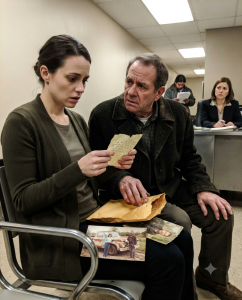
Walter didn’t answer immediately. He sat across from her in the waiting room of the county records annex, his coat still on despite the heat, both hands resting on his knees as if he didn’t trust himself to move. He was in his seventies now, broad-shouldered but collapsing inward, with the look of a man who had outlived the usefulness of silence and hated himself for that fact.
“The same day as the porch photo,” he said at last.
Leah looked up sharply.
The porch photo had already shaken her. In it, her mother stood outside a weathered rental house, one hand on a railing, her head turned as if she’d heard someone behind her. For years Leah had seen that image as a random old picture. But once Walter said, quietly, “That isn’t caution. That’s fear,” she had never been able to see it the old way again.
Now this second photograph sat in her hands like confirmation.
Walter swallowed. When he spoke again, his voice had gone flat, stripped down by old shame.
“I drove the truck.”
The sentence landed harder than any revelation before it.
Leah looked from the photograph back to him, and for a second she felt the world split—not dramatically, but with the cold precision of a seam finally showing. Walter had not merely known about her mother. He had been there. He had occupied space inside the missing hours of family history, the hours no one ever explained cleanly, the hours that seemed to swallow every question Leah had ever asked as a child.
She laid both photographs on her lap with almost painful care.
“You knew my mother.”
Walter nodded once.
“For one summer before she married your father,” he said. “Then again the year she tried to leave him.”
The waiting room changed after that.
The receptionist behind the desk stopped typing. A volunteer named Carmen, who had been helping Walter pull archived land records, froze with a file in her hand. No one openly stared, but the air had shifted in that unmistakable public way that happens when a private truth suddenly becomes bigger than the room holding it.
Leah barely noticed them.
“My mother tried to leave him?”
“Yes.”
Such a small word. Such devastation inside it.
All Leah’s life, the official story had held. Her mother had been nervous, clumsy, fragile under stress. She fell. She fainted. She startled easily. Her split lip came from a cabinet corner. Her bruises came from bumping into things. Her fear—when it appeared in photographs, in memory, in the strange hush that used to settle over the kitchen after certain nights—was never called fear. It was called exhaustion. Or nerves. Or “your mother’s moods.”
Leah had grown up in a house where the truth was always one room away and nobody opened the door.
Walter reached into his coat pocket and removed a folded note. It was yellowed and soft with age, the paper worn where it had been folded and unfolded over many years. He held it like it weighed far more than it should.
“She gave me this the day after that truck picture,” he said. “Told me if she didn’t come back by nightfall, I was supposed to take it to a doctor in Dry Creek. Someone she trusted.”
Leah’s heartbeat turned loud.
Walter looked at the note, not at her.
“I didn’t.”
The words came out low. Ruined.
Leah did not blink. “Why?”
His face tightened as if the answer hurt in places age had not numbed.
“Because your father found me first.”
That was the moment everything rearranged.
Not only the past, but the shape of her own memories. Her father’s version of events. The strange six-hour gap on the day her mother’s injuries were first noticed. The split lip no one could explain. The weeks of silence afterward, in which her mother moved through the house like a person measuring exits. The way every adult in town seemed to know something and refuse to name it.
Walter exhaled through his nose. “He told me she’d changed her mind. Said she was embarrassed. Said if I cared about her at all, I’d stay out of it. I believed the part that was easiest for me to survive.”
Leah hated how much that sounded like the truth.
Cowardice rarely arrives dressed as cruelty. More often it comes disguised as caution, confusion, respect for privacy. One person says it’s not their place. Another says things are complicated. A third says they don’t want to make things worse. And somewhere inside those tidy excuses, someone gets abandoned.
Her father had built a life on that kind of silence.
Maybe the whole town had helped.
Leah held out her hand.
Walter gave her the note.
Three words were written on the outside, in her mother’s handwriting.
For Leah later.
Leah felt sick before she even opened it.
She unfolded the paper carefully, expecting a goodbye or a confession, something dramatic enough to justify the years of secrecy around it. Instead she found a list.
A motel name.
A route number.
A bank account.
It was not the language of surrender. It was logistics. Movement. Planning. Escape.
Then she saw the final line, written smaller than the rest, crowded near the bottom as though her mother had nearly decided not to include it.
If he says I fell, don’t believe him.
Leah had to read it three times.
Because her father had used those exact words.
He says I fell.
He had told police that. Doctors too. Neighbors. Extended family. He repeated it over the years with such practiced steadiness that it hardened into family history. Leah herself had echoed parts of it as a teenager, then again as a young woman, defending facts she had never examined because some lies become structural when repeated often enough.
She lifted her eyes to Walter.
“There’s more,” he said quietly.
He reached into his coat again and took out a torn envelope with no stamp and no address. The paper was thicker than the note, more recent, but still old. He placed it atop the photographs without fully letting go.
“The thing she wanted the doctor to have,” he said. “Or part of it.”
Leah stared at him. “What is it?”
Walter’s expression changed. For the first time since he had spoken, guilt gave way to something rawer.
Fear.
“I only got it back three days ago,” he said. “After the doctor died.”
Dry Creek sat fifteen miles away, barely a town anymore. Its clinic had closed years earlier. Leah had vague childhood memories of the doctor there—a quiet man with silver glasses and careful hands. She had no idea he had known her mother, much less been trusted by her.
“How?” she asked.
Walter looked toward Carmen, who now stood closer than before, pale and tight-jawed.
“The doctor’s niece found a storage box while clearing out his office,” Walter said. “She remembered my name from an old Christmas card. Called me because she thought I might know why a sealed envelope marked with your mother’s initials had been hidden inside a file cabinet panel.”
Leah felt cold all over.
Walter continued, “I opened it. I shouldn’t have, but I did.”
“What was inside?”
“A copy of a report. Two photographs. And a name.”
Carmen made a sound under her breath—small, frightened, involuntary.
Leah turned to her. “You know about this?”
Carmen hesitated, then nodded once. “Only the name.”
“What name?”
Neither of them answered immediately, and that silence told Leah more than words would have. The secret was not only personal. It reached outward. Into town history, perhaps. Into other people’s fear.
Walter finally said, “Before you see it, you need to understand something. Your mother wasn’t just trying to leave your father. She was trying to take something with her.”
Leah stared.
“A record,” Carmen said suddenly, as if blurting it out was the only way she could survive holding it. “That’s what my aunt used to whisper about. Not money. Not an affair. A record.”
Walter shot her a look, but it was too late.
Leah’s pulse raced. “A record of what?”
Walter drew a breath. “Illegal property transfers. Missing payments. False signatures. Land that changed hands after people got pressured out, or injured, or disappeared from negotiations. Your father’s name wasn’t always on the paperwork. But he was connected. So were others.”
Leah actually laughed then, once, in disbelief. It sounded terrible in the room. Her father had spent decades presenting himself as a proud, stubborn, self-made man—hard around the edges, maybe, but respectable. He served on committees. Donated to church roof funds. Knew sheriffs, contractors, bankers. If he had a temper, people called it old-fashioned. If he intimidated someone, they called it strong-willed.
“How does my mother fit into that?”
“She worked the books for a while,” Walter said. “Part-time. Your father thought she only handled routine ledgers. But she started noticing patterns. Withdrawals that didn’t line up. Parcel numbers swapped. A trust account that should’ve been closed but wasn’t. She copied things.”
Leah looked back down at the envelope.
“Why didn’t she go to police?”
Walter’s expression said she already knew the answer.
Small town.
Big names.
Wrong decade.
Wrong woman.
“She tried to tell one deputy she was scared,” Carmen said quietly. “He sent her home with advice to keep peace in the marriage.”
Leah closed her eyes for a moment. When she opened them again, the room looked harshly bright.
Walter removed the report from the envelope first. It was a medical notation from the Dry Creek doctor, brief but precise. Patient reports fall inconsistent with injuries. Bruising pattern suggests external force. Patient requests duplicate copy held off-site. Follow-up recommended if safe.
Leah read the lines in silence, each word driving a fresh nail through the official story.
Then Walter handed over the photographs.
The first showed the inside of a motel room. Her mother sat on the bed, looking directly at the camera. Her mouth was bruised. Her left cheek was swollen. But she was holding up a ledger page toward the lens. She had documented herself and the paper together, proof tied to proof.
The second photograph was worse.
It showed a page from that ledger in close enough detail to read several names and parcel numbers. At the bottom, in one corner, appeared the signature that made Carmen inhale sharply.
Leah recognized it too.
Not because it belonged to her father.
Because it belonged to the county judge who had officiated at her parents’ anniversary party twenty years later.
“It wasn’t just him,” Leah whispered.
“No,” Walter said. “It never was.”
The name that had frightened Carmen was part of a network—bankers, an assessor, a contractor, a deputy, and the judge. Men protected by one another’s silence, reputations reinforced by Sunday attendance and civic speeches. If Leah’s mother had copied records tying them together, then leaving her husband would not have been the only threat. Taking those records to someone trustworthy could have exposed all of them.
Suddenly the old narrative made sick sense. A woman in distress. A fall. A family matter. Something private, unfortunate, tragic, but not criminal. Better not to pry.
Leah looked up at Walter. “Did she die because of the records?”
Walter’s face folded under the weight of the question. “I don’t know. But I know this—she was alive when I last saw her, frightened but determined. And she told me, ‘If anything happens, it won’t be an accident.’”
That sentence stayed in the air between them.
Leah thought of her mother’s careful smiles in later photos. The way she avoided eye contact when certain names came up. The one time, at fourteen, Leah had found her sitting at the kitchen table in the dark, not crying exactly, but hollowed out. When Leah asked what was wrong, her mother had said, “Some people make a whole town kneel by teaching everyone what happens to anyone who stands.”
At the time it had sounded poetic and strange.
Now it sounded literal.
“What do I do with this?” Leah asked.
Walter answered without hesitation. “Take copies. Keep originals separate. Do not confront him alone.”
The front door opened then, and every head turned.
No one entered immediately. But through the reflected glare on the glass, a figure stood just outside, still and familiar.
Leah knew that posture before she saw the face.
Her father.
He had one hand resting against the doorframe as though the building belonged to him. He wasn’t rushing in. That was what made it terrifying. He was standing there with the patience of someone who already knew enough. Someone who expected the room to bend around him the way rooms always had.
Leah’s first emotion was not fear.
It was rage.
Not hot and chaotic, but clean. Clarifying. The kind that arrives after years of confusion and tells the truth in a single pulse: He lied. He kept lying. And he counted on your love to help him do it.
Walter pushed the papers toward her. “Put them in your bag.”
She did.
By the time her father opened the door and stepped inside, Leah was already standing.
He looked older than she remembered from the week before. Not physically older. Strategically older. The face of a man reaching for frailty because dominance no longer serves. His eyes moved from Walter to Carmen to Leah’s bag.
“So,” he said, calm as ever. “I wondered how long this nonsense would take.”
Leah had imagined confronting him a hundred ways over the years. In none of them did her voice come out so steady.
“Mom didn’t fall.”
His gaze shifted to her. “You don’t know what you’re talking about.”
“I know she left instructions. I know she told someone not to believe you.”
For the first time, something cracked in his expression. Not guilt. Annoyance. Calculation.
Walter stood too. “It’s over.”
Her father actually smiled at that, a tired little smile meant to make everyone else feel foolish. “You think paper changes anything? Half the people named in those records are dead.”
“Not all of them,” Carmen said.
That made him turn.
Carmen had gone pale, but she did not look away. “My aunt kept copies,” she said. “She gave one to her lawyer before she died.”
Leah looked at Carmen sharply. Walter too.
Carmen swallowed. “I didn’t know how much was real until today. But I made a call after Walter showed me the judge’s signature.”
For the first time, Leah’s father lost the room. Just slightly. Just enough.
“What call?”
Carmen’s voice shook, but held. “State investigators.”
Silence.
Then, faintly in the distance, the sound of another car pulling into the lot.
Her father heard it too.
The old confidence did not collapse all at once. It drained. A tiny shift in the eyes. A realization that for once, he might not be able to isolate the woman with the truth and talk her back into silence before witnesses arrived.
He turned to Leah, and the mask changed again. Softer now. Familiar. Regretful.
“Your mother was sick,” he said. “You were too young to understand.”
Leah stepped closer.
“No,” she said. “I was trained not to.”
He opened his mouth, perhaps to deny more, perhaps to reach for another version of the past, but the words never quite formed. Maybe because he saw something in Leah that he had never seen in her mother at the end—not fear, not pleading, not a desperate hope that honesty would save her.
He saw evidence walking around with his face and her mother’s memory.
And evidence, once it starts speaking, is hard to put back in the dark.
The investigators did come. Not with sirens, not dramatically, but with folders and careful questions and the unnerving politeness of people who already know enough to be dangerous. They took statements from Walter, from Carmen, from the receptionist who had heard more than anyone realized. They took copies of the note, the photographs, the report. They asked Leah if she felt safe going home, and when she laughed at the absurdity of that question, one of them quietly arranged a hotel for her.
The inquiry widened over the following months.
Records surfaced.
Old land transfers were reopened.
A retired deputy suddenly remembered things he had once found easier to forget.
The judge’s estate was subpoenaed.
A banker’s son turned over boxes he had inherited without understanding why his father kept them locked.
Some of the men named in the ledger were dead. Some were too ill to stand trial. But reputations cracked. Estates were sued. Fraud findings were issued. One surviving contractor pleaded out. A former clerk admitted signatures had been backdated. And at the center of more than one document, more than one witness statement, stood Leah’s father.
He was never charged with murder. There wasn’t enough left to prove that in court after all those years.
But he was charged with fraud, coercion, conspiracy, witness intimidation.
And when questioned about Leah’s mother, he changed his story twice in one afternoon.
That, more than anything, told Leah what she needed to know.
Her mother’s death certificate never changed. Official records move slower than truth, and sometimes they refuse truth altogether. But the story around her mother did change. In town, in whispers first, then in newspaper columns, then in the unbearable directness of neighbors who suddenly wanted to say they had always suspected.
Leah hated that part.
Always suspected.
Suspicion is not courage.
Silence is not innocence.
She buried Walter a year later, after a heart attack took him before the civil cases ended. By then he had given every statement he could, turned over every scrap he had saved, and apologized to Leah more times than she could count. She never told him he was absolved, because he wasn’t. But she did hold his hand once near the end when he whispered, “I should have delivered the note.”
“Yes,” she said.
And then, because it was also true, “But you delivered it eventually.”
As for her mother, Leah finally drove to the motel named in the note. It was abandoned now, paint peeled away, rooms dark and gutted. She stood in the parking lot holding a copy of the photograph where her mother sat bruised but unbroken on the bed, ledger page raised like a signal fire.
She tried to imagine what that must have cost her. To know danger clearly and document it anyway. To be frightened and still plan. To leave behind proof not because she was certain it would save her, but because maybe one day it would save the truth.
That was the part Leah carried forward.
Not the fear.
Not the fall lie.
Not even the betrayal.
The insistence on leaving a record.
Sometimes, late at night, Leah still wondered what would have happened if Walter had delivered the note on time. Whether a different doctor, a different deputy, a different decade could have changed the ending. Whether her mother might have escaped if even one person had been braver sooner.
She never found an answer that satisfied her.
What she found instead was something less comforting and more honest: the biggest red flag had never been her father’s temper alone. It had been how many people learned to orbit it. How many called danger “private.” How many mistook survival for neutrality. And how easy it is, in the wrong town, for the truth to remain hidden until one woman writes a sentence small at the bottom of a page and trusts that someday her daughter will finally read it.