Laura only agreed to the museum because her son had stopped laughing.
That was the simplest truth of it. Not because she was ready. Not because grief had softened enough to let her revisit the places Mark loved. Not because a family outing sounded healing in any of the bright, sensible ways other people described healing.
She went because Owen had become too careful.
For nearly four months after the funeral, Laura had followed every piece of advice offered by friends, neighbors, sympathetic teachers, and grief pamphlets folded into neat thirds.
Keep the routine.
Get him outside.
Don’t hide your own feelings, but don’t make him carry them.
Let him talk when he’s ready.
Children process loss differently.
She had nodded through all of it. She had thanked everyone. She had made breakfast, packed lunches, washed socks, signed school forms, and sat through bedtime with a smile that often trembled at the corners. She had done everything she was supposed to do.
And none of it changed the thing that haunted her most.
Owen was only seven, but after Mark died, he moved through the house like someone much older. He closed cabinet doors gently. He asked before turning up cartoons. He stood in the hallway sometimes, watching Laura with solemn eyes, as if measuring whether she could survive another question.
Before the accident, he had been noisy in all the right ways. He shouted dinosaur names across the kitchen. He wore holes in his jeans. He turned every stick he found into a sword, a telescope, or a fossil brush.
After the accident, he became a child who apologized for needing milk.
The truck that killed Mark had run a red light on a wet Thursday evening. That was how the police officer had said it, with the numb efficiency people use when facts are all they have left to offer. Laura remembered almost nothing else about that conversation except the sound of Owen laughing in the living room, unaware that the shape of his world had already split open.
Three days later, they were supposed to go to the museum.
Mark had been absurdly excited about the new dinosaur wing. He’d shown Owen maps on the museum website, circled exhibits in blue pen, and promised they’d spend the whole day there. He had a way of making museums feel less like buildings and more like treasure hunts.
He loved fossils with a kind of wholehearted sincerity that would have been embarrassing in anyone else. But Mark made enthusiasm look dignified. He once spent nearly forty minutes explaining trilobites to a stranger’s child because, afterward, he told Laura, “He asked a real question. You can’t waste that.”
So when Owen looked up from dinner one evening and asked, “Can we still go to the museum like Dad promised?” Laura said yes before fear could stop her.
Then she spent two sleepless nights regretting it.
By Saturday, the sky was a dull sheet of gray. Laura parked in the museum garage with a knot in her stomach and sat for a moment with both hands on the steering wheel.
“You okay, Mom?” Owen asked from the back seat.
She pasted on the gentlest smile she could manage. “Yeah, baby. Just thinking.”
He nodded and accepted that answer more easily than a child should.
Inside, the museum was exactly as Mark would have remembered it. The giant suspended whale still ruled the lobby. Children still pointed upward with open-mouthed delight. The café still smelled faintly of coffee and sugar. The gift shop still displayed plush dinosaurs in a bin near the entrance.
The world had not changed because Mark was gone. Laura knew that, of course. But seeing it felt crueler than knowing it.
Owen reached for her hand with one hand and clutched his sketchbook with the other. He had carried that sketchbook almost everywhere since the funeral. Drawing had become his second language. Dinosaurs filled most of the pages. So did trucks, bones, strange hallways, museum signs, and once, heartbreakingly, a gravestone beneath dark slashes of rain.
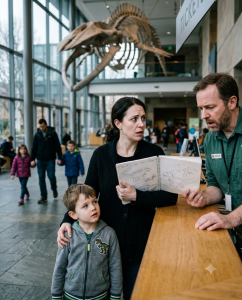
At the ticket desk, the man behind the counter noticed the sketchbook and smiled.
“Artist?” he asked.
Owen gave a tiny shrug.
The man looked to Laura for permission before saying, “Can I see?”
She appreciated that small courtesy enough to nod.
He took the sketchbook with careful hands. Laura noticed his museum badge then. NATHAN. He was perhaps forty, with dark hair streaked silver at the temples and a face that carried a tired kindness. There was no ring on his left hand, but the pale outline remained.
He turned one page. Then another.
Then his hand stopped.
Laura saw it happen before she understood why: all the color drained from his face, and his eyes fixed on one page with the stunned intensity of someone staring at a memory made physical.
“What?” Laura asked.
He looked at Owen. Then at her. Then back at the page.
“Who told him to draw this?” he asked quietly.
Laura stepped closer, pulse suddenly racing.
It was one of Owen’s dinosaur drawings. A rough but lively sketch of towering bones beneath an arching ceiling. Underneath, in clumsy block letters, her son had written:
ME AND DAD UNDER THE BIG BONES
HE SAID HIS FRIEND NATE WOULD LET US SEE THE BACK ROOM
For a moment, Laura could only stare.
Then her eyes lifted to his badge.
Nathan.
No, she thought instantly. No. Too many Nathans existed in the world for this to mean anything. Children got names wrong. They stitched together memories and wishes all the time.
But Nathan was staring at Owen as though the little boy had just opened a locked door with a sentence.
“Your husband,” Nathan said slowly, carefully. “Was his name Mark Ellis?”
The museum lobby seemed to recede around her. Laura reached for Owen’s hand without thinking.
“How do you know that?”
Nathan swallowed. “Because Mark and I worked here together.”
Worked here.
The words hit with strange force, not because they were dramatic, but because they were impossible.
Mark had told Laura many stories about the museum. He had volunteered there in college. He had loved the exhibits. He had gone to lectures, donor events, special previews. But he had never once said he worked there. Never mentioned a coworker named Nathan. Never referred to a back room, a badge, or any unfinished surprise involving Owen.
“You knew my husband?” Laura asked.
Nathan’s expression tightened. “Very well.”
The phrase unsettled her more than it should have. Not casually. Not years ago in passing. Very well.
Owen tugged gently at her sleeve. “Mom?”
Laura ignored the question forming in his eyes and asked the one in her own. “Then why would my son write that you were supposed to show us the back room?”
Nathan’s fingers tightened around the sketchbook. He looked at Owen first, and Laura saw something raw flash across his face—grief, fear, maybe guilt.
Then he looked at her.
“Because,” he said softly, “if Mark kept that promise, then he told your son something he never told you.”
Everything inside Laura went cold.
Before she could press him, Nathan slid something thin between the pages of the sketchbook and handed it back.
“There’s a staff door beside the Hall of Mammals,” he said in a voice just loud enough for her alone. “Blue frame. End of the corridor. If you still want the full tour, be there in twenty minutes.”
“Tell me now,” Laura said sharply.
His gaze flicked to Owen. “I won’t do this in front of him.”
The next family stepped up to the desk. A little girl asked for a sticker map. The ticket printer whirred. Life kept moving with unbearable normalcy.
Laura took Owen into the dinosaur wing because she did not know what else to do.
She tried to be present. She pointed out enormous femurs and jagged teeth. She asked whether he thought the Triceratops looked friendly or grumpy. Owen answered in brief murmurs, but she could feel he knew something inside her had changed.
At the first bench, she opened the sketchbook.
The object Nathan had slipped inside was not a business card.
It was an old museum access pass.
MARK ELLIS
Temporary Collections Staff
Lower Level Archive Access
The picture was younger, but unmistakably Mark. The museum logo at the top had changed styles years ago. This badge was old, real, worn at the corners from use.
Laura’s hands shook so badly she almost dropped it.
“Mom?” Owen said softly.
She forced her voice to stay calm. “Honey… when did Dad tell you about the back room?”
Owen looked down at his shoes. “A long time ago.”
“How long?”
He thought carefully. “The day we got hot chocolate after school. Before my birthday.”
That put it nearly six months earlier, long before the accident.
“What exactly did he say?”
Owen’s face tightened with concentration. “He said when I was seven, he would show me where the bones sleep before everybody else sees them.”
Laura felt a chill.
“Anything else?”
“He said not to tell yet. He wanted it to be a surprise for you too, when it was finished.”
Finished.
The word lodged in her chest.
“What was finished?”
Owen shook his head. “I don’t know.” Then, after a pause: “He said Uncle Nate would help if he couldn’t.”
Laura stared at him. “Uncle Nate?”
Owen nodded. “That’s what Dad called him when we practiced the secret.”
Practiced the secret.
The museum around her became unreal. Mark had not simply hidden a past job. He had hidden an active plan. He had introduced another man to their son under an intimate name Laura had never heard. He had prepared Owen to remember something she was never meant to know until later.
She stood too quickly, her knees weak.
“Come on,” she said.
Nathan was waiting near the staff corridor exactly where he’d said he would be. Up close, Laura could see he was braced for impact.
“I need the truth,” she said.
He looked at Owen. “There’s a small prep room just inside. He can sit there with paper and pencils for a few minutes. Glass wall. You can see him the whole time.”
Laura hesitated. Every warning instinct in her body was awake. But Owen was safe beside her, the room was visible, and something in Nathan’s face told her he expected anger, not trust.
Inside the staff corridor, he led them to a narrow workroom lined with cabinets. He set Owen up at a table with fresh paper and museum pencils.
“Draw me your favorite fossil,” Nathan said gently.
Owen nodded, already seated.
Laura waited until the door swung mostly shut behind them before turning on Nathan.
“Start talking.”
For a moment he simply looked at the floor.
Then he said, “Mark did work here. Years ago. Not for very long on paper, but longer than anyone realized.”
Laura folded her arms hard across herself. “Why would he hide that from me?”
“Because he didn’t leave under normal circumstances.”
She said nothing.
Nathan took a slow breath. “We were in collections support together. Cataloging, storage prep, occasional educational access. It was temporary work, but Mark loved it. Too much, probably. He got attached to pieces, to histories, to things other people would walk past.”
“That sounds like him.”
A sad smile flickered over Nathan’s mouth. “Yeah. It does.”
Laura hated that he got to sound like he knew her husband.
“What happened?”
Nathan leaned against the wall, but only lightly, as if he didn’t deserve comfort. “There was a private donor collection scheduled for transfer. Not publicly displayed. Some items came from an estate donation. Most of it was properly documented. One item wasn’t.”
Laura narrowed her eyes. “What item?”
He met her gaze. “A fossil egg.”
She almost laughed from sheer disbelief. “You’re telling me my husband lied to me for years over a fossil egg?”
“No,” Nathan said quietly. “I’m telling you he found out it wasn’t supposed to be there.”
That stopped her.
Nathan continued. “The paperwork was wrong. Dates didn’t match. Ownership trail had holes. Mark noticed because he noticed everything. He started asking questions. Quietly at first. Then less quietly.”
Laura felt something shift inside her. This was familiar. Mark had always pushed when something didn’t add up. He could not ignore injustice once he spotted it, even in small places.
“He thought it had been stolen?” she asked.
“He thought someone was laundering artifacts through donor channels. Making illegal acquisitions look legitimate once they entered private collections.”
Laura stared. “That can happen?”
Nathan gave her a bleak look. “More often than people want to admit.”
She thought of all the evenings Mark had come home distracted, all the times he’d said he was just tired, all the moments she had not pressed because marriage teaches you to trust what you’re given.
“What did he do?”
“He copied records. Photographed labels. Sent concerns upward. And then suddenly his contract wasn’t renewed.”
Laura’s breath caught.
“He got fired?”
“Officially, he was temporary staff whose term ended. Unofficially…” Nathan spread his hands. “He was told to let it go.”
“And he did?”
Nathan’s eyes moved toward the prep room where Owen was drawing. “No. He kept digging.”
A memory flashed through Laura’s mind—Mark staying up late at the kitchen table with his laptop closed the moment she entered. The way he once snapped, unusually harsh, when she touched a manila folder and asked what it was. He apologized right away. She had forgotten the moment until now.
Or thought she had.
“He never told me any of this.”
“I know.”
“Why?”
Nathan hesitated too long.
Laura felt dread rise. “Why?”
“Because by then,” Nathan said, “it wasn’t just professional anymore.”
She stared at him.
He held her gaze and said the thing she had already started fearing but had not yet named. “He was trying to build a case with me.”
The hallway went silent.
“With you,” Laura repeated.
Nathan nodded once.
“What does that mean?”
“It means after he left the museum, we stayed in contact. It means we met off-site, compared records, tracked provenance gaps, talked to one retired curator who was willing to say more than he should. It means if anyone knew what Mark was doing, it was me.”
Laura felt suddenly hot, then cold. “Were you his friend?”
“Yes.”
“That’s not an answer.”
Nathan looked wrecked by the question before he said, “He was my best friend.”
Something painful and complicated cracked through her anger. She had known all of Mark’s college friends, his cousins, the men from work, the fathers from Owen’s school group. No Nathan. No best friend hidden in plain sight.
“How could I not know your name?”
“Because Mark didn’t want you involved until he had proof. He thought if it turned ugly, plausible distance would protect you.”
“Protect me?” Her voice sharpened. “He let me bury him without knowing who he really was.”
Nathan flinched.
Laura pressed on. “Did he think I was too fragile? Too stupid? Too what?”
“No,” Nathan said immediately. “He thought he was running out of time.”
That knocked the anger sideways.
“What does that mean?”
Nathan’s face had gone pale again. “The week before he died, he told me someone had been following him.”
Laura’s stomach dropped.
“What?”
“He noticed the same SUV twice near Owen’s school, once near your street, and once in the grocery parking lot. He told me he might have enough to turn everything over. He said once the evidence was secure, he would tell you everything. That museum trip…” Nathan swallowed. “That was supposed to be the day after. He was going to show Owen the archive room because he’d finally arranged legal access again. It was his way of making something good exist next to all the ugly parts.”
Laura pressed her fingertips to her mouth.
The accident report had said a truck ran a red light. Wet roads. Instant death. Tragic and random.
“You think it wasn’t an accident,” she whispered.
Nathan was silent for a long moment. “I think I don’t know. And not knowing has made me sick for months.”
Laura leaned back against the wall because her knees could no longer be trusted.
“Why didn’t you come to the funeral?”
His expression fractured. “I did.”
She looked up.
“I stood in the back for ten minutes and left before the service started. I saw you with Owen. I saw his mother. I couldn’t…” He stopped, jaw tightening. “I didn’t know how to walk up to a widow and say, ‘Hi, I’m the reason your husband spent his last year chasing dangerous people through museum records.’”
Laura’s throat burned.
In the prep room, Owen held up a drawing to the glass, trying to show a spiky dinosaur to no one in particular. Laura waved weakly. He smiled a little, and it was the first real smile she had seen in weeks.
That nearly undid her.
“What was in the back room?” she asked quietly.
Nathan let out a breath. “Come see.”
He led her farther down the corridor and unlocked a climate-controlled archive room. Metal shelving lined the space. Gray boxes. Catalog drawers. Numbered trays. Nothing dramatic at first glance.
Then he walked to one shelf and opened a flat archival case.
Inside, nestled in protective foam, was a small fossil cast mounted beside a printed plaque draft.
Family Discovery Program
In memory of Mark Ellis
Planned opening postponed
Laura stared without understanding.
Nathan spoke carefully. “Mark was building an outreach display proposal. Not official at first. His own idea. He wanted a children’s archive program where kids could see how collections were preserved before exhibits opened. Behind-the-scenes access. Hands-on education. He kept saying museums shouldn’t feel like sealed vaults to children.”
Tears blurred her vision.
“He got the pilot approved?”
“Almost. Quietly. Through one curator who believed in him. He wanted to tell you once the donor mess was finished and the paperwork was clean. He wanted to bring Owen here on his seventh birthday and then bring you in after. He said you’d laugh at how sentimental he was.”
Laura covered her mouth.
All at once, two griefs collided inside her. The first was the old one: Mark was dead. The second was newer and crueler: he had died carrying both a lie and a surprise, both a danger and a gift.
Nathan opened another drawer and removed a sealed envelope.
“He left this with me,” Nathan said. “I was supposed to give it to you after the museum visit. If anything happened before then… he told me to wait until Owen asked for the place himself. He said if Owen remembered the promise on his own, it meant the day was right.”
Laura took the envelope with shaking fingers. Mark’s handwriting on the front nearly buckled her knees.
For Laura and Owen.
She opened it carefully.
Inside was a letter and a folded photograph.
The photograph showed Mark in this very room, grinning, one arm slung around Nathan’s shoulder, both of them younger, dust-smudged, absurdly happy. On the back Mark had written: Proof Nate does exist, in case Laura thinks I made him up.
A strangled laugh escaped her through tears.
Then she unfolded the letter.
Laura,
If you’re reading this the plan changed, and I’m sorry for that already.
First, if this got to you late, it means I waited too long to explain things the right way. That is my fault, not yours.
There are things I kept quiet because I wanted certainty before I handed you fear. I found something at the museum years ago that didn’t sit right, and once I started pulling the thread, I couldn’t stop. Nate knows everything. Trust him on the facts, even if you don’t trust him with my terrible coffee opinions.
If all goes well, by the time you read this, Owen has seen the back room, touched the learning casts, and told me at least six corrections about dinosaur names.
The pilot program is for him, but also for kids like him—kids who deserve wonder before the world teaches them caution.
I didn’t tell you sooner because I wanted to hand you truth and safety together. If I failed at that, I am sorrier than these words can hold.
Please know this part clearly: there was no second life. No second family. No secret love story waiting in the dark. Only work I thought I could finish before it touched you.
Love him big. Love yourself gently. And when you’re ready, come stand under the big bones and know I meant every promise, even the ones I ran out of time to keep.
Mark
Laura finished reading and wept in the quiet cold of the archive room.
Nathan stood back and let her.
After a long time, she wiped her eyes and asked the question still lodged in her chest. “Did he really trust you?”
Nathan’s own eyes were wet now. “With everything.”
She looked at the photograph again, at the easy closeness between them, and understood at last that the intimacy she had sensed was real, but not in the way fear had whispered. It was the intimacy of shared risk, shared purpose, and years of silence chosen for the wrong reasons but not cruel ones.
“What happened to the case?” she asked.
Nathan straightened. “After he died, I turned everything over to an investigative unit through the board’s outside counsel. Quietly. With backups in three places. Two months ago, a donor intermediary was indicted. More people may be coming.”
Laura looked at him sharply. “And you never told me?”
“I wanted to. But until the filing was public, I was warned not to. And once it was public…” He gave a miserable shrug. “How do you walk into a widow’s life with news that her husband might have died while uncovering artifact fraud?”
She had no answer to that.
They returned to Owen, who immediately launched into an explanation of the creature he had drawn. Nathan listened with full attention, asking questions exactly the way Mark would have. Laura watched the two of them and felt fresh sorrow rise, but also something steadier beneath it.
Owen tugged at Nathan’s sleeve. “Can I see where the bones sleep now?”
Nathan looked at Laura.
For the first time all day, she did not feel split in two by the question. She felt wounded, yes. Angry still. Confused about all the things Mark had hidden. But she also knew this: whatever he had concealed, it had not been because he loved them less. It had been because he made the fatal mistake of believing he could carry danger alone and deliver only wonder when the time was right.
Laura nodded.
Nathan took them into the archive room again, this time with the overhead lights warmer, the drawers opened one by one, the learning casts laid gently before Owen like treasure. Her son’s face changed in that room. The care did not vanish, but wonder pushed through it. He smiled. Then laughed. Then asked twelve questions in a row, one overlapping the next.
Laura had to turn away for a second because the sound was too precious.
Before they left, Nathan handed Owen a small replica fossil from the education bin.
“Temporary junior curator pass,” he said solemnly.
Owen grinned and tucked it into his pocket like a medal.
Later, outside the museum beneath the dim gray sky, Laura stood for a moment with her son’s hand in hers. The building behind her no longer felt like a trap. It felt like a door Mark had tried, imperfectly and too late, to leave open for them.
She still had anger waiting for him. Questions too. Why he hadn’t trusted her with the whole truth. Why he thought protection meant silence. Why so many women were left to discover their husbands through paperwork and leftovers and other people’s memories.
But she also had the letter. The photograph. The archive room. The sound of Owen laughing under the big bones at last.
Some losses never become fair. Some truths arrive after they can heal what they should have saved. And sometimes the hardest thing to live with is not betrayal, but the unbearable shape of someone’s good intentions.
As they walked to the car, Owen slipped his small hand more firmly into hers and said, “Dad was right. It was a really good surprise.”
Laura looked back once at the museum and felt tears sting again.
Maybe the biggest red flag had been Mark’s silence. Maybe the greatest mercy was that what he hid was danger, not disloyalty. Maybe love that tries to protect by withholding truth still leaves damage behind.
She didn’t know yet whether that made him easier to forgive.
She only knew that beneath all the secrecy, all the fear, and all the years he’d kept that part of himself locked away, he had still been reaching for the same thing she was—
a way to keep wonder alive for their son before the world hardened around him.